C723 Quantitative Business Analysis Final C723 Quantitative Business Analysis - Final WGU Questions With Correct Anawers | VERIFIED
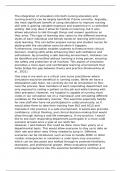
C723 Quantitative Business Analysis Final C723 Quantitative Business Analysis - Final WGU Questions With Correct Anawers | VERIFIED Hypothesis - ANSWER is an assumption about a population parameter such as a mean or a proportion null hypothesis (H0) - ANSWER -represents the status quo -states a belief that the population parameter is ≤, =, or ≥ a specific value -believed to be true unless there is overwhelming evidence to the contrary alternative hypothesis (H1) - ANSWER -represents the opposite of the null hypothesis -believed to be true if the null hypothesis is found to be false -always states that the population parameter is >, ≠, or < a specific value two-tail hypothesis test - ANSWER is used whenever the alternative hypothesis is expressed as ≠ one-tail hypothesis test - ANSWER is used when the alternative hypothesis is stated as < or > Type I error - ANSWER -occurs when the null hypothesis is rejected when it is true -when it occurs the producer is looking for a problem in its process that does not exist Type II error - ANSWER -occurs when we fail to reject the null hypothesis when it is not true -when it occurs the customer is getting a product from a process that is not performing properly Correlation analysis - ANSWER -is used to measure both the strength and direction of a linear relationship between two variables -A relationship is linear if the scatter plot of the independent and dependent variables has a straight-line pattern correlation coefficient, r - ANSWER -indicates both the strength and direction of the linear relationship between the independent and dependent variables population correlation coefficient (ρ) - ANSWER refers to the correlation between all values of two variables of interest in a population confidence interval for the mean - ANSWER is an interval estimate around a sample mean that provides us with a range within which the true population mean is expected to lie confidence level - ANSWER is defined as the probability that the interval estimate will include the population parameter of interest Student's t-distribution - ANSWER is used in place of the normal probability distribution when the sample standard deviation, s, is used in place of the population standard deviation, σ probability sample - ANSWER is a sample in which each member of the population has a known, nonzero, chance of being selected for the sample simple random sample - ANSWER is a sample in which every member of the population has an equal chance of being chosen Sampling error - ANSWER is defined as the difference between the sample statistic and the population parameter Central Limit Theorem - ANSWER states that the sample means of large-sized samples will be normally distributed regardless of the shape of their population distributions normal probability distribution - ANSWER is useful when the data tend to fall into the center of the distribution and when very high and very low values are fairly rare exponential distribution - ANSWER is used to describe data where lower values tend to dominate and higher values don't occur very often. uniform distribution - ANSWER describes data where all the values have the same chance of occurring Discrete data - ANSWER -Values are whole numbers (integers) -Usually counted, not measured Continuous data - ANSWER -Can potentially take on any value, depending only on the ability to measure accurately -Often measured, fractional values are possible Variance - ANSWER a measure of the spread
Escuela, estudio y materia
- Institución
- C723 Quantitative Bus
- Grado
- C723 Quantitative Bus
Información del documento
- Subido en
- 10 de diciembre de 2023
- Número de páginas
- 6
- Escrito en
- 2023/2024
- Tipo
- Examen
- Contiene
- Preguntas y respuestas
Temas
-
c723 quantitative business analysis final c7
-
c723 quantitative business analysis final c723 qu

Documento también disponible en un lote