Edexcel as level geography paper 1 mark scheme june 2023
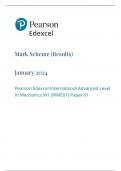
Mark Scheme (Results) Summer 2023 Pearson Edexcel GCE in Geography (8GE01) Paper 1: Dynamic Landscapes Edexcel and BTEC Qualifications Edexcel and BTEC qualifications are awarded by Pearson, the UK’s largest awarding body. We provide a wide range of qualifications including academic, vocational, occupational and specific programmes for employers. For further information visit our qualifications websites at or . Alternatively, you can get in touch with us using the details on our contact us page at Pearson: helping people progress, everywhere Pearson aspires to be the world’s leading learning company. Our aim is to help everyone progress in their lives through education. We believe in every kind of learning, for all kinds of people, wherever they are in the world. We’ve been involved in education for over 150 years, and by working across 70 countries, in 100 languages, we have built an international reputation for our commitment to high standards and raising achievement through innovation in education. Find out more about how we can help you and your students at: Summer 2023 Question Paper Log Number P70931RA Publications Code 8GE0_01_2306_MS All the material in this publication is copyright © Pearson Education Ltd 2018 General Marking Guidance • All candidates must receive the same treatment. Examiners must mark the first candidate in exactly the same way as they mark the last. • Mark schemes should be applied positively. Candidates must be rewarded for what they have shown they can do rather than penalised for omissions. • Examiners should mark according to the mark scheme not according to their perception of where the grade boundaries may lie. • There is no ceiling on achievement. All marks on the mark scheme should be used appropriately. • All the marks on the mark scheme are designed to be awarded. Examiners should always award full marks if deserved, i.e. if the answer matches the mark scheme. Examiners should also be prepared to award zero marks if the candidate’s response is not worthy of credit according to the mark scheme. • Where some judgement is required, mark schemes will provide the principles by which marks will be awarded and exemplification may be limited. • When examiners are in doubt regarding the application of the mark scheme to a candidate’s response, the team leader must be consulted. • Crossed out work should be marked UNLESS the candidate has replaced it with an alternative response. Paper 1 Mark scheme (v7 Standardisation) Question number Answer State one hazard caused by an earthquake. Mark 1(a) AO1 (1 mark) Award 1 mark for a correctly identified hazard: • Tsunami • Landslide / Rockslide • Avalanche • Crustal fracturing • Ground shaking • Aftershocks • Building collapse • Liquefaction • Fire Accept any other appropriate response, including some human impacts, e.g. disease / famine (1) Question number Answer Compare the data about earthquakes before and after 2005. Mark 1(b)(i) AO3 (2 marks) Award 1 mark for each correctly identified comparison between the earthquake frequency before and after 2005. • There are more recorded earthquakes after 2005 • The highest magnitude earthquakes occur after 2005 • There are more years with a higher number of earthquakes after 2005 Accept any other correct comparison based on figure 1a. (2) Question number Answer Suggest one reason why this data might concern the government of Iran and Iraq. Mark 1(b)(ii) AO1 (2 marks)/AO2 (1 mark) Award 1 mark for analysing the resource to suggest a reason for having concern, and a further 2 marks for justifying the possible reason, for example: • Frequency might affect more people who can report / need medical support / are increasingly vulnerability / whose buildings require protection / require hazard education stretching government resources / costing a lot more money . • Increased frequency might make it hard to communities to recover after one earthquake before the next one strikes which affects vulnerability / resilience / capacity to cope / requires more support by the government to rebuild / prepare so more people might be injured / die / homeless . • Increased frequency might create earthquake fatigue as communities get used to earthquakes which means they might struggle with resilience / preparations and might need more intervention by government to cope . • The higher intensity earthquakes might affect more people because earthquake waves could travel to more isolated areas / cause more damage in densely populated areas requiring more government intervention to support rescue efforts / provide more direct action to reach areas that have been cut-off / better infrastructure is needed to prepare for inevitable further quakes . • Increased frequency of earthquakes might hurt the reputation of the country / government because perception of threat level is higher so tourists are less likely to visit and bring income / people trust the government’s capacity to cope less and reduces the government’s ability to act to reduce the threat from future earthquakes . • The earthquakes occur alongside ongoing conflict / warring factions so infrastructure / roads / hospitals are destroyed / damaged / in dis-repair making it difficult to treat / support affected communities . Accept any other appropriate response based on figure 1a.
Escuela, estudio y materia
- Institución
- Edexcel as level geography paper 1
- Grado
- Edexcel as level geography paper 1
Información del documento
- Subido en
- 9 de diciembre de 2023
- Número de páginas
- 45
- Escrito en
- 2023/2024
- Tipo
- Examen
- Contiene
- Preguntas y respuestas
Temas
-
edexcel as level geography paper 1 mark scheme jun

Documento también disponible en un lote