
RPSGT EXAM Review Test Solution 2023
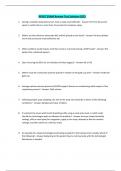
RPSGT EXAM Review Test Solution 2023 1. During a multiple sleep latency test, how is sleep onset defined? - Answer-The first 30-second epoch in which there is more than 15 seconds of cumulative sleep. 2. Where are the reference electrodes M1 and M2 placed on the head? - Answer-On the earlobes and in the prearicular area behind the ear 3. What condition would require a full face mask or oral mask during a CPAP study? - Answer-The patient has a deviated septum. 4. Eyes mirroring the EEG are an indication of what stage(s)? - Answer-N2 or N3 5. Where must the conductive paste be placed in relation to the gold cup wire? - Answer-Inside the gold cup 6. Average volume-assured pressure (AVAPS) support focuses on maintaining which aspect of the respiratory process? - Answer-Tidal volume 7. Following proper prep swabbing, the skin at the prep site should be in which of the following conditions? - Answer-Abraded and clear of debris 8. If a patient has issues with mouth breathing while using a nasal-only mask, in which order should the technologist work to alleviate the problem? - Answer-Increase heated humidity settings, offer a nasal spray for congestion, apply a chin strap, attempt to flex the comfort settings, and then switch to a full face tnask. 9. An example of a sleep technologist acclimating a patient to the testing room includes which of the following? - A 13. What is the sleep efficiency formula? - Answer-[TST/TRT] X 100 14. What is the formula used to calculate AHI? - Answer-[Total apneas and hypopneas/TST] X 60 15. During a BiPAP titration, acceptable changes to the settings when a patient begins having complex sleep apnea include which ofthe following? - Answer-Change to a spontaneous-timed mode with a backup rate or reduce IPAP settings. 16. The artifacts that are most likely to cause high-amplitude, low-frequency waves seen on the EEG are - Answer-respiratory artifacts 17. True statements about quantitative values for end tidal carbon dioxide (CO2) monitoring include all of the following EXCEPT - Answer-it only provides a range of CO2 values. 18. Accoring to the AASM what is the maximum IPAP setting when using BiPAP on a patient over 12 years of age? - Answer-30cm 19. Is an arousal needed to score a RERA in pediatric patients? - Answer...
Información del documento
- Subido en
- 6 de diciembre de 2023
- Número de páginas
- 2
- Escrito en
- 2023/2024
- Tipo
- Examen
- Contiene
- Preguntas y respuestas

