
URINARY SYSTEM AND FLUID BALANCE
COMPOSITION OF THE URINARY SYSTEM:
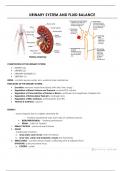
KIDNEYS (2)
URETERS (2)
URINARY BLADDER (1)
URETHRA (1)
URINE – contains excess water, ions, wastes & toxic substances
FUNCTIONS OF THE URINARY SYSTEM:
Excretion: removes waste from blood (with skin, liver, lungs)
Regulation of Blood Volume and Pressure: controls ECF volume
Regulation of Concentration of Solutes in Blood – positively and negatively charged ions
Regulation of Extracellular Fluid pH – Hydrogen ions
Regulation of RBC Synthesis: erythropoietin (low BP)
Vitamin D Synthesis: calcium
KIDNEYS
– bean-shaped; size of a tightly clenched fist
- Posterior abdominal wall, each side of vertebral column
RETROPERITIONEAL – “behind peritoneum”
RENAL – Latin for “kidney”
1. RENAL CAPSULE – surrounds each kidney
2. HILUM
- medial side of kidney
a. renal artery and nerves enter the kidney
b. renal vein, ureter and lymphatic vessels exit the kidney
3. RENAL SINUS – contains blood vessels; collecting urine & adipose tissue
DIVISIONS: (surrounds renal sinus)
a. CORTEX – outer;
1|Urinary system
, b. MEDULLA – inner
4. RENAL PYRAMIDS – “cone-shaped”
a. Base - between the cortex and medulla
b. Tips – center of the kidney
5. CALYX – “funnel-shaped”; surrounds the tips of renal pyramids
6. RENAL PELVIS – joint of calyces; larger funnels
7. URETER – narrowing of the renal pelvis; small tubes, kidneys->urinary bladder
NEPHRON – functional unit of the kidney; 1.3M
PARTS:
a. RENAL CORPUSCLE
1. Bowman capsule – enlarged end of nephron
– form double-walled chamber
CAVITY: opens to proximal convoluted tubule ( fluid:away)
INNER LAYER: has podocytes (spec.cells, processes with gaps) w/c wrap
glomerulus
capillaries.
OUTER LAYER: simple squamous epithelial cells
2. Glomerulus – tuft capillaries = ball of yarn
- within indentation of bowman capsule
Glomerular capillaries – pores in walls
b. PROXIMAL COVOLUTED TUBULE
c. LOOP OF HENLE: (1 thick, 2 thin segments)
Thin Segment of the Descending Limb – extends to renal sinus; hairpin turn,
Thin & Thick Segments of the Ascending Limb - back to cortex
d. DISTAL CONVOLUTED TUBULE
Renal Corpuscle > Proximal Convoluted Tubule > Thin Segment of the Descending Limb > Thin Segment of the
Ascending Limb > Thick Segment of the Ascending Limb > Distal Convoluted Tubule > Collecting Duct >
Papillary Duct > Calyx
Renal artery -> (RENAL PYRAMIDS) Interlobar artery -> (CORTEX & MEDULLA) -> Arcuate artery -> (CORTEX)
Interlobular artery -> (GLOMERULAR) -> afferent arterioles -> Efferent arterioles -> Peritubular capillaries ->
Interlobular vein -> Arcuate vein -> renal vein -> Inferior Vena Cava
NEPHRONS – sorts substances: waste products, toxins, excess materials
JUXTAMEDULLARY NEPHRONS (15%) – have loops of Henle deep to the medulla
CORTICAL NEPHRONS (85%) – do not extend deep into the medulla
FILTRATION MEMBRANE – consists of glomerular capillaries, podocytes and of the basement membrane
FILTRATE – fluid that passes across the filtration membrane
RENAL ARTERIES – branch off the abdominal aorta and enter the kidneys
2|Urinary system

