bacb new ethics code questions well answered rated A+
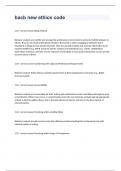
bacb new ethics code1.01 - correct answer Being Truthful Behavior analysts are truthful and arrange the professional environment to promote truthful behavior in others. They do not create professional situations that result in others engaging in behavior that is fraudulent or illegal or that violates theCode. They also provide truthful and accurate information to all required entities (e.g., BACB, licensure boards, funders) and individuals (e.g., clients, stakeholders, supervisees, trainees), and they correct instances of untruthful or inaccurate submissions as soon as they become aware of them. 1.02 - correct answer Conforming with Legal and Professional Requirements Behavior analysts follow the law and the requirements of their professional community (e.g., BACB, licensure board). 1.03 - correct answer Accountability Behavior analysts are accountable for their actions and professional services and follow through on work commitments. When errors occur or commitments cannot be met, behavior analysts take all appropriate actions to directly address them, first in the best interest of clients, and then in the best interest of relevant parties. 1.04 - correct answer Practicing within a Defined Role Behavior analysts provide services only after defining and documenting their professional role with relevant parties in writing 1.05 - correct answer Practicing within Scope of Competence Behavior analysts practice only within their identified scope of competence. They engage in professional activities in new areas (e.g., populations, procedures) only after accessing and documenting appropriate study, training, supervised experience, consultation, and/or co-treatment from professionals competent in the new area. Otherwise, they refer or transition services to an appropriate professional. 1.06 - correct answer Maintaining Competence Behavior analysts actively engage in professional development activities to maintain and further their professional competence. Professional development activities include reading relevant literature; attending conferences and conventions; participating in workshops and other training opportunities; obtaining additional coursework; receiving coaching, consultation, supervision, or mentorship; and obtaining and maintaining appropriate professional credentials. 1.07 - correct answer Cultural Responsiveness and Diversity Behavior analysts actively engage in professional development activities to acquire knowledge and skills related to cultural responsiveness and diversity. They evaluate their own biases and ability to address the needs of individuals with diverse needs/backgrounds (e.g., age, disability, ethnicity, gender expression/identity, immigration status, marital/relationship status, national origin, race, religion, sexual orientation, socioeconomic status). Behavior analysts also evaluate biases of their supervisees and trainees, as well as their supervisees' and trainees' ability to address the needs of individuals with diverse needs/sts follow the law and the requirements of their professional community (e.g., BACB, licensure board 1.08 - correct answer Nondiscrimination Behavior analysts do not discriminate against others. They behave toward others in an equitable and inclusive manner regardless of age, disability, ethnicity, gender expression/identity, immigration status, marital/relationship status, national origin, race, religion, sexual orientation, socioeconomic status, or any other basis proscribed by law 1.09 - correct answer Nonharassment Behavior analysts do not engage in behavior that is harassing or hostile toward others. 1.10 - correct answer Awareness of Personal Biases and Challenges
Escuela, estudio y materia
- Institución
- BACB
- Grado
- BACB
Información del documento
- Subido en
- 1 de diciembre de 2023
- Número de páginas
- 20
- Escrito en
- 2023/2024
- Tipo
- Examen
- Contiene
- Preguntas y respuestas
Temas

Documento también disponible en un lote