AMSCO AP US History Chapter 27 question n answers graded A+ 2023/2024
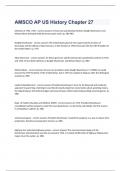
AMSCO AP US History Chapter 27elections of 1952, 1956 - correct answers In these two presidential elections Dwight Eisenhower and Richard Nixon defeated Adlai Stevenson quite easily. (p. 580-581) Dwight Eisenhower - correct answers The United States general who supervised the invasion of Normandy and the defeat of Nazi Germany. In the election of 1952 he became the the 34th President of the United States. (p. 579) Adlai Stevenson - correct answers An Illinois governor and the Democratic presidential nominee in 1952 and 1956. He lost both elections to Dwight Eisenhower and Richard Nixon. (p. 580) Richard Nixon - correct answers He was vice president under Dwight Eisenhower. In 19868, he would become the 37th President of the United States, but in 1974 he resigned in disgrace after the Watergate scandal. (p. 580) modern Republicanism - correct answers President Eisenhower's term for his balanced and moderate approach to governing. Claiming he was liberal toward people but conservative about spending money. He helped balance the federal budget and lowered taxes without destroying existing social programs. (p. 580) Dept. of Health, Education and Welfare (HEW) - correct answers In 1953, President Eisenhower consolidated welfare programs under this new department, run by Oveta Culp Hobby, the first woman in a Republican cabinet. (p. 580) soil-bank program - correct answers President Eisenhower created this program as a way to reduce farm production, thereby increasing farm income. (p. 580) Highway Act; interstate highway system - correct answers The most permanent legacy of the Eisenhower administration was this act passed in 1956. It created 42,000 miles of highway linking every major city in the nation. (p. 580) John Foster Dulles - correct answers In the Eisenhower administration, he was the Secretary of State that pursued a policy of pushing the USSR and China to the brink of war. However, Eisenhower prevented him from carrying his ideas the extreme. (p. 581) brinksmanship - correct answers The principle of pushing Communist nations to the brink of war, thinking they would back down because of American nuclear superiority. (p. 581) massive retaliation - correct answers This was Eisenhower's policy, it advocated the full use of American nuclear weapons to counteract even a Soviet ground attack in Europe. (p. 582) decolonization - correct answers After World War II, dozens of European colonies in Asia and Africa became independent countries. (p. 582) India, Pakistan, Indonesia - correct answers From 1947 to 1949, these three countries gained their independence. (p. 582) Third World - correct answers Term applied to a group of developing countries that often lacked stable political and economic institutions. Their need for foreign aid often made them pawns of the United States and the Soviet Union during the Cold War. (p. 582) CIA, covert action - correct answers Undercover intervention in foreign government by the CIA during Eisenhower's presidency. (p. 582) Iranian overthrow - correct answers In 1953, the CIA helped overthrow this government and established a monarch ruler with close ties to the U.S. He provided favorable oil prices and purchased American military arms. (p. 582) Korean armistice - correct answers In July 1953, China and North Korea agreed to an armistice that would divide Korea into North Korea and South Korea near the 38th parallel. (p. 583) Indochina - correct answers In the early 1950s, France was fighting to retake control of their colony in southeastern Asia. The French were defeated in 1954 and they agreed to give up Indochina, which was divided into the nations of Cambodia, Laos, and Vietnam. (p. 583)
Escuela, estudio y materia
- Institución
- AMSCO AP
- Grado
- AMSCO AP
Información del documento
- Subido en
- 28 de noviembre de 2023
- Número de páginas
- 8
- Escrito en
- 2023/2024
- Tipo
- Examen
- Contiene
- Preguntas y respuestas
Temas
-
amsco ap us history chapter 27

Documento también disponible en un lote