SHARP Career Course Test 1, Verified Solution 2023 100%
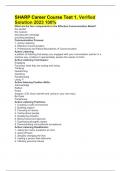
SHARP Career Course Test 1, Verified Solution 2023 100% What are the four components to the Effective Communication Model? the sender the receiver decoding the message providing feedback Communication Process: 1. Active Listening 2. Effective Communication 3. Professional and Ethical Boundaries of Communication Active Listening: a pattern of listening that keeps you engaged with your conversation partner in a positive way, enables to appropriately assess the needs of victim Active Listening Techniques: Engaging Focusing: what they are saying and doing. Thinking Questioning Clarifying Paraphrasing Using "I" Active listening Positive Skills: Acknowledge Reflect Probe Support: (CB: show warmth and caring in your own way) Be Quiet Paraphrase Active Listening Practices: 1. Creating a safe environment 2. Building rapport 3. Focusing on issues 4. Caring about people 5. Displaying empathy 6. Being honest and genuine 7. Expressing thoughts clearly 8. Demonstrating unconditional acceptance Active Listening Roadblocks: 1. asking too many questions at once 2. going off topic 3. abruptly changing the flow 4. making a person feel defensive 5. Inflicting personal values 6. Cutting off discussions of feelings 7. Jumping to conclusion Effective communication techniques: Listening Paying attention Focusing on the words Being empathetic Suspending one's own thoughts and feelings-(You think about them instead of you) Communication Styles: Aggressive Passive aggressive Passive Assertive (Most common) Establishing boundaries of communication with a victim/complainant -Provide professional information only -Separate appropriate vs. inappropriate behavior -Do not promote a false sense of security -Ease into the boundaries -Discuss that you are an advocate and a coordinator -Discuss with the victim all the resources that could help. -Guide the victim through the process -Do not let the victim get too connected Why is it important to maintain boundaries: essential in maintaining the victims trust and sense of safety. Boundary Violation: -Giving victim an unsolicited hug -Inviting the victim to social activities -Making decisions for the victim -Offering to babysit victims children -Transporting victim to an appointment in a POV -Letting victim stay with you at your home -Accepting any gifts -Accepting goods or services Ethical Boundaries -Practicing ethical behavior -maintaining limits -don't lose your professional focus Types of Army Briefings Information Briefing Decision Briefing Mission Briefing Staff Briefing Information Briefing: Delivers information Decision Briefing: obtains answer to a question or results in a decision on a COA Mission Briefing: secures a unified goal/effort toward accomplishing a mission The staff briefing: coordinates unit efforts by informing commander and staff of the current situation What should the presentation introduction include: Name and duty title; topic; purpose; motivator, transition. What is the goal of the motivator: to hook the audience What is a transition: When you move from one section to next What is facilitation? When you carry out a brief that is led by the audience, create a discussion with assistance by making it easier What is P5D? (Verbal communication) Projection Pitch Pace Pauses Pronunciation Distractors What are the elements of APCE? Ask Pause Call Evaluate What are techniques to consider for leading a discussion? -Ask open-ended question -Ask questions before calling on a student by name -Consider responses you weren't seeking -Acknowledge responses -Ask student to elaborate -Find a way to include quiet students -Find a way to quiet down an exuberant student What are some techniques for answering student questions: Paraphrase first, Respond, Redirect, Probe, Discuss, postpone What is Victimology? scientific study of victimization including the relationship between victims and offenders, the interactions between victims and the criminal justice system. and the social group What three victim assistance programs were created in 1972
Información del documento
- Subido en
- 28 de noviembre de 2023
- Número de páginas
- 9
- Escrito en
- 2023/2024
- Tipo
- Examen
- Contiene
- Preguntas y respuestas