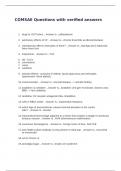
TNCC 8TH EDITION QUESTIONS AND ANSWERS
TNCC 8TH EDITION QUESTIONS AND ANSWERS The major cause of preventable death after injury - CORRECT ANSWER-Uncontrolled hemorrhage The best measure of the adequacy of cellular perfusion and helps to predict the outcome of resuscitation - CORRECT ANSWER-Base deficit Examples of primary blast injuries - CORRECT ANSWER-Blast lung, ruptured tympanic membrane, TBI, abdominal hemorrhage Examples of secondary blast injuries - CORRECT ANSWER-Wounds from debris and bomb fragments Examples of tertiary blast injuries - CORRECT ANSWER-Blunt or penetrating trauma from the body being thrown by the blast Examples of quaternary blast injuries - CORRECT ANSWER-Injuries or illness related to explosion: burns, toxic injury from chemicals Examples of quinary blast injuries - CORRECT ANSWER-Injuries associated with exposure to hazardous materials from the components of the blast Questions to ask for airway assessment (need 4) - CORRECT ANSWER-Is the tongue obstructing? Are there any foreign objects? Is there any edema? Are there loose or missing teeth? Is there snoring, gurgling, or stridor? Is there bony deformity? Is there blood, vomit, or secretions? Questions to ask during breathing assessment. (Need 4) - CORRECT ANSWER-Is there symmetrical chest rise? Is there spontaneous breathing? Is there tracheal deviation or JVD? What is their skin color? Are there open wounds or deformities in the chest? What's the depth, pattern, and rate of respirations? Is there increased work of breathing? Are breath sounds present and equal? 3 ways to assess ETT placement - CORRECT ANSWER-1. Apply end tidal, assess CO2 after 5-6 breaths 2. Assess for symmetrical chest wall rise and fall 3. Auscultation over the epigastrium for gurgling and bilateral breath sounds. What do you document after placing an ETT? - CORRECT ANSWER-ETT placement at teeth or gums Situations that require a definitive airway - CORRECT ANSWER-GCS 8 or less Apnea Inhalation injury Increased risk of aspiration Anticipate decreased neuro status Severe maxo fractures Laryngeal/tracheal injury Where do you listen for breath sounds? - CORRECT ANSWER-2nd intercostal space at midclavicular line and 5th intercostal space at anterior axillary line King airway - CORRECT ANSWER-A multidimensional esophageal airway that traps the glottis opening between an esophageal cuff and an oropharyngeal cuff 3 things to assess for circulation - CORRECT ANSWER-Palpate central pulse Assess (again) for external hemorrhage Inspect and palpate skin for color, temp, and moisture. When do you establish IV access? - CORRECT ANSWER-Right after the circulatory assessment At what point to you evaluate need for transfer or definitive care? - CORRECT ANSWER-After the primary survey How do you palpate the iliac crests? - CORRECT ANSWER-Downward and medially The 3 components of the pediatric assessment triangle - CORRECT ANSWER-Skin circulation, work of breathing, general appearance What type of fluids should you give kids with normal blood glucose? - CORRECT ANSWER-Fluids with dextrose to prevent hypoglycemia How much fluid do you give a kid? - CORRECT ANSWER-20mL/kg
Escuela, estudio y materia
- Institución
- TNCC
- Grado
- TNCC
Información del documento
- Subido en
- 23 de noviembre de 2023
- Número de páginas
- 4
- Escrito en
- 2023/2024
- Tipo
- Examen
- Contiene
- Preguntas y respuestas
Temas
-
tncc 8th edition questions and answers
-
the major cause of preventable death after injury
-
what assessment finding gives concern for severe b
-
where do you secure a pelvic binder