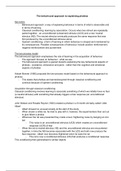
The behavioural approach to explaining phobias
Key terms
- Behavioural approach: a way of explaining behaviour in terms of what is observable and
in terms of learning
- Classical conditioning: learning by association. Occurs when two stimuli are repeatedly
paired together - an unconditioned (unlearned) stimulus (UCS) and a new ‘neutral’
stimulus (NS). The neutral stimulus eventually produces the same response that was
first produced by the unconditioned stimulus alone
- Operant conditioning: a form of learning in which behaviour is shaped and maintained by
its consequences. Possible consequences of behaviour include positive reinforcement,
negative reinforcement and punishment
The two-process model
The behavioural approach emphasises the role of learning in the acquisition of behaviour
- The approach focuses on behaviour - what we see
- The behavioural approach is geared towards explaining the key behavioural aspects of
phobias - avoidance, endurance and panic - rather than the cognitive and emotional
aspects of phobias
Hobart Mowrer (1960) proposed the two-process model based on the behavioural approach to
phobias
- This states that phobias are learned/acquired through classical conditioning and
continue because of operant conditioning
Acquisition through classical conditioning
Classical conditioning involves learning to associate something of which we initially have no fear
(a neutral stimulus) with something that already triggers a fear response (an unconditioned
stimulus)
John Watson and Rosalie Rayner (1920) created a phobia in a 9-month old baby called ‘Little
Albert’
- Albert showed no unusual anxiety at the start of the study
- When shown a white rat, he tried to play with it, however, the experimenters then set out
to give Albert a phobia
- Whenever the rat was presented they made a loud, frightening noise by banging an iron
bar
- This noise is an unconditioned stimulus (UCS) which creates an unconditioned
response (UCR) of fear
- When the rat (a neutral stimulus, NS) and the unconditioned stimulus are encountered
together, in time the NS becomes associated with the UCS and both now produce the
fear response - Albert now becomes frightened when he sees the rat
- The rat is now a conditioned stimulus (CS) that produces a conditioned response
This conditioning then generalised to similar objects
Key terms
- Behavioural approach: a way of explaining behaviour in terms of what is observable and
in terms of learning
- Classical conditioning: learning by association. Occurs when two stimuli are repeatedly
paired together - an unconditioned (unlearned) stimulus (UCS) and a new ‘neutral’
stimulus (NS). The neutral stimulus eventually produces the same response that was
first produced by the unconditioned stimulus alone
- Operant conditioning: a form of learning in which behaviour is shaped and maintained by
its consequences. Possible consequences of behaviour include positive reinforcement,
negative reinforcement and punishment
The two-process model
The behavioural approach emphasises the role of learning in the acquisition of behaviour
- The approach focuses on behaviour - what we see
- The behavioural approach is geared towards explaining the key behavioural aspects of
phobias - avoidance, endurance and panic - rather than the cognitive and emotional
aspects of phobias
Hobart Mowrer (1960) proposed the two-process model based on the behavioural approach to
phobias
- This states that phobias are learned/acquired through classical conditioning and
continue because of operant conditioning
Acquisition through classical conditioning
Classical conditioning involves learning to associate something of which we initially have no fear
(a neutral stimulus) with something that already triggers a fear response (an unconditioned
stimulus)
John Watson and Rosalie Rayner (1920) created a phobia in a 9-month old baby called ‘Little
Albert’
- Albert showed no unusual anxiety at the start of the study
- When shown a white rat, he tried to play with it, however, the experimenters then set out
to give Albert a phobia
- Whenever the rat was presented they made a loud, frightening noise by banging an iron
bar
- This noise is an unconditioned stimulus (UCS) which creates an unconditioned
response (UCR) of fear
- When the rat (a neutral stimulus, NS) and the unconditioned stimulus are encountered
together, in time the NS becomes associated with the UCS and both now produce the
fear response - Albert now becomes frightened when he sees the rat
- The rat is now a conditioned stimulus (CS) that produces a conditioned response
This conditioning then generalised to similar objects