DAANCE Exam Questions and Answers LATEST REAL EXAM |Graded A+
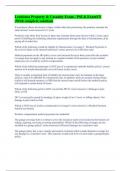
Wave of Depolarization an advancing wave of charge reversal as the nerve impulse advance a long the neuron Wakefullness system consists of a central core in the brainstem with neurons that radiate to the cortex Vomiting Center the center in the brainstem that induces vomiting Vital Centers centers in the brainstem that control such physiologic processes as blood pressure and pulse, depth and rate of respiration Vestibular nerve part of the eighth cranial nerve that is connect with equilibrium and hearing Venule any of the small vessels that collect blood from networks of capillaries and join them to form veins Ventricular tachycardia a cardia dsrhythmia in which there is rapid firing of an ectopic focus in the ventricles and a wide QRS complex with no p waves Ventricular rhythms a cardia dsrhythmia in which the pacemaker is in the ventricles rather than in the SA node or atria Ventricular focus a displace point of origin for a dysrhythmia that is in the ventricles Ventricular fibrillation arrhythmia characterized by contractions of ventricle muscle fibers due to rapid excitation of myocardial fibers without coordinated contraction of the ventricle Sensory nerve a nerve of the peripheral nervous system that conducts impulses from a sense organ to the spinal cord or brain Sinoatrial node a microscopic collection of heart muscle fibers where cardiac rhythm originates; also called the pacemaker of the heart sinus arrhythmia a cardiac dysrhythmia similar to normal sinus rhythm, but withslight variation in rate with inspiration and expiration sinus bradycardia cardiac dysrhythmia similar to normal sinus rhythm except for a slower rate of less than 60 bpm sinus rhythms cardiac rhythms in which the pacemaker is the sinoatrial node sinus tachycardia dysrhythmia similar to normal sinus rhythm except for an increase in rate of greater than 100 bpm but less than 150 bpm stroke volume the amount of blood ejected from a ventricle during each beat of the heart subcutaneous beneath the skin superior vena cava the venous trunk that drains blood from the head, neck, upper extremities, and chest and empties into the right atrium of the heart supraventricular foci central points of origin of dsrhythmias, which are located above the level of the ventricles in the atria sympathommimetic having activity that mimics the effects of the sympathetic nervous system, epinephrine synapse the junction between two neurons where impulses are transmitted from one neuron to another synaptic cleft the gap between two nerves where they meet at a synapse syncope fainting synergistic the phenomenon that exists when two drugs are administered together, and the combined effect is greater than the sum of its parts systolic pertaining to the phase of the heart's pumping action when the ventricles contract, forcing blood either to the lungs or peripheral circulation T wave the EKG waveform that represents repolarization of the ventricles Tachycardia fast heart rate terminal button the bulge at the end of the nerve that touches the next nerve in the never pathway at a synapse third degree AV block an atrioventricular block in which the impulse does not conduct from the atria to the ventricles and there is independent contraction of the atria and ventricles Thrombosis formation of a blood clot in a blood vessel, usually a vein Tidal Volume the amount of gas that is inspired or expired during one respiratory cycle titrate to give a small quantity of a drug and assess its effects before giving additional drugs trachea windpipe tracheostomy the surgical creation of an opening into the trachea through the neck transient ischemic attack a brief attack of cerebral dysfunction caused by reduced blood flow in the brain trigeminal nerve the fifth cranial nerve, which supplies sensation to the face, teeth, mouth, and nasal cavity type I diabetes insulin-dependent diabetes type II diabetes noninsulin- dependent diabetes vagus nerve the tenth cranial nerve, which supplies fibers to many parts of the body, including the ears, tongue, pharynx, larynx, and thoracic, and abdominal viscera vapocoolant a chemical spray applied to the skin to rapidly cool the skin surface vaporizer a device that allows for the controlled evaporation and release of inhalation anesthetic agents for the administration of inhalation anesthesia vasoconstriction the decrease in the diameter of a vessel, especially constriciton of arterioles leading to decreased blood flow to a part vascoconstrictors pharmacologic agents that cause blood vessels to constrict vasodilation dilation of a vessel vein vessel that carries blood from organs ventricle one of a pair of cavities that have thick muscular walls and make up the bulk of the heart P wave a wave appearing on a cardiac monitor tracing that reflects the electrical activity that produces contraction of the atria Paradoxical effect an effect that is the opposite of the intended effect Parenteral routes of medication administration other than by mouth Paroxysmal tachycardia a condition marked by sudden attacks of rapid heartbeats PEA a cardiac dsyrhythmia in which a normal rhythm such as sinus bradycardia appears on the monitor screen although there is no contraction of the heart pharmacodynamics the effects that the drug has on various body system pharmacokinetics the effect that the body has on a drug pharynx the muscular and membranous cavity leading from the mouth and lower nasal passages to the trachea phlebitis inflammation of a blood vessel in response to an irritating intravenously administered substance pneumonitis inflammation of the lungs pons almond shaped structure that is the upper-most portion of the brainstem and serves as a "bridge" to the midbrain potentiate to make stronger or enhance the effect of a drug PAC a premature firing of an ectopic focus in the atria producing an early contraction of the atria PVC premature contraction of the heart that is independent of the normal rhythm and arises in response to an impulse in the ventricle Prothrombin protein present in plasma that represents one of several coagulation factors protease inhibitors class of pharmacologic agents used in the treatment of AIDS to help prevent viral replication pseudocholinesterase a type of enzyme found in the blood that is responsible for the metabolic breakdown of the muscle relaxant succinylcholine pterygoid plexus a network of veins corresponding to the second and third parts of maxillary arter
Escuela, estudio y materia
- Institución
- DAANCE
- Grado
- DAANCE
Información del documento
- Subido en
- 18 de noviembre de 2023
- Número de páginas
- 20
- Escrito en
- 2023/2024
- Tipo
- Examen
- Contiene
- Preguntas y respuestas
Temas
- daance exam questions
- daance exam
-
daance exam questions and answers graded a
-
daance exam questions and answers 2023
-
daance exam questions and answers 2024
-
daance exam questions and answers verified