
1 LE: Genome architecture
Autosomal dominant diseases might skip a generation, which means that it
doesn’t show in the phenotype.
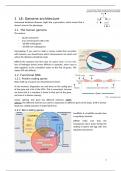
1.1 The human genome
The nucleus
- 22 pair autosomes
- 2 sex chromosomes (XX or XY)
- ~20.000 coding genes
- ~25.000 non-coding genes
Karyotyping: If you want to make a mouse model that correlates
with humans, you should know which chromosomes are which and
where the deletions should be made.
Difficult the sequence the first exon of a gene: exon 1 is G-C rich,
lots of hydrogen bonds (more difficult to separate, more easy to
stick together) as the translation starts on the first 18 genes. This
makes PCR also difficult.
1.2 Functional DNA
1.2.1 Protein coding genes
Basic build-up of a gene you should know by heart.
At the moment, diagnostics are only done on the coding part
of the gene and a bit of the UTRs. This is convenient, because
we know that if a mutation is found in that part of the gene,
we know it is disease causing.
Genes: splicing. One gene has different isoforms: MAPT:
splicing. The different isoforms can come to expression in different parts of the body. (UTR is shorter
black box, coding sequence is larger black box)
1.2.2 Non-coding genes
LncdRNAs & si/miRNAs usually have
a regulatory function.
piRNAs make sure that the
transposons don’t jump during the
making of sperm and egg cells (not
regulatory processes)
1
,Small ncRNA: mechanism of action
A long gene that encodes small precursors, these smaller pieces
can form hairpins (miRNAs, siRNA) or not (ds, siRNA; ssRNA,
piRNA). Dicer processes these structures > mature small RNAs.
The ~20 nt RNAs are used to recognize their target RNA (binding);
miRNAs coding genes, siRNA transposons and exogenous genes,
piRNA transposons and other genes.
miRNA
How does it work? Drosha/pahsa cuts pri-miRNA to pieces
(hairpins), exportin transports these out of the nucleus. The RISC complex recognizes these pieces
and makes sure that it is going to be one RNA that can bind to the mRNA found in the cell. Then
there is an inhibition of translation initiation/elongation mRNA deadenylation; the complex bind to
the complementary sequence of the target.
miRNA in the human genome: miRNAs are polycistronic (multiple
small genes)
Feingold syndrome 2: miR-17~19 deletion (less miRNA); short
finger, hypoplastic thumbs, syndactyly toes.
Long non-coding
Natural antisense transcripts (NATs): influence the expression of the corresponding sense transcript:
mechanism of action hypothesises (all 3 can be causative)
- a: steric hinderance of the RNA polymerase; if one allele is expressed the other one cannot
be expressed
2
, - b: because of the binding to exon 3 of the opposite strand RNA, it cannot be spliced correctly
(one isoform is produced)
- c: the mRNA can be retained by RNA editing (stays in the nucleus, cannot be translated)
Cis-NATs in the human genome: can be regulatory changing.
1.2.3 Regulatory elements
Different types of regulatory elements: core promoter (where
transcription starts), proximal promotor elements (before the core
promotor) and distal regulatory elements. Not all the regulatory
elements are checked as the gene only starts after the promoter.
1.3 ‘Junk’ DNA
Mostly transposons: Transposable elements (TEs)
- ~45% of the human genome
- <0.05% active
- Most abundant: Alu elements (10% of the human genome)
1.4 The epigenome
Most extreme e.g. of the effect of epigenetic modification on gene
expression? > X – inactivation: non-coding RNA Xist spreads in cis the
X-chromosome that is to be inactivated. Seen as a bar body in the
nucleus of the cells (black spot).
DNA methylation > ‘imprinting’ > inactivation
Genomic imprinting:
- Males: during spermatogenesis the old imprint is erased and new sex-specific imprint is
established in the sperm cells.
- Females: during oogenesis the already established
imprint stays in the egg cells.
- Essential for normal development
- Deregulation results in complex genetic diseases
- ~100 imprinted genetic loci
Angelman syndrome: Intellectual disability, laugh a lot
unexpectedly, Ataxia, No speech, Epilepsy, Typical face, Friendly
loss of maternal gene expression
Prader Willi syndrome: Neonatally: Hypotonia, feeding
problems, First decade of life: obesities, small, intellectual
disability (mild), hypogonadism, behavioural problems loss of paternal
gene expression
Uniparental disomy: AS/PWS
- Two alleles from mother or father
- Also results in the syndromes as the same gene is solely present.
1.5 Example exam questions
- MIR = always hairpin
3
, - If the purple line is even thicker, then it is protein coding
2 LE: genome variation
2.1 Genome variation
- Variation = Any deviation from the ref genome
- Polymorphism: variation ≥1% of the alleles in a population
- Mutation: variation <1% of the alleles in a population
- Pathogenic: disease-causing mutation or polymorphism
Online genome browsers: UCSC, Ensembl, etc.
2.2 SNVs & indels
Single nucleotide variant (SNV): a substitution of a single nucleotide for another. A SNV can be rare in
one population, but common in a different population. Sometimes SNVs are known as single
nucleotide polymorphisms (SNPs, present in ≥1% population), although SNV and SNPs are not
interchangeable.
Insertion or deletion (indel): ≤10 bp
- Silent changes: a point mutation where one nucleotide in a genetic sequence is replaced
with another nucleotide, altering the corresponding codon to another codon for the same
amino acid. No observable effect on the phenotype.
- Missense changes: a single nucleotide base in a DNA sequence is swapped for another one,
resulting in a different codon and, therefore, a different amino acid.
- Nonsense changes (stop mutation): a sequence change gives rise to a stop codon rather than
a codon specifying an amino acid.
- Frameshift changes: the insertion or deletion of nucleotide bases in numbers that are not
multiples of three.
- Insertion or duplication: A duplication occurs when a stretch of one or more nucleotides in a
gene is copied and repeated next to the original DNA sequence. This type of variant may alter
the function of the protein made from the gene.
- In frame deletion: A deletion is in-frame if the reading frame of the gene is preserved and
not disrupted, so some dystrophin protein can be made. The protein may be shorter than
normal, but it is still functional.
4
Autosomal dominant diseases might skip a generation, which means that it
doesn’t show in the phenotype.
1.1 The human genome
The nucleus
- 22 pair autosomes
- 2 sex chromosomes (XX or XY)
- ~20.000 coding genes
- ~25.000 non-coding genes
Karyotyping: If you want to make a mouse model that correlates
with humans, you should know which chromosomes are which and
where the deletions should be made.
Difficult the sequence the first exon of a gene: exon 1 is G-C rich,
lots of hydrogen bonds (more difficult to separate, more easy to
stick together) as the translation starts on the first 18 genes. This
makes PCR also difficult.
1.2 Functional DNA
1.2.1 Protein coding genes
Basic build-up of a gene you should know by heart.
At the moment, diagnostics are only done on the coding part
of the gene and a bit of the UTRs. This is convenient, because
we know that if a mutation is found in that part of the gene,
we know it is disease causing.
Genes: splicing. One gene has different isoforms: MAPT:
splicing. The different isoforms can come to expression in different parts of the body. (UTR is shorter
black box, coding sequence is larger black box)
1.2.2 Non-coding genes
LncdRNAs & si/miRNAs usually have
a regulatory function.
piRNAs make sure that the
transposons don’t jump during the
making of sperm and egg cells (not
regulatory processes)
1
,Small ncRNA: mechanism of action
A long gene that encodes small precursors, these smaller pieces
can form hairpins (miRNAs, siRNA) or not (ds, siRNA; ssRNA,
piRNA). Dicer processes these structures > mature small RNAs.
The ~20 nt RNAs are used to recognize their target RNA (binding);
miRNAs coding genes, siRNA transposons and exogenous genes,
piRNA transposons and other genes.
miRNA
How does it work? Drosha/pahsa cuts pri-miRNA to pieces
(hairpins), exportin transports these out of the nucleus. The RISC complex recognizes these pieces
and makes sure that it is going to be one RNA that can bind to the mRNA found in the cell. Then
there is an inhibition of translation initiation/elongation mRNA deadenylation; the complex bind to
the complementary sequence of the target.
miRNA in the human genome: miRNAs are polycistronic (multiple
small genes)
Feingold syndrome 2: miR-17~19 deletion (less miRNA); short
finger, hypoplastic thumbs, syndactyly toes.
Long non-coding
Natural antisense transcripts (NATs): influence the expression of the corresponding sense transcript:
mechanism of action hypothesises (all 3 can be causative)
- a: steric hinderance of the RNA polymerase; if one allele is expressed the other one cannot
be expressed
2
, - b: because of the binding to exon 3 of the opposite strand RNA, it cannot be spliced correctly
(one isoform is produced)
- c: the mRNA can be retained by RNA editing (stays in the nucleus, cannot be translated)
Cis-NATs in the human genome: can be regulatory changing.
1.2.3 Regulatory elements
Different types of regulatory elements: core promoter (where
transcription starts), proximal promotor elements (before the core
promotor) and distal regulatory elements. Not all the regulatory
elements are checked as the gene only starts after the promoter.
1.3 ‘Junk’ DNA
Mostly transposons: Transposable elements (TEs)
- ~45% of the human genome
- <0.05% active
- Most abundant: Alu elements (10% of the human genome)
1.4 The epigenome
Most extreme e.g. of the effect of epigenetic modification on gene
expression? > X – inactivation: non-coding RNA Xist spreads in cis the
X-chromosome that is to be inactivated. Seen as a bar body in the
nucleus of the cells (black spot).
DNA methylation > ‘imprinting’ > inactivation
Genomic imprinting:
- Males: during spermatogenesis the old imprint is erased and new sex-specific imprint is
established in the sperm cells.
- Females: during oogenesis the already established
imprint stays in the egg cells.
- Essential for normal development
- Deregulation results in complex genetic diseases
- ~100 imprinted genetic loci
Angelman syndrome: Intellectual disability, laugh a lot
unexpectedly, Ataxia, No speech, Epilepsy, Typical face, Friendly
loss of maternal gene expression
Prader Willi syndrome: Neonatally: Hypotonia, feeding
problems, First decade of life: obesities, small, intellectual
disability (mild), hypogonadism, behavioural problems loss of paternal
gene expression
Uniparental disomy: AS/PWS
- Two alleles from mother or father
- Also results in the syndromes as the same gene is solely present.
1.5 Example exam questions
- MIR = always hairpin
3
, - If the purple line is even thicker, then it is protein coding
2 LE: genome variation
2.1 Genome variation
- Variation = Any deviation from the ref genome
- Polymorphism: variation ≥1% of the alleles in a population
- Mutation: variation <1% of the alleles in a population
- Pathogenic: disease-causing mutation or polymorphism
Online genome browsers: UCSC, Ensembl, etc.
2.2 SNVs & indels
Single nucleotide variant (SNV): a substitution of a single nucleotide for another. A SNV can be rare in
one population, but common in a different population. Sometimes SNVs are known as single
nucleotide polymorphisms (SNPs, present in ≥1% population), although SNV and SNPs are not
interchangeable.
Insertion or deletion (indel): ≤10 bp
- Silent changes: a point mutation where one nucleotide in a genetic sequence is replaced
with another nucleotide, altering the corresponding codon to another codon for the same
amino acid. No observable effect on the phenotype.
- Missense changes: a single nucleotide base in a DNA sequence is swapped for another one,
resulting in a different codon and, therefore, a different amino acid.
- Nonsense changes (stop mutation): a sequence change gives rise to a stop codon rather than
a codon specifying an amino acid.
- Frameshift changes: the insertion or deletion of nucleotide bases in numbers that are not
multiples of three.
- Insertion or duplication: A duplication occurs when a stretch of one or more nucleotides in a
gene is copied and repeated next to the original DNA sequence. This type of variant may alter
the function of the protein made from the gene.
- In frame deletion: A deletion is in-frame if the reading frame of the gene is preserved and
not disrupted, so some dystrophin protein can be made. The protein may be shorter than
normal, but it is still functional.
4



