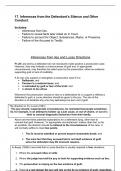
17. Inferences from the Defendant’s Silence and Other
Conduct.
Includes:
- Inferences from lies.
- Failure to reveal facts later relied on in Court.
- Failure to account for Object, Substances, Marks, or Presence.
- Failure of the Accused to Testify.
Inferences from lies and Lucas Directions
F1.25 Lies told by a defendant do not necessarily make positive a prosecution case.
However, they may indicate a consciousness of guilt and, in appropriate
circumstances, may therefore be relied upon by the prosecution, either as evidence
supporting guilt or lack of credibility.
A lie can only support or strengthen a prosecution case if it is:
Deliberate; and
Concern is a material issue; and
Is motivated by guilt or fear of the truth; and
Is shown to be untrue.
Whenever the prosecution choose to rely on a defendants lie, to support a reflects a
defendant’s guilt, a Lucas direction should be given to the jury. The aim of the
direction is to illustrate why a lie may not always be born out of guilt.
The direction in R v Lucas (1981).
The jury should, inappropriate circumstances, be reminded that people sometimes
lie, for example, in an attempt to bolster up a just cause, or out of shame, or out of a
wish to conceal disgraceful behaviour from their family.
Above are the three potential explanations for a defendant lying, other than to
conceal that guilt. However, “In appropriate circumstances” makes clear that, so far
as possible, the direction should be tailored to the circumstances of the case. It
will normally suffice to meet two points:
1. The lie must be admitted or proved beyond reasonable doubt; and
2. The mere fact that they accused lied is not itself evidence of guilt
since the defendant may life innocent reasons.
In Burge (1996) it was held that a Lucas direction is usually required in four situations:
1. Where the accused relies on alibi;
2. Where the judge has told the jury to look for supporting evidence such as lies;
3. The prosecution is relying on the lies evidence of guilt;
4. There is a real danger the jury will rely on the lie as evidence of guilt, regardless
, A Lucas direction is not necessary where it is otiose, either:
Where the rejection of the explanation provided by the accused leave the
jury with no choice but to convict; or
Where the accuses offer up an explanation for lies and the judge has
dealt with that in the summing up.
The Right to Silence
20.1 The right to silence, or privilege against self-incrimination, or afforded under
the general notions of Article 6 ECHR.
Conduct.
Includes:
- Inferences from lies.
- Failure to reveal facts later relied on in Court.
- Failure to account for Object, Substances, Marks, or Presence.
- Failure of the Accused to Testify.
Inferences from lies and Lucas Directions
F1.25 Lies told by a defendant do not necessarily make positive a prosecution case.
However, they may indicate a consciousness of guilt and, in appropriate
circumstances, may therefore be relied upon by the prosecution, either as evidence
supporting guilt or lack of credibility.
A lie can only support or strengthen a prosecution case if it is:
Deliberate; and
Concern is a material issue; and
Is motivated by guilt or fear of the truth; and
Is shown to be untrue.
Whenever the prosecution choose to rely on a defendants lie, to support a reflects a
defendant’s guilt, a Lucas direction should be given to the jury. The aim of the
direction is to illustrate why a lie may not always be born out of guilt.
The direction in R v Lucas (1981).
The jury should, inappropriate circumstances, be reminded that people sometimes
lie, for example, in an attempt to bolster up a just cause, or out of shame, or out of a
wish to conceal disgraceful behaviour from their family.
Above are the three potential explanations for a defendant lying, other than to
conceal that guilt. However, “In appropriate circumstances” makes clear that, so far
as possible, the direction should be tailored to the circumstances of the case. It
will normally suffice to meet two points:
1. The lie must be admitted or proved beyond reasonable doubt; and
2. The mere fact that they accused lied is not itself evidence of guilt
since the defendant may life innocent reasons.
In Burge (1996) it was held that a Lucas direction is usually required in four situations:
1. Where the accused relies on alibi;
2. Where the judge has told the jury to look for supporting evidence such as lies;
3. The prosecution is relying on the lies evidence of guilt;
4. There is a real danger the jury will rely on the lie as evidence of guilt, regardless
, A Lucas direction is not necessary where it is otiose, either:
Where the rejection of the explanation provided by the accused leave the
jury with no choice but to convict; or
Where the accuses offer up an explanation for lies and the judge has
dealt with that in the summing up.
The Right to Silence
20.1 The right to silence, or privilege against self-incrimination, or afforded under
the general notions of Article 6 ECHR.