Independent Africa - TANZANIA
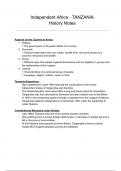
History Notes
Aspects on the Country to Know:
1. Political
= The government or the public affairs of a country.
2. Economic
= Choices made about who can create, benefit from, and have access to a
country's resources and wealth.
3. Social
= Different ways that people organize themselves and live together in groups and
the relationships which happen.
4. Cultural
= Characteristics of a particular group of people.
= Language, religion, clothes, music or food.
Tanzania Experience:
- Was established in April 1964 following the combination of the former
independent states of Tanganyika and Zanzibar.
- The United Republic came about after a long and harsh period of colonization.
- Tanganyika was first colonized by Germans and later handed over to the British
in 1920 in the trusteeship system through a mandate from the League of Nations.
- Tanganyika attained independence in December 1961 under the leadership of
Julius Nyerere.
Constitutional Monarchy under Britain:
- Late 1960s Tanzania was one of the world’s poorest countries.
- Was suffering from a severe foreign debt burden, a decrease in foreign aid and a
fall in the price of commodities.
- At first Nyerere had expected aid from Britain, Tanganyika’s former colonial
master BUT England pleaded poverty and withdrew.
, Independence:
- In 1962 Tanganyika declared their independence and became a republic.
= Nyerere became President.
- Nyerere
= Called teacher (Mwalimu).
= Remember for his personal integrity.
= Believed in Pan-Afrikanism and equity.
= Rejected tribalism and opposed neo-colonialism.
= Passed the Preventive Detention Act.
- Preventive Detention Act
= After the army attempted mutiny.
= Allowed a person to be put in detention if they act out to threaten the state.
= Was a negative thing.
- 1963 Nyerere abolished all other political parties. (TANU only party allowed)
- 1964 Tanzania and Zanzibar merged to form the United Republic of Tanzania.
- In 1967 Tanzania became a one party state.
= Members of the public could vote for parliamentary officials. (no official
opposition yet)
- Effects of a one party state
= Stability.
= No challenge of leadership and separate regional movement.
= Elections ensure accountability.
- Arusha Declaration
= Stated commitment to African Socialism and introduced leadership Code and
Ujaama. (positive thing)
= Attempted to avoid economic neo-colonialism.
Arusha Declaration:
- Was a success.
- 1967 TANTU created it in the northern town of Arusha.
- It outlined the Tanzanian government’s commitment to a socialist approach to
development.
= Reduced the income inequality.
= Shited development efforts towards rural areas through the collectivization of
agriculture, villagization and large-scale nationalization.
= Reformed the education system.
= Outline how resources can be used.
- It declared support for all African countries trying to gain independence.
= Support for Pan-Africanism
- Aimed at creating a self-reliant and self-sustaining society.
History Notes
Aspects on the Country to Know:
1. Political
= The government or the public affairs of a country.
2. Economic
= Choices made about who can create, benefit from, and have access to a
country's resources and wealth.
3. Social
= Different ways that people organize themselves and live together in groups and
the relationships which happen.
4. Cultural
= Characteristics of a particular group of people.
= Language, religion, clothes, music or food.
Tanzania Experience:
- Was established in April 1964 following the combination of the former
independent states of Tanganyika and Zanzibar.
- The United Republic came about after a long and harsh period of colonization.
- Tanganyika was first colonized by Germans and later handed over to the British
in 1920 in the trusteeship system through a mandate from the League of Nations.
- Tanganyika attained independence in December 1961 under the leadership of
Julius Nyerere.
Constitutional Monarchy under Britain:
- Late 1960s Tanzania was one of the world’s poorest countries.
- Was suffering from a severe foreign debt burden, a decrease in foreign aid and a
fall in the price of commodities.
- At first Nyerere had expected aid from Britain, Tanganyika’s former colonial
master BUT England pleaded poverty and withdrew.
, Independence:
- In 1962 Tanganyika declared their independence and became a republic.
= Nyerere became President.
- Nyerere
= Called teacher (Mwalimu).
= Remember for his personal integrity.
= Believed in Pan-Afrikanism and equity.
= Rejected tribalism and opposed neo-colonialism.
= Passed the Preventive Detention Act.
- Preventive Detention Act
= After the army attempted mutiny.
= Allowed a person to be put in detention if they act out to threaten the state.
= Was a negative thing.
- 1963 Nyerere abolished all other political parties. (TANU only party allowed)
- 1964 Tanzania and Zanzibar merged to form the United Republic of Tanzania.
- In 1967 Tanzania became a one party state.
= Members of the public could vote for parliamentary officials. (no official
opposition yet)
- Effects of a one party state
= Stability.
= No challenge of leadership and separate regional movement.
= Elections ensure accountability.
- Arusha Declaration
= Stated commitment to African Socialism and introduced leadership Code and
Ujaama. (positive thing)
= Attempted to avoid economic neo-colonialism.
Arusha Declaration:
- Was a success.
- 1967 TANTU created it in the northern town of Arusha.
- It outlined the Tanzanian government’s commitment to a socialist approach to
development.
= Reduced the income inequality.
= Shited development efforts towards rural areas through the collectivization of
agriculture, villagization and large-scale nationalization.
= Reformed the education system.
= Outline how resources can be used.
- It declared support for all African countries trying to gain independence.
= Support for Pan-Africanism
- Aimed at creating a self-reliant and self-sustaining society.