Equilibrium Constant, Kp
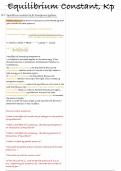
19.1 Equilibrium constant Kp for homogenous systems:
Partial pressure: the amount of pressure contributed by each
gas towards the total pressure.
Partial pressure = mole fraction x total pressure
Mole fraction of gas = number of moles of gas A in mix
Total number of moles of gas in mix
In reaction aA(g)+ bB(g) ——-> yY(g) + zZ(g)
Kp = (p^yY)(p^zZ)
(p^aA)(p^bB)
The effect of changing temperature-
Le Chatelier’s principle applies in the same way, if the
forward reaction is exothermic the backward reaction is
endothermic.
As temperature increases, the Equilibria favours the
endothermic reaction and so it moves to the left, takes in
heat energy so it decreases again.
If temperature decreases the Equilibria favours the
exothermic reaction moving to the right, this increasing
temperature again.
Increasing pressure, means the equilibrium will move to the
side that favours the production of the least moles / uses the
most moles of gas in order to decrease the pressure again.
Decreasing pressure, equilibrium moves to the side
producing more moles / using less moles of gas to increase
the pressure again.
If the number of moles of gas is the same for the forward /
backward reaction it has no effect.
Common exam questions:
“What is the effect of introducing a catalyst on the position
of equilibrium?”
“What is the effect of increasing / decreasing temperature
on the position of Equilibria?”
“What is the effect of increasing / decreasing pressure of
the position of equilibria?”
“What is meant by partial pressure?”
“Calculate the partial pressure of each substance if the total
pressure is…”
“Calculate Kp with the correct units”
“If the value of Kp is…and the partial pressure of X,Y,Z
are…respectively at a pressure of…calculate the number of
moles of gas…”
19.1 Equilibrium constant Kp for homogenous systems:
Partial pressure: the amount of pressure contributed by each
gas towards the total pressure.
Partial pressure = mole fraction x total pressure
Mole fraction of gas = number of moles of gas A in mix
Total number of moles of gas in mix
In reaction aA(g)+ bB(g) ——-> yY(g) + zZ(g)
Kp = (p^yY)(p^zZ)
(p^aA)(p^bB)
The effect of changing temperature-
Le Chatelier’s principle applies in the same way, if the
forward reaction is exothermic the backward reaction is
endothermic.
As temperature increases, the Equilibria favours the
endothermic reaction and so it moves to the left, takes in
heat energy so it decreases again.
If temperature decreases the Equilibria favours the
exothermic reaction moving to the right, this increasing
temperature again.
Increasing pressure, means the equilibrium will move to the
side that favours the production of the least moles / uses the
most moles of gas in order to decrease the pressure again.
Decreasing pressure, equilibrium moves to the side
producing more moles / using less moles of gas to increase
the pressure again.
If the number of moles of gas is the same for the forward /
backward reaction it has no effect.
Common exam questions:
“What is the effect of introducing a catalyst on the position
of equilibrium?”
“What is the effect of increasing / decreasing temperature
on the position of Equilibria?”
“What is the effect of increasing / decreasing pressure of
the position of equilibria?”
“What is meant by partial pressure?”
“Calculate the partial pressure of each substance if the total
pressure is…”
“Calculate Kp with the correct units”
“If the value of Kp is…and the partial pressure of X,Y,Z
are…respectively at a pressure of…calculate the number of
moles of gas…”