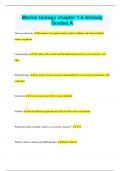
Marine biology chapter 1-4 Already Graded A
Marine biology chapter 1-4 Already Graded A Ocean productivity Production of organic matter by photosynthetic and chemosynthetic marine organisms Oceanography The study of the oceans and their phenomena such as waves,currents , and tides Marine biology The study of living organisms that inhabit the seas and their interactions with each other Dead zone Area of ocean water that is oxygen depleted Plankton All the different organisms that float or drift in the seas currents What percentage of earths surface is covered by seawater ? 71% Which scientist sailed on the HMS Beagle? Charles Darwin Modern oceanography and marine biology are attributed to what expedition ? Challenger Expedition Who was the chief scientist of the challenger expedition ? Charles Wyville Thompson Darwin produced a well respected monograph of what marine organism ? The Barnicle Which of these scientists conducted studies in the Antarctic Sea ? Sir Alistair Hardy What marine mammal did Hardy study ? The whale Abiotic factors Physical factors Biotic factors Biological factors Zones of stress Regions above or below the optimal range of an environmental variable Zones of intolerance Environmental variable is so far from the optimal range the organism cannot survive Intertidal zone Region of shore covered by high tide and exposed at low tide _________ is a measure of the concentration of salt in water . Is salt the solute or the solvent ?_______ Salinity ,solute What are the two major divisions of the ocean Pelagic division (water column ) , Benthic division (ocean bottom ) T/F Solutes are the liquid in which solid substances are dissolved False T/F the abyssal zone is one of the zones of the pelagic division False Midocean ridge Mountain range that forms along cracks on the ocean floor Fracture zones Linear region of unusually irregular ocean bottom that runs perpendicular to ocean ridges Subduction zones Region of the ocean floor where old crust sinks to the earths core and is recycled Theory of plate tectonics The movement of continental masses is the result of the movement of the rigid slabs ,or plates on which they rest Escarpments Continuous line of cliffs with sharp vertical drops formed by movement of lithospheric plates along faults A small body of water that is mostly cut off from an ocean by land formations is called : A gulf A body of water that is smaller than an ocean and is more or less landlocked is called : A sea The oceanic crust is primarily made up of : Basalt -type rock The name Pangaea was coined by : Alfred Wegener Sediments are classified on the basis of what two things ? Origin , particle size What is the depth of the Mariana Trench ? 1120 meters Manganese nodules are an example of _______ sediments Hydrogenous If sediment is composed of 30% or more biogenous sediments is called : Ooze Name the three types of plate boundaries and how they move Convergent (toward ) Divergent (away) Transform fault ( sliding past ) Coriolis effect The deflection of the path of winds and ocean currents that result from the rotation of the earth Gyre Circular flow pattern of water around the edge of an ocean basin Transverse currents Currents that connect Easter and western boundary currents with a gyre Ekman spiral The spiral flow of water that results from movement of water due to friction Isopycnal Having the same density at the top as well as the bottom Which is not a greenhouse gas ? Carbon dioxide Chlorofluorocarbons Methane Nitrogen Nitrogen The two main factors controlling the density of water are : Salinity and temperature Winds are named based on : The direction form which they are coming The _____ are located between 0 degrees and 30 degrees latitude Trade winds Winds found between 30 degrees and 60 degrees latitude Westerlies Winds found between 60 degrees latitude and the poles Easterlies The area of calm ,rising air at the equator Doldrums The volume of water transported in an ocean current is measured in : Sverdrups TF western boundary currents are slow moving False TF eastern boundary currents are rich in nutrients True TF western boundary currents move warm water away from the equator towards the poles True TF cold water is more dense than warm water True TF the temperature and salinity of water below 1000 meters is unstable False
Escuela, estudio y materia
- Institución
- Marine biology
- Grado
- Marine biology
Información del documento
- Subido en
- 27 de octubre de 2023
- Número de páginas
- 8
- Escrito en
- 2023/2024
- Tipo
- Examen
- Contiene
- Preguntas y respuestas
Temas
-
marine biology chapter 1 4 already graded a

Documento también disponible en un lote