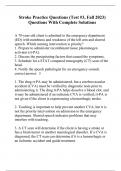
Stroke Practice Questions (Test #3, Fall 2023) Questions With Complete Solutions
A 78-year-old client is admitted to the emergency department (ED) with numbness and weakness of the left arm and slurred speech. Which nursing intervention is priority? 1. Prepare to administer recombinant tissue plasminogen activator (rt-PA). 2. Discuss the precipitating factors that caused the symptoms. 3. Schedule for a STAT computed tomography (CT) scan of the head. 4. Notify the speech pathologist for an emergency consult. correct answer: 3 1. The drug rt-PA may be administered, but a cerebrovascular accident (CVA) must be verified by diagnostic tests prior to administering it. The drug rt-PA helps dissolve a blood clot, and it may be administered if an ischemic CVA is verified; rt-PA is not given if the client is experiencing a hemorrhagic stroke. 2. Teaching is important to help prevent another CVA, but it is not the priority intervention on admission to the emergency department. Slurred speech indicates problems that may interfere with teaching. 3. A CT scan will determine if the client is having a stroke or has a brain tumor or another neurological disorder. If a CVA is diagnosed, the CT scan can determine if it is a hemorrhagic or an ischemic accident and guide treatment. 4. The client may be referred for speech deficits and/or swallowing difficulty, but referrals are not the priority in the emergency department. TEST TAKING HINT: When "priority" is used in the stem, all answer options may be appropriate for the client situation, but only one option is the priority. The client must have a documented diagnosis before treatment is started The nurse is assessing a client experiencing motor loss as a result of a left-sided cerebrovascular accident (CVA). Which clinical manifestation would the nurse document? 1. Hemiparesis of the client's left arm and apraxia. 2. Paralysis of the right side of the body and ataxia. 3. Homonymous hemianopsia and diplopia. 4. Impulsive behavior and hostility toward family correct answer: 2 1. A left-sided cerebrovascular accident (CVA) will result in right-sided motor deficits; hemiparesis is weakness of one-half of the body, not just the upper extremity. Apraxia, the inability to perform a previously learned task, is a communication loss, not a motor loss. 2. The most common motor dysfunction of a CVA is paralysis of one side of the body, hemiplegia; in this case with a left-sided CVA, the paralysis would affect the right side. At
Información del documento
- Subido en
- 26 de octubre de 2023
- Número de páginas
- 26
- Escrito en
- 2023/2024
- Tipo
- Examen
- Contiene
- Preguntas y respuestas