Summary cell growth & differentiation
– Translational: developmental
disorders and malignancies
1
,Chapter 1 Blood cell disorders
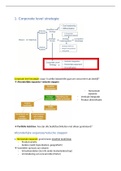
Hematopoiesis is the development of blood cells takes place in the bone marrow
Hematopoietic stem cells (HSCs) are present in the bone marrow give rise to all blood cells differentiate in
the BM into progenitor cells
Differentiation is steered by growth factors extrinsic
In combination with transcription factors stem cell intrinsic
o Intrinsic factors might change over time might be the reason why children in average
develop lymphoid leukaemia more often than myeloid leukaemia than elderly
Progenitor cells referred to as ‘blasts’ remain within the BM and only enter the periphery when
fully differentiated
o Lymphoid
o Myeloid
HSCs have the capacity to self-renew very slow division so more Quiescent
Multi-hit model: mutations passed on to daughter cells
With each SC division the number of mutations increases
Commonly used marker for blasts and HSCs is CD34
Differentiation is tightly regulated mutations can cause disbalance
Many genes involved
Driver mutations: almost all of these are in signalling regulation
Leukaemia vs myelodysplastic syndrome
A quite severe and common developmental disorder in hematopoiesis is leukemia:
Leukemia is the accumulation of immature cells in the BM blasts do not leave the BM
Upregulated proliferation growth factor independent
Decreased apoptosis
And a block in differentiation leads to accumulation of blasts
Acute when >20% of cells in the BM are blasts
Myelodysplastic syndrome: we speak of myelodysplastic syndrome when the blood cells have an abnormal shape
but they do differentiate
Indolent MDS: So unlike in leukaemia cells differentiate
Aggressive MDS: And with aggressive MDS the cells look dysplastic on top of their blocked differentiation
Thus can develop into leukaemia at a later stage we speak of this when differentiation gets
blocked and blasts start accumulating
Affected lineage differs per patient hence symptoms differ per patient
Both leukaemia (AML) and myelodysplastic syndrome (MDS) have a higher incidence amongst the elderly which
largely impacts treatment and prognosis.
2
, Development of leukaemia
Mutations are acquired due to carcinogenic agents, and naturally during cell division all mutations in HSCs are
passed on to daughter cells
Development of leukaemia is a multi-hit process multiple driver mutations required to acquire the cancer
hallmarks
These mutations are in genes that regulate the balance between proliferation and apoptosis give
the cell a growth advantage
o Positive selection leads to mutation co-occurrence
Causes clonal expansion
CHIPs might increase the risk for leukaemia because they can be malignant in combination with
other mutations
Full blown leukaemia is a combination of mutations in 2-3 genes from different categories:
I: growth factor receptors
II: signal transduction molecules
III: gene expression regulation
o TFs
o Epigenetic regulators
o RNA splicing factors
o Chromatin organisation
IV: apoptosis
Enzymes involved in DNA (de)methylation are often mutated in AML hypermethylation of promoters for tumour-
suppressor genes or demethylation of proto-oncogenes
DNMT(3a): copy methylation profile after division hyperactivity
Hypomethylating agents: Azacitidine and decitabine are cytosine analogues incorporated at C-
sites but cannot be methylated
TET(2) proteins: operate in active demethylation need α-ketogluterate as a substrate
IDH1/2: convert α-KG into α-HG
Inhibitors of IDH1/2 increase α-KG levels
3
– Translational: developmental
disorders and malignancies
1
,Chapter 1 Blood cell disorders
Hematopoiesis is the development of blood cells takes place in the bone marrow
Hematopoietic stem cells (HSCs) are present in the bone marrow give rise to all blood cells differentiate in
the BM into progenitor cells
Differentiation is steered by growth factors extrinsic
In combination with transcription factors stem cell intrinsic
o Intrinsic factors might change over time might be the reason why children in average
develop lymphoid leukaemia more often than myeloid leukaemia than elderly
Progenitor cells referred to as ‘blasts’ remain within the BM and only enter the periphery when
fully differentiated
o Lymphoid
o Myeloid
HSCs have the capacity to self-renew very slow division so more Quiescent
Multi-hit model: mutations passed on to daughter cells
With each SC division the number of mutations increases
Commonly used marker for blasts and HSCs is CD34
Differentiation is tightly regulated mutations can cause disbalance
Many genes involved
Driver mutations: almost all of these are in signalling regulation
Leukaemia vs myelodysplastic syndrome
A quite severe and common developmental disorder in hematopoiesis is leukemia:
Leukemia is the accumulation of immature cells in the BM blasts do not leave the BM
Upregulated proliferation growth factor independent
Decreased apoptosis
And a block in differentiation leads to accumulation of blasts
Acute when >20% of cells in the BM are blasts
Myelodysplastic syndrome: we speak of myelodysplastic syndrome when the blood cells have an abnormal shape
but they do differentiate
Indolent MDS: So unlike in leukaemia cells differentiate
Aggressive MDS: And with aggressive MDS the cells look dysplastic on top of their blocked differentiation
Thus can develop into leukaemia at a later stage we speak of this when differentiation gets
blocked and blasts start accumulating
Affected lineage differs per patient hence symptoms differ per patient
Both leukaemia (AML) and myelodysplastic syndrome (MDS) have a higher incidence amongst the elderly which
largely impacts treatment and prognosis.
2
, Development of leukaemia
Mutations are acquired due to carcinogenic agents, and naturally during cell division all mutations in HSCs are
passed on to daughter cells
Development of leukaemia is a multi-hit process multiple driver mutations required to acquire the cancer
hallmarks
These mutations are in genes that regulate the balance between proliferation and apoptosis give
the cell a growth advantage
o Positive selection leads to mutation co-occurrence
Causes clonal expansion
CHIPs might increase the risk for leukaemia because they can be malignant in combination with
other mutations
Full blown leukaemia is a combination of mutations in 2-3 genes from different categories:
I: growth factor receptors
II: signal transduction molecules
III: gene expression regulation
o TFs
o Epigenetic regulators
o RNA splicing factors
o Chromatin organisation
IV: apoptosis
Enzymes involved in DNA (de)methylation are often mutated in AML hypermethylation of promoters for tumour-
suppressor genes or demethylation of proto-oncogenes
DNMT(3a): copy methylation profile after division hyperactivity
Hypomethylating agents: Azacitidine and decitabine are cytosine analogues incorporated at C-
sites but cannot be methylated
TET(2) proteins: operate in active demethylation need α-ketogluterate as a substrate
IDH1/2: convert α-KG into α-HG
Inhibitors of IDH1/2 increase α-KG levels
3