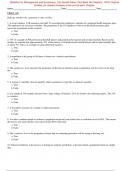
NR-507 Study Guide and Practice Questions
NR-507 Study Guide and Practice Questions 1. Types of immunity ch 7 & 8 a. Innate- natural epithelial barrier and inflammation the make innate resistance and protection pg. 191 Innate immunity includes two lines of defense: Natural barriers and inflammation. i. Natural barriers- physical, mechanical, and biochemical barriers at the body’s surfaces ii. Inflamation- associated with infection usually initiates an adaptive process that results in a long-term and very effective immunity to the infecting microorganism, referred to a adaptive, acquired or specific immunity. Use of the Epithelial cells with no memory function involved. b. Adaptive/ acquired- immune response or immunity, after innate and inflammation, Third line of defense, initiated when innate immune system signals the cells of adaptive immunity. There is a delay between primary exposure to antigen and maximum response, however there is immediate action against secondary exposure. Response is specific toward antigen. Involves T lymphocytes, B Lymphocytes, macrophages, and dentric cells. Specific immunologic memory by T and B lymphocytes i. Active (Acquired) -after natural exposure to an antigen or after immunization pg. 227 ii. Passive (Acquired)- preformed antibodies or t lymphocytes are transferred rom a donor to the recipient, maternal to fetus, or bone marrow transplant pg. 227 Questions What type of immunity is produced when an immunoglobulin crosses the placenta? ▪ Passive-aquired immunity The mucosal secretions of the cervix secrete which immunoglobulin? ▪ IgA A student nurse asks the clinician which cells are most primary in a patient's immunity. What is the clinician's best answer? • Lymphocytes. A nurse recalls humoral immunity is generated through the process of: • producing antibodies. While taking a health history, if a person has resistance to a disease from natural exposure to an antigen, how would the nurse document this form of immunity? • Active acquired What type of immunity will the nurse expect in an individual who is given a vaccine? • Active acquired immunity A new mother asks the nurse about immunity of her newborn as she is breastfeeding. The nurse's response should include a discussion on which type of immunity? • Passive The nurse has been explaining to a student nurse about the different types of immunity. Which response indicates that the student nurse has a good understanding of adaptive immunity? • Both the humoral and cell-mediated immunity develop memory cells Cancer cells and virus-infected body cells can be killed before activation of adaptive immunity by • natural killer cells The primary immune response . • has a lag period while B cells proliferate and differentiate into plasma cells Which of the following is true about the number of binding sites per functional antibody unit? • IgM contains 10 binding sites. Which cell of the immune system is absolutely required for an adaptive immune response? • Helper T cell The adaptive immune system involves three major cell types: antigen-presenting cells, T cells, which constitute cell- mediated immunity, and B cells, which govern humoral immunity. The nurse understands that the function of IgG is as what? • A bond with target cells and a promoter of phagocytosis The nurse understands that which type of immunity is the longest acting? • Natural active Natural killer cells are specialized lymphocytes that are one of the major parts of which immunity? • Innate 2. Alveolar ventilation/perfusion- pg. 1239 Ch 34 Effective gas exchange depends on an approximately even distribution of gas (ventilation) and blood (perfusion) in all portion s of the lungs. The lungs are suspended from the hila in the thoracic cavity. When the individual is in an upright position, gravity pulls the lungs down toward the diaphragm and compresses their lower portions or bases. a. Ratio between the amount of air getting into the alveoli and the amount of blood being sent to the lungs. Questions A consequence of alveolar hypoxia is: Pulmonary artery vasoconstriction The pressure required to inflate an alveolus is inversely related to: Alveolus radius The nurse is describing the movement of blood into and out of the capillary beds of the lungs to the body organs and tissues. What term should the nurse use to describe this process? Perfusion A pulmonologist is discussing the base of the lungs with staff. Which information should be included? At the base of the lungs: Arterial perfusion pressure exceeds alveolar gas pressure When the pulmonologist discusses the condition in which a series of alveoli in the left lower lo be receive adequate ventilation but do not have adequate perfusion, which statement indicates the nurse understands this condition? When this occurs in a patient it is called: Alveolar dead space Which of the following conditions should the nurse monitor for in a patient with hypoventilation? hypercapnia A nurse is describing the pathophysiology of emphysema. Which information should the nurse include? Emphysema results in: the destruction of alveolar septa and air trapping
Escuela, estudio y materia
- Institución
- NR 507
- Grado
- NR 507
Información del documento
- Subido en
- 17 de octubre de 2023
- Número de páginas
- 59
- Escrito en
- 2023/2024
- Tipo
- Examen
- Contiene
- Preguntas y respuestas
Temas
-
nr 507 study guide and practice questions