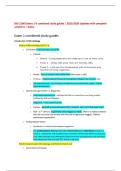
NUR 2063 Final Exam Study Guide
NUR 2063 Final Exam Study Guide Module 1: STRESS – WHAT IS IT?, PURPOSE OF, WHAT DETERMINES RESPONSE? WHAT IS IT? – physical, chemical or emotional factor that results in tension of body or mind, real or perceived threat to homeostasis, can be positive or negative PURPOSE – WHAT DETERMINES RESPONSE – SELYE GAP SYNDROME STAGES, BODY’S RESPONSES TO STAGES – ALARM, RESISTANCE, EXHAUSTION: ALARM – the stressor upsets homeostasis or cellular balance; releases epi and norepi, and cortisol; Body has decreased resistance to stressors RESISTANCE – Body fights back by adjusting to the stress; body trying to return to homeostasis; Glucose, free fatty acids and amino acids elevated for energy, growth and repair EXHAUSTION – Rest permits enhanced adaptation; No rest = overtraining, injury, lack of adaptation; point where body can no longer reach homeostasis; Allostatic overload – “cost” of body’s organs and tissues for an excessive or ineffectively regulated allostatic response STRESS IN CHILDREN: PHYSIOLOGICAL – Immune system, stunt in growth, high blood pressure MEDIATORS OF STRESS, E.G. NOREPINEPHRINE, EPINEPHRINE, CORTISOL – WHAT DO THEY DO? Norepinephrine (Catecholamines) – released during alarm stage; constricts blood vessels and raises blood pressure; reduces gastric secretions and increases night and far vision Epinephrine (Catecholamines) – released during the alarm stage; enhances myocardial contractibility, increases heart rate, and increases cardiac output; causes bronchodilation; increases the release of glucose from the liver(glycogenolysis) and elevates blood glucose levels Cortisol (Glucocorticoid) – released during alarm stage; primary glucocorticoid; may be synergistic or antagonistic to catecholamines; suppresses the immune system, decreases serotonin, increases blood sugar, increases blood pressure, decreases sensitivity to pain, and heightens memory and attention ALDOSTERONE (mineralocorticoid)– essential for sodium conservation in the kidneys, salivary glands, sweat glands, and colon LONG TERM GLUCOCORTICOID EFFECTS ON BODY: osteoporosis, inability to fight infection (comp host), can weaken muscle/atrophy of skeletal muscle ENDORPHINS AND ENKEPHALINS: ENDORPHINS- are an endogenous opioid peptide derived from cells in the hypothalamus, have analgesic properties ENKEPHALINS – One of two types of pain-suppressing pentapeptides; they are produced in the body and are located in the pituitary gland, brain, and GI tract Module 2 PHAGOCYTOSIS: WHAT IS IT? – When leukocytes attack the bad cells and “eat” them STEPS IN CARCINOGENESIS, INITIATION, PROMOTION, PROGRESSION: INITIATION – Initiating events in chromosomes (such as aberrations) or in DNA; initiators are radiation, chemical carcinogens, UV etc. PROMOTION – low doses of tumor initiators are necessary to convert the initiated cells to cancer cells; EX: TPA, phorbol esters, estrogen and excessive fat PROGRESSION – Increased genetic instability resulting in aggressive growth phenotype GENERAL CHARACTERISTICS OF BENIGN VS MALIGNANT TUMORS: BENIGN – Does not immediately kill host, does not invade or spread to distant sites, causes less damage to host tissue, many are encapsulated, closely resembles original tissue, grows more slowly, little vascularity MALIGNANT – can kill host if left untreated, invades local tissue and overruns neighboring cells, can migrate to distant areas (metastasis), does not closely resemble tissue of origin (anaplasia), greater degree of anaplasia indicates aggressive malignancy, grows rapidly, may initiate tumor vessel growth, frequently necrotic, dysfunctional WHAT ARE SIGNS OF INFLAMMATION? Redness, swelling(edema), heat, pain, and loss of function CAUSES OF INFLAMMATION? Infection, build-up of pressure, and injury WHAT CAUSES EDEMA? Staying in one position too long, crushing injury, and fluid that is trapped in the body. WHAT DO TREATMENTS DO TO REDUCE INFLAMMATION, E.G. GLUCOCORTICOIDS, ICE: Ice soothes inflammation by reducing blood in the area and stops spasms causing pain, while glucocorticoids reduce the activity of the immune system and cause the inflammatory cells to not come to the site of inflammation. ACTIVE VS. PASSIVE IMMUNITY: Active: results from the production of antibodies in response to the presence of an antigen. EX. Allergic reaction Passive: Introduction of antibodies from another person or animal. EX. The placenta LYMPH NODE LOCATIONS: Axillary regions, inguinal/groin, and neck. IMMUNOGLOBULIN: WHAT IS IT? - Module 3 MYASTHENIA CRISIS: weakening muscle functioning results in respiratory failure KELOID – Overgrowth of scar tissue HERPES ZOSTER (SHINGLES) – Acute inflammatory disease of a dermatomal segment of the skin; believed to be reactivated by latent varicella zoster virus from previous chicken pox; Unilateral, painful, can result in postherpetic neuralgia Vesicles on erythematous base of single or associated group of dorsal root ganglia; ATOPIC DERMATITIS – complex genetic disease resulting from gene-gene and gene- environment interaction; highest incidence in children most of which are less than 5yrs old; pruritis always present; usually on face, scalp or exterior surfaces of extremities; SIGNS – erythema, papules, lichenification (skin condition that is caused by excessive itching or rubbing which results in thick leathery patches of skin) COMPARTMENT SYNDROME – complication of soft tissue injury; results from swelling and bleeding within a restricted area; can be either acute, chronic or crush; pale and shiny due to lack of blood flow; swelling crushes nerves which causes excruciating pain; Treatment is emergent decompression which is where they cut through tissue to relieve pressure 5 P’s – pain out of proportion, paralysis, paresthesia, pallor, and pulselessness RHEUMATOID ARTHRITIS – systemic, autoimmune, inflammatory; women are 2-3x more likely than men with the peak age being 40-50; it affects the hands, wrists, knees and feet more; if it is in the spine it usually affects the upper cervical area; symptoms are malaise, fatigue, diffuse musculoskeletal pain; bilaterally symmetric
Escuela, estudio y materia
- Institución
- NUR 2063
- Grado
- NUR 2063
Información del documento
- Subido en
- 17 de octubre de 2023
- Número de páginas
- 21
- Escrito en
- 2023/2024
- Tipo
- Examen
- Contiene
- Preguntas y respuestas
Temas
-
nur 2063 final exam study guide