Nutrition Science Final Exam questions and answers 100% guaranteed success.
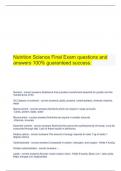
Nutrition Science Final Exam questions and answers 100% guaranteed success. Nutrient - correct answers.Substance that provides nourishment essential for growth and the maintenance of life Six Classes of nutrients - correct answers.Lipids, proteins, carbohydrates, minerals vitamins, water Macronutrient - correct answers.Nutrients which we require in large amounts -Carbs, protein, lipids, water Micronutrient - correct answers.Nutrients we require in smaller amounts -Vitamins, minerals Essential nutrient - correct answers.Nutrients that cannot be synthesized by the body, must be consumed through diet. Lack of these results in deficiency Dietary calorie - correct answers.The amount of energy required to raise 1 kg of water 1 degree celcius Carbohydrates - correct answers.Composed of carbon, hydrogen, and oxygen. Yeilds 4 kcal/g. Simple carbohydrates - correct answers.... Lipids - correct answers.Structer: hydro-carbon chain. Yeilds 9 kcal/g. Basic unit = fatty acids. Major storage unit: triglycerides Proteins - correct answers.Composed of carbon, hydrogen, oxygen and nitrogen. Yeilds 4 kcal/g. Basic unit: amino acid VitaminsFat soluble vitamins - correct answers.Vitamins D,E,A and K. Easily stored in the body (greater toxicity risk) Water soluble vitamins - correct answers.Vitamins C and B complex. Easily excreted and easily destroyed during cooking process Major minerals - correct answers.Minerals required in gram amounts. Ex. sodium, potassium, calcium Trace minerals - correct answers.Minerals we require 100 mg/d of. Ex. iron, zinc, copper, selenium Phytochemicals - correct answers.Physiologically active compounds that benefit the body but are not essential; specifically from plants. Ex. lycopene, flavinoids Zoochemicals - correct answers.Physiologically active compounds that benefit the body but are not essential; specifically from animals. Ex. leutin & zeaxanthin in eggs Alcohol - correct answers.Yields 7 kcal/g Fortification - correct answers.When nutrients are added to a food where there were previously not present Enrichment - correct answers.Reintroducing nutrients into a food that have been lost during processing Scientific method - correct answers.Observe, hypothesize, experient, analyze and conclude "Double-blind" study - correct answers.Study where neither the patients nor the doctors running the trial know who has the placebo Correlation - correct answers.An association between the change in two variables Key dietary recommendations (USDA) - correct answers.-Eat a variety of nutrient-dense foods -Limit trans fats, choleterol and added sugar/salt -Balance out calories in and out -Make gradual weight changes -Maximum weight loss should be 10 % of total body weight Daily Reference Intakes (DRI) - correct answers.Values used to plan and asses healthy consumption of nutrients Estimated Average Requirement (EAR) - correct answers.Satisfies the needs of 50% of the people in that age group Recommended Dietary Allowances (RDA) - correct answers.Dietary intake level of a nutrient considered to meet the requirements of 97.5 % of healthy Americans Adequete Intake Levels (AI) - correct answers.When the RDA hasn't been established, but the amount established is considered to be adequate. Tolerable upper intake levels (UL) - correct answers.To caution against exessive intake of nutrients (like vitamin A) that can be harmful Acceptable Macronutrient Distribution Ranges (AMDR) - correct answers.Describes the portion of energy that should come from each macronutrient AMDR for carbohydrates - correct answers.45-65% AMDR for protein - correct answers.10-35% AMDR for lipids - correct answers.20-35% (10% from saturated, 7% if at risk for heart disease) Important characteristics of myplate - correct answers.Less specific than Harvard plate- doesn't differentiate between different types of the macronutrients Digestion - correct answers.Chemical and physical breakdown of food into compounds usable by the body Absorbtion - correct answers.Taking up of compounds by the body, either through the stomach lining or intestinal walls Order of structures in the GI tracts - correct answers.Mouth, pharynx, epiglottis, esophagus, lower esophageal sphincter, stomach, pyloric sphincter, bile duct, sphincter of Oddi, duodenum, small intestine, large intestine, appendix, rectum, anal sphincter, anus Pancreas - correct answers.Makes digestive enzymes that help digest food Galbladder - correct answers.Storage and transportation of bile and digestive enzymes Liver - correct answers.Produces bile, which digests fats for better absorbtion Saliva - correct answers.Produced in the mouth, begins the digestion of starches and fats Lysozyme - correct answers.Enzyme that destroys certain bacteria fou d in saliva Mucus - correct answers.Produced in the stomach to protect from stomach acid Pepsin - correct answers.Enzyme used to partially hydrogenize protein. Reseased as inactive pepsinogen HCL - correct answers.Breaks down large globs of protein Chloecystokinin - correct answers.Hormone that controls the quantity of pancreatic juice and bile in the small intestine Secretin - correct answers.Hormone that controls the environment in the duodenum by reguating secretions of the stomach and pancreas; also regulates water homeostasis Nutrients absorbed by the stomach - correct answers.Alcohol, water Nutrients absorbed by the small intestine - correct answers.Minerals, glucose, amino acids, fats, vitamins, water (70-90%), alcohol (80%)
Geschreven voor
- Instelling
- Nutrition Science
- Vak
- Nutrition Science
Documentinformatie
- Geüpload op
- 13 oktober 2023
- Aantal pagina's
- 11
- Geschreven in
- 2023/2024
- Type
- Tentamen (uitwerkingen)
- Bevat
- Vragen en antwoorden
Onderwerpen
-
nutrition science final exam questions

Ook beschikbaar in voordeelbundel