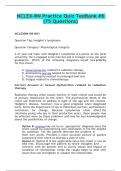
NCLEX-RN Practice Quiz Test Bank #8 (75 Questions)
NCLEX-RN Practice Quiz Test Bank #8 (75 Questions) 1. 1. Question A 21-year-old male with Hodgkin’s lymphoma is a senior at the local university. He is engaged to be married and is to begin a new job upon graduation. Which of the following diagnoses would be a priority for this client? o A. Sexual dysfunction related to radiation therapy o B. Anticipatory grieving related to terminal illness o C. Tissue integrity related to prolonged bed rest o D. Fatigue related to chemotherapy Incorrect Correct Answer: A. Sexual dysfunction related to radiation therapy Radiation therapy often causes sterility in male clients and would be of primary importance to this client. The psychosocial needs of the client are important to address in light of the age and life choices. Hodgkin’s disease, however, has a good prognosis when diagnosed early. Know the importance of sex to individual, partner, and patient’s motivation for change. Because lymphomas often affect the relatively young who are in their productive years, these people may be affected more by these problems and may be less knowledgeable about the possibilities of change. • Option B: Grieving may not be an appropriate diagnosis since the client would be experiencing new milestones in his life despite his condition. Let the patient describe the problem in own words. Provides a more accurate picture of patient experience with which to develop a plan of care. • Option C: Option B is not applicable since the client is not on bed rest. Encourage the patient to share thoughts and concerns with his partner and to clarify values and impact of condition on relationship. Helps the couple begin to deal with issues that can strengthen or weaken the relationship. • Option D: Fatigue may occur during chemotherapy, but it is not the priority diagnosis. Identify pre-existing and current stress factors that may be affecting the relationship. The patient may be concerned about other issues, such as job, financial, and illness-related problems. 2. 2. Question A client has autoimmune thrombocytopenic purpura. To determine the client’s response to treatment, the nurse would monitor: • A. Platelet count • B. White blood cell count • C. Potassium levels • D. Partial prothrombin time (PTT) Incorrect Correct Answer: A. Platelet count Clients with autoimmune thrombocytopenic purpura (ATP) have low platelet counts, making answer A the correct answer. The laboratory tests will show low platelet count, usually 40×10^9/L for over three months. Blood film shows large platelets and tiny platelet fragments. Bone marrow examination shows an increased number of megakaryocytes. • Option B: Often associated with the CBC is a differential, which refers to the relative amounts of white blood cell types (i.e., neutrophil, lymphocyte, eosinophil, etc.) as a percentage of the total number of WBCs. Of note, if a subtype of white blood cells seems to be elevated based on the differential, the actual value of the type of white blood cells should be calculated by multiplying the percentage listed on the differential by the total number of white blood cells. • Option C: Potassium disorders are related to cardiac arrhythmias. Hypokalemia occurs when serum potassium levels under 3.6 mmol/L—weakness, fatigue, and muscle twitching present in hypokalemia. Hyperkalemia occurs when the serum potassium levels above 5.5 mmol/L, which can result in arrhythmias. Muscle cramps, muscle weakness, rhabdomyolysis, myoglobinuria are presenting signs and symptoms in hyperkalemia. • Option D: Patients with a propensity for bleeding should undergo testing to determine the presence of a clotting disorder. For patients with deficiencies or defects of the intrinsic clotting cascade, the PTT will be elevated. Normal PTT values can vary between laboratories but 25 to 35 seconds is considered normal. 3. 3. Question The home health nurse is visiting a client with autoimmune thrombocytopenic purpura (ATP). The client’s platelet count currently is 80, it will be most important to teach the client and family about: • A. Bleeding precautions • B. Prevention of falls • C. Oxygen therapy • D. Conservation of energy Incorrect Correct Answer: A. Bleeding precautions The normal platelet count is 120,000–400, Bleeding occurs in clients with low platelets. The priority is to prevent and minimize bleeding. Review laboratory results for coagulation status as appropriate: platelet count, prothrombin time/international normalized ratio (PT/INR), activated partial thromboplastin time (aPTT), fibrinogen, bleeding time, fibrin degradation products, vitamin K, activated coagulation time (ACT); and educate the at-risk patient and caregivers about precautionary measures to prevent tissue trauma or disruption of the normal clotting mechanisms. • Option B: Thoroughly conform patient to surroundings; put call light within reach and teach how to call for assistance; respond to call light immediately; avoid use of restraints; obtain a physician’s order if restraints are needed; and eliminate or drop all possible hazards in the room such as razors, medications, and matches. • Option C: Option C is important, but platelets do not carry oxygen. Wash hands and teach patient and SO to wash hands before contact with patients and between procedures with the patient; encourage fluid intake of 2,000 to 3,000 mL of water per day, unless contraindicated. • Option D: Option D is of lesser priority and is incorrect in this instance. Recommend the use of soft-bristled toothbrushes and stool softeners to protect mucous membranes; and if infection occurs, teach the patient to take antibiotics as prescribed; instruct the patient to take the full course of antibiotics even if symptoms improve or disappear. 4. 4. Question A client with a pituitary tumor has had transsphenoidal hypophysectomy. Which of the following interventions would be appropriate for this client? • A. Place the client in Trendelenburg position for postural drainage • B. Encourage coughing and deep breathing every 2 hours • C. Elevate the head of the bed 30° • D. Encourage the Valsalva maneuver for bowel movements Incorrect Correct Answer: C. Elevate the head of the bed 30° Elevating the head of the bed 30° avoids pressure on the sella turcica and alleviates headaches. A, B, and D are incorrect. In the immediate postoperative period, patients are monitored in an intensive care unit with monitoring for neurological deterioration, epistaxis, visual dysfunction, diabetes insipidus (DI), and hypotension secondary to acute hypocortisolism. • Option A: Placing the patient in Trendelenburg will increase the intracranial pressure. The most common complications are CSF leak, sinusitis, and meningitis. CSF leaks, occurring in 6 in every 100 cases, is usually prevented by a multilayer closure at the end of surgery. In the occurrence of a leak in the postoperative period, the patient is advised bed rest, and a lumbar drain is placed. If the leak does not improve in 24 hours, exploration and closure of the defect are to be done. • Option B: Coughing and deep breathing causes increase in intracranial pressure. Worsening of vision as a result of bleeding or manipulation and arterial hemorrhage are other immediate complications. A detailed study of preoperative imaging is essential to avoid catastrophes like optic nerve and carotid artery injury. • Option D: Valsalva maneuver increases the intracranial pressure. The first follow up visit is 1 week after the procedure, where postoperative day 7 serum sodium levels are reviewed to rule out occult hyponatremia. Serial nasal endoscopies are done for debridement and to assess healing. The frequency of follow-up visits is determined by nasal crusting and maintenance of nasal hygiene with irrigation. Routine early postoperative imaging is not done in most patients. 5. 5. Question The client with a history of diabetes insipidus is admitted with polyuria, polydipsia, and mental confusion. The priority intervention for this client is: • A. Measure the urinary output • B. Check the vital signs • C. Encourage increased fluid intake • D. Weigh the client Incorrect Correct Answer: B. Check the vital signs A large amount of fluid loss can cause fluid and electrolyte imbalance that should be corrected. The loss of electrolytes would be reflected in the vital signs. Monitor for signs of hypovolemic sh
Escuela, estudio y materia
- Institución
-
Chamberlain College Of Nursing
- Grado
-
NCLEX
Información del documento
- Subido en
- 12 de octubre de 2023
- Número de páginas
- 77
- Escrito en
- 2023/2024
- Tipo
- Examen
- Contiene
- Preguntas y respuestas
Temas
- nclex rn practice quiz
- nclex rn
-
nclex rn practice quiz test bank 8
-
nclex rn practice quiz test bank

Documento también disponible en un lote