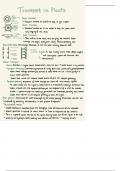
Epidermis
Cortex
Pavenchyma fissue Stem transect :
Phloem
⑧
0 xylem
e ↳ Vascular bundles around
Root hair
are the edge to
give support
I
-
Root transect
&
:
Exodermis
Epidermis
S ↳ Vascular bundles in the middle to help
are the
plant resist
-
any tugging of the
I stem
Palisade
xylem
mesophyll
Leaf transect :
- Phloem
↳ The midrib
of
tissue
midrib leas
is the main vein the vascular
carrying
the
through organ along
the with
many smaller,
branching vein .
Plasmodesmata Microscopic Channels in the cal :
wall
linking adjacent caus
ensignified
I isn
wan
xylem A non
living tissue that offers support
:
.
and
transports water and mineral ions
transpiration
Water Transport :
Roots Maintain higher solute concentration than the soil ->
water moves in
by osmosis
·
:
a
Symplast Pathway Continuous cytoplasm of living connected by plasmodesmata
·
plant cens
:
Water osmosis as water leaves the cen in front
moves
through constantly by giving it
·
,
a
lower water potential
Water then enters the vascular bundle bundle and joins the
apoplast
pathway
· of water and intercellular spaces
Apoplast pathway Movement
through cell walls
:
As water
xylem cohesive force is established creating a flow
·
moves into the a ,
continuous .
Water is forced into the
symplast pathway at the
Casparian strip to enter the vascular
bundle passes through the
selectively permeable cen membrane,
removing toxic solutes
Water then returns to the apoplast
pathway to
·
enter the
xylem
Root of of minerals
pressure Movement water
encouraged by the active
pumping into the root
:
↳ Evidenced
by inhibiting Mitochondria s root
pressure disappears
Transpiration Stream :
"Water molecules evaporate from the
mesophyll ceus and more out of the stomata
2 .
Water potential is lowered adjacent sen by osmosis
so water moves in from an
3
This is repeated across the leaf to the xylem
moving water out of the xylem to the leaf
.
,
4 .
Water forms hydrogen bonds creating both adhesion and cohesion Capillary action
-
Cortex
Pavenchyma fissue Stem transect :
Phloem
⑧
0 xylem
e ↳ Vascular bundles around
Root hair
are the edge to
give support
I
-
Root transect
&
:
Exodermis
Epidermis
S ↳ Vascular bundles in the middle to help
are the
plant resist
-
any tugging of the
I stem
Palisade
xylem
mesophyll
Leaf transect :
- Phloem
↳ The midrib
of
tissue
midrib leas
is the main vein the vascular
carrying
the
through organ along
the with
many smaller,
branching vein .
Plasmodesmata Microscopic Channels in the cal :
wall
linking adjacent caus
ensignified
I isn
wan
xylem A non
living tissue that offers support
:
.
and
transports water and mineral ions
transpiration
Water Transport :
Roots Maintain higher solute concentration than the soil ->
water moves in
by osmosis
·
:
a
Symplast Pathway Continuous cytoplasm of living connected by plasmodesmata
·
plant cens
:
Water osmosis as water leaves the cen in front
moves
through constantly by giving it
·
,
a
lower water potential
Water then enters the vascular bundle bundle and joins the
apoplast
pathway
· of water and intercellular spaces
Apoplast pathway Movement
through cell walls
:
As water
xylem cohesive force is established creating a flow
·
moves into the a ,
continuous .
Water is forced into the
symplast pathway at the
Casparian strip to enter the vascular
bundle passes through the
selectively permeable cen membrane,
removing toxic solutes
Water then returns to the apoplast
pathway to
·
enter the
xylem
Root of of minerals
pressure Movement water
encouraged by the active
pumping into the root
:
↳ Evidenced
by inhibiting Mitochondria s root
pressure disappears
Transpiration Stream :
"Water molecules evaporate from the
mesophyll ceus and more out of the stomata
2 .
Water potential is lowered adjacent sen by osmosis
so water moves in from an
3
This is repeated across the leaf to the xylem
moving water out of the xylem to the leaf
.
,
4 .
Water forms hydrogen bonds creating both adhesion and cohesion Capillary action
-