
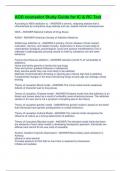
AOD counselor Study Guide for IC & RC Test
According to NIDA addiction is: - ANSWER-a chronic, relapsing disease that is characterized by compulsive drug seeking and use, despite harmful consequences NIDA - ANSWER-National Institute of Drug Abuse ASAM - ANSWER-American Society of Addiction Medicine ASAM says addiction is - ANSWER-A primary chronic disease of brain reward, motivation, memory, and related circuitry. Dysfunction in these circuits leads to characteristic biological, psychological, social and spiritual manifestations.This is reflected in pathologically pursuing reward or relief by substance use and other behaviors. Factors that influence addiction - ANSWER-Genetics (40-60 % of vulnerability to addiction) Home and family-parents or family that use drugs Peer and school- greatest influence in adolescent Early use-the earlier they use more likely to be addicted Methods of Administration-Smoking or injecting give intense high that is addictive Fundamental changes in the brain-introducing drugs at early age can damage critical thinking Theory of causation-Moral model - ANSWER-The moral model-human weakness defects of character lead to drug abuse. Theory of causation -Disease model - ANSWER-Disease model hols that addiction is an illness and comes about as a result of unhealthy neuro-chemical process. The addiction stands on it's own and is not a symptom of anything else in this theory Theory of causation-genetic model - ANSWER-the genetic model is based on the belief that individuals have genetic predisposition to certain behaviors. Theory of causation-Cultural Model - ANSWER-The cultural model recognizes the influence of culture as a strong determinant of addiction. Theory of Causation-Blended model - ANSWER-The blended model holds that there are elements of each other model in developing therapeutic approach. Individuals are different and cannot fit into one mold of causation Alcohol- Sedative hypnotic-Depressant - ANSWER-Most widely used substance in America ethanol or ethyl alcohol Provides pleasure for first half an hour then is replaced by drowsiness irritates and sedates Alcohol effects on the body - ANSWER-*Loss of eye control muscles *Hypoglycemia *peripheral neuritis *fatty liver * Cardiac arrhythmia *facial edema *increased blood pressure *anemia low blood sugar, dehydration, headache, gastrointestinal effects Cannabis - ANSWER-has depressant, stimulant, analgesic, and even hallucinatory effects behind alcohol most popular drug of abuse delts-9-tetrahydrocannabinol or THC Cannabis effects on the body - ANSWER-* Respiratory illness, * heightened risk of heart attack, * Effects fetus during pregnancy * Increased depression, anxiety, and suicidal thoughts * loss of motivation*can induce schizophrenia*Impaired judgement*effects the brain as depressive drug Prescription drugs - ANSWER-drugs used for non-medical reasons can alter brain activity and lead to dependance Common Opioids (perscriptions) - ANSWER-Oxycodone(oxycotin)Propoxxyhene(darvon)hydrocodone(Vicodin)hydromorphone can cause imparied motor function nausea,vomitting, increased heart rate and blood pressure. (Diludid)Dermeral, Opiods can cause drowsiness, constipation, and depressed breathing Central Nervous System Depressants (perscription) - ANSWER-Barbituates: Nembutal (pentrobarbitaol sodium) Benzodiazapines: Dazapam (valium) Alprazolam (Xanax) Stimulants (perscription) - ANSWER-detoamphetamine (Dexedrine) Methylphenidate (Ritalin) NAC - ANSWER-Nucleus Accumbens-the brains pleasure center Drugs effect stimulation of the pleasure ccenter Recovery - ANSWER-Process of change whereby individuals improve their health and wellness to live self-directed life, and strive to reach their full potential. Domain I - ANSWER-Screening , Assessment, and Engagement, Domain II - ANSWER-Treatment planning, Collaboration, and Referral Domain III - ANSWER-Counseling
Información del documento
- Subido en
- 29 de septiembre de 2023
- Número de páginas
- 6
- Escrito en
- 2023/2024
- Tipo
- Examen
- Contiene
- Preguntas y respuestas

