
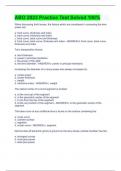
ABO 2023 Practice Test Solved 100%
When discussing thick lenses, the factors which are considered in computing the lens power are: a. front curve, thickness and index b. back curve, thickness and index c. front curve, back curve and thickness d. front curve, back curve, thickness and index - ANSWER-d. front curve, back curve, thickness and index Toric transposition shows: a. lens thickness b. power in principal meridians c. the power of the ADD d. the lens diameter - ANSWER-b. power in principal meridians Increasing the diameter of a minus power lens always increases its: a. vertex power b. center thickness c. weight d. refractive index - ANSWER-c. weight The optical center of a round segment is located: a. at the very top of the segment b. in the geometric center of the segment c. 5 mm from the top of the segment d. at the very bottom of the segment - ANSWER-b. in the geometric center of the segment The base curve of any multifocal lens is found on the surface containing the: a. cross curve b. cylinder surface c. segment d. ocular curve - ANSWER-c. segment Normal slab-off (bicentric grind) is ground on the lens whose vertical meridian has the: a. strongest curves b. most plus power c. least plus power d. least minus power - ANSWER-c. least plus power The refractive error indicated by the Rx +1.75 -2.75 x 090 is: a. compound hyperopic astigmatism b. compound myopic astigmatism c. simple myopic astigmatism d. mixed astigmatism - ANSWER-d. mixed astigmatism Tempering a lens by heat treating results in a lens being: a. less resistant to impact b. more resistant to impact c. more resistant to surface scratching d. impossible to break - ANSWER-b. more resistant to impact A slab-off lens is for the correction of: a. astigmatic errors b. excessive weight of lens c. excessive prism imbalance at the reading level d. exotropia - ANSWER-c. excessive prism imbalance at the reading level Chem-tempering makes a glass lens more impact resistant by placing the lens in a potassium nitrate bath. The lens undergoes a process known as: a. ion exchange b. iron oxide activation c. silver halide transfer d. thermal bleaching - ANSWER-a. ion exchange Which wavelengths of light have been indicated as possible contributors to the onset of cataracts? a. 400-520 nm b. 520-635 nm c. 350-400 nm d. 635-750 nm - ANSWER-c. 350-400 nm When the lenses are laid out and marked for cutting and edging, the lenses are usually decentered so as to correspond to the patient's pupillary distance after lenses are inserted. This is done for the following reason: a. to avoid unwanted prism b. for cosmetic effect c. to use off-center lenses d. to avoid thick edges on the nasal side - ANSWER-a. to avoid unwanted prism Light falling on the front surface of a spectacle lens is: a. partially reflected, partially absorbed and the remainder refracted b. partially reflected and the remainder refracted c. partially absorbed and the remainder refracted d. totally refracted - ANSWER-a. partially reflected, partially absorbed and the remainder refracted A concave mirror: a. can focus parallel incident rays to form a real image b. can focus parallel incident rays to form a virtual image c. always produces inverted images of real objects d. produces virtual images smaller than the real object - ANSWER-a. can focus parallel incident rays to form a real image White light is broken into its component colors when it is: a. diffracted b. refracted c. reflected d. diffracted or refracted - ANSWER-d. diffracted or refracted To the viewer; the image seen in a plane mirror appears to be: a. inverted b. one-half as large as the object c. twice as large as the object d. as far behind the mirror as the object is in front of it - ANSWER-d. as far behind the mirror as the object is in front of it The velocity of light is the least in: a. air b. polycarbonate c. water d. flint glass - ANSWER-d. flint glass A lens dispersing white light into its component colors is an example of: a. achromatic abberration b. isochromatic abberation c. chromatic abberation d. newton's fringes - ANSWER-c. chromatic abberation
Información del documento
- Subido en
- 28 de septiembre de 2023
- Número de páginas
- 69
- Escrito en
- 2023/2024
- Tipo
- Examen
- Contiene
- Preguntas y respuestas

