Nha Ccma Exam
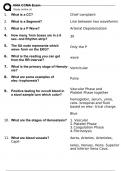
1. What is a CC? Chief complaint 2. What is a Segment? Line between two waveforms 3. What is a P Wave? Arterial Depolarization 4. How many 1mm boxes are in a 6 sec- ond Rhythm strip? 5. The SA node represents which wave- form on the EKG? 6. What is the reading you can get from the RR interval? 7. What is the primary stage of Hemoly- sis? 8. What are some examples of elec- trophoresis? 9. Positive testing for occult blood in a stool sample turn which color? 30 Only the P wave Ventricular Pulse Vascular Phase and Platelet Phase together hemoglobin, serum, urine, cere- brospinal and fluid based on elec- trical charge. Blue 10. What are the stages of Hemostasis? 1. Vascular 2. Platelet Phase 3. Coagulation Phase 4. Fibrinolysis 11. What are blood vessels? Aorta, Arteries, Arterioles, Capil- laries, Venues, Veins, Superior and Inferior Vena Cava. 12. What is the outer connective tissue layer of a blood vessel? 13. What is the Inner endothelial tissue of a blood vessel? Tunica Adventitia Tunica Intima 14. What is the inner smooth layer of a blood vessel? 15. What are the standards of right and wrong in a medical setting? Tunica Tunica Media Code of ethics 16. What do you find in capillaries? A mixture of venous and arterial blood is found 17. The average adult has how many liters of blood? 18. What is the percentage of water in Blood? 19. What is the percentage of Plasma in blood? 20. What is the percentage of formed ele- ments in blood? 21. 99% of formed elements in blood are what? 5-6 Liters 92% 55% 45% Red Blood Cells or Erythrocytes 22. Where do you find hemoglobin? Red blood cells 23. Where do all blood cells originate? Bone marrow 24. How many red blood cells per micro- liter of blood are there? 25. What is the second most numerous White Blood Cell? 26. Whose numbers increase in intracel- lular infections and TB? 27. Their numbers increase in bacterial in- fections and often are first on scene. 4.2 to 6.2 million Lymphocytes with 20-40% Monocytes Neutrophils 28. Which white blood cells play an impor- Lymphocytes tant role in viral infection as well as in Immunity? 29. What is the number of leukocytes for the average adult per microliter? mL 30. What is Leukopenia? Decrease in white blood cells seen with viral infection and leukemia 31. What comprises 3-8% of WBC or leukocytes? 32. What are the largest leukocytes in size? Monocytes Monocytes 33. What carries histamine? Basophil 34. What injury to a blood vessel causes it to constrict slowing the clod of blood? 35. What is the preferred site for venipuncture? 36. What test is used to evaluate the in- trinsic pathway and monitor heparin therapy? 37. What test is used to evaluate the ex- trinsic pathway and also used to mon- itor Warfarin therapy? Vascular Phase of Hemostasis Antecubital fossa APTT aka PTT PT 38. What is Fibrinolysis? Breakdown and removal of a clot 39. What converts the temporary platelet plug into a stable fibrin clot? 40. What is the 2nd choice vein for venipuncture and most often the only one palpable in an obese patient? Coagulation Phase Cephalic vein 41. What antiseptics are used in Phle- botomy? 42. What is the length of needles com- monly used in venipuncture? 43. What gauge of needle can cause he- molysis? 44. What is the average gauge of needle used for drawing blood? 45. What are the 3 Skills of the Phle- botomist? 46. What are some analytical errors dur- ing collection of blood? 47. What are some analytical errors be- fore collection of blood? 48. What are some analytical errors after blood collection? - 70% isopropyl alcohol pads Most common: - Provolone - Iodine for blood cells - Chlorhexidine Gluconate for pa- tients that are allergic to Beta- dine/Iodine. 1 inch ( up to 1.5") Smaller than 23 gauge 21-23 Social, Clerical and Technical - Extended tourniquet time - Hemolysis - Wrong order of draw - Failure to invert tubes - Faulty technique under filling tubes - Patient misidentification - Improper time - Wrong tube - Not fasting - Exercise (cortisol levels) - Patient posture - Poor coordination with other treat- ments - Improper site prep. - Medication interference - Not inverting tubes or not spin- ning tubes) delays in processing - Exposure to light - Improper storage conditions - Dimming clots 49. What is Fistula? Permanent surgical connection be- tween an artery and a vein, never used for venipuncture 50. What is Edema? Accumulation of fluid in tissue 51. What is Thrombophlebitis? Inflammation of a vein with clot for- mation 52. Explanation of Hemo-concentration The increase in proportion of formed elements to plasma caused by leaving on the tourni- quet for more than 2 minutes 53. What is the consequence of insuffi- cient pressure applied after withdraw- al of needle? Thrombus 54. What are additives in Green Top Tube? Heparin and Sodium 55. Why is the green top tube never used for hematology? 56. What are common tests for the light blue sodium citrate tube? 57. What are common tests for the laven- der EDTA tube? 58. What color test tube is used to per- form on plasma such as: - Ammonia - Carboxyhemoglobin - STAT electrolytes? Green tops additive heparin in- terferes with the Wright's stained blood test Coagulation studies, PT (extrinsic and warfarin), APTT/PTT(intrinsic and heparin), TT, BT and FDP CBC, Differential, ESR and Sickle cell screening Green top tube(heparin) tests 59. How long does it take for blood to clot by normal coagulation process in the red top tube? 30-60 minutes 60. What is Quality Control? The primary purpose is to pro- vide reliable data about a patient's health status by ensuring the accu- racy of a test while detecting and eliminating error. 61. What are common tests for the red topped tube? 62. What is the order of the draw for cap- illary specimens? 63. What are antiseptics not used on a dermal puncture site? 64. For which procedure would you warm the site for a minimum of 3-4 minutes to increase blood flow? Serum chemistry tests, Serology tests and Blood bank (glass only) 1. Lavender first 2. Tubes with other additives 3. Tubes without other additives Betadine, (because it interferes with several tests like bilirubin) Uric acid, Phosphorus and Potassium dermal punctures (heel sticks) (Capillary sticks) 65. What are the preferred sites for dermal the distal segment of the third or punctures? 66. Heel sticks are performed on which patients? 67. Where on the foot is the dermal punc- ture made on patients less than a year old? forth finger of the non-dominant hand infants less than 1 year old the medial and lateral areas of the plantar surface of the foot 68. Dermal puncture is made in what? the fleshy portion of the finger slightly to the side of the center perpendicular to the lines of the fingerprints 69. What will occur if you puncture the heel more than 2 mm deep? 70. What are the identification require- ments for Blood Bank? 71. What does the Toxicology section of the lab analyze? 72. What is the percentage of the popula- tion with the D antigen present? osteomyelitis - Patient's full name - Date of Birth - Hospital ID # or SSN for outpa- tient - Date and time of collection as well as the phlebotomist's initials Plasma levels of drugs and poi- sons 85% 73. What are the 4 blood types? A, B, AB and O 74. Which Blood Type has neither the Anti-A nor the Anti-B Plasma Antibod- ies? 75. This section of the lab uses serum to analyze the presence of antibodies such as: - Bacteria - Fungi - Viruses - Parasites ...against the body's own substances? AB Serology (immunology) Section 76. What is Mycology? study of fungi 77. The physical examination of urine consists of what? 78. A low power microscope has a magni- fying power of what? Color, Clarity and Specific gravity 100x 79. Oil immersion objectives on the mi- croscope reach maximal magnifica- tion of what? 80. This objective of the microscope is used for observing bacteria, white blood cells differential count and Red Blood Cell morphology 81. What is the eyepiece of the micro- scope? 1000x Oil immersion Ocular lens 82. The focal length is what? the distance of the object to be ex- amined to the center of the lens 83. What is the conversion for meter to inches? 84. High power objective on a microscope magnification is what? 1 meter = 39.37 inches 400x 85. 1000 meters are equal to what? 1 kilometer 86. What is the conversion for millimeters to inches? 87. What is the conversion for kilograms to pounds? 88. What is the abbreviation for micro liter? 89. What is the abbreviation for decime- ter? 1 millimeter = .04 inches 1 kilogram = 2.2 lbs. uL dm 90. gram positive stains are what? deep violet (violet to black) 91. Gram negative stains are which col- or? light to dark red 92. Which bacteria takes up and retains the crystal violet and resists alcohol discoloration? 93. Which bacteria is decolorized com- pletely by ethanol and takes up safranin counterstain? Gram positive bacteria, appears blue to black gram negative bacteria, which ap- pears red 94. What is the Gram Stain Sequence? - Crystal violet - Gram's Iodine - 95% ethyl alcohol/acetone mix/safranin stain 95. What are the parts of the urinary sys- tem? 96. When checking for hormones in urine when do you collect the urine sample? 97. Which urine specimen provides the clearest and most accurate results? 98. Which urine sample requires aseptic technique? 99. Examination of urine consists of what? 100. Physical examination of urine con- sists of what? 101. What amount of urine must you have to be sufficient for analysis? 102. What is the normal range of specific gravity of random collection? Two Kidneys, Two Ureters, One Bladder and One Urethra During the first void in the morning Clean catch midstream specimen Clean catch specimen Physical, Chemical and Micro- scopic Volume (adequate for testing), Ob- serving color and appearance, Odor and Specific gravity 25mL 1.005 to 1.030 103. 1.015 to 1.025 What is the normal range of specific gravity of urine in adults with normal diet and fluid intake? 104. microscopic examination of urine re- quires what amount of urine? 10-15mL 105. Urine Specific Gravity is what? the ratio of weight of a given v
Información del documento
- Subido en
- 27 de septiembre de 2023
- Número de páginas
- 57
- Escrito en
- 2023/2024
- Tipo
- Examen
- Contiene
- Preguntas y respuestas