CPDT-KA - Learning Theory Terminology – Definitions 2023
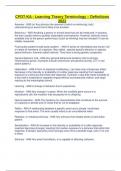
CPDT-KA - Learning Theory Terminology – Definitions 2023 Aversive - ANS-(n) Any stimulus the removal of which is reinforcing; (adj.) characterizing an event that is likely to be avoided. Behaviour - ANS-Anything a person or animal does that can be measured. In practice, the term usually refers to publicly observable overt behavior. However, behavior that is available only to the person performing it (such as thinking) may be included if it can be reliably measured. Fixed action pattern/modal action pattern. - ANS-A series of interrelated acts found in all or nearly all members of a species. Also called , species-specific behavior or species typical behavior; formerly called instincts. They have a strong genetic component. General behavior trait - ANS-Any general behavioral tendency that is strongly influenced by genes. Examples include introversion and general anxiety. (C?. fi xed action pattern.) Habituation - ANS-A form of classical conditioning - can have only a temporary effect. Decrease in the intensity or probability of a reflex response resulting from repeated exposure to a stimulus that elicits that response. Example: a dog that reacts excitedly to a door bell is subjected to repeated ringing without accompanying visitors, and stops reacting to the meaningless stimuli. Learning - ANS-A change in behavior due to experience. Mutation - ANS-Any change in a gene. When the modified gene occurs in a reproductive cell, the mutation may be passed on to offspring. Natural selection - ANS-The tendency for characteristics that contribute to the survival of a species to persist and for those that do not to disappear. Reflex - ANS-A relationship between a specific event and a simple, involuntary response to that event. The term usually refers to an unconditional reflex. Releaser, or releasing stimulus - ANS-Any stimulus that reliably elicits a fixed action pattern. Sensitization - ANS-An increase in the intensity or probability of a reflex response (reaction becomes stronger) resulting from earlier exposure to a stimulus that elicits that response. Example: dog barks more strongly every time a doorbell rings, even if no one is there. Stimulus - ANS- Continues...
Escuela, estudio y materia
- Institución
- CPDT-KA
- Grado
- CPDT-KA
Información del documento
- Subido en
- 23 de septiembre de 2023
- Número de páginas
- 9
- Escrito en
- 2023/2024
- Tipo
- Examen
- Contiene
- Preguntas y respuestas

Documento también disponible en un lote