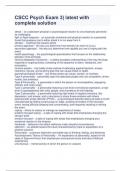
CSCC Psych Exam 3| latest with complete solution
CSCC Psych Exam 3| latest with complete solution stress - an unpleasant physical or psychological reaction to circumstances perceived as challenging. fight or flight response - an automatic emotional and physical reaction to a perceived threat that prepares one to either attack it or run away from it. stressor - Anything that causes stress primary appraisal - the way you determine how stressful an event is to you. secondary appraisal - the way you determine how capable you are of coping with the event. health psychology - the psychological specialization that focuses on the relationship between mind and body. General Adaptation Syndrome - a widely accepted understanding of the way the body responds to ongoing stress, consisting of the sequence of alarm, resistance, and exhaustion. immune system - the bodily innate method of defending against bacteria, viruses, infections, injuries, and anything else that can cause illness or death. psychphysiological illness - any illness stress can cause, worsen, or maintain. Type A personality - personality type that describes people who are competitive, driven, hostile, and ambitious Type B Personality - a personality in which the person is noncompetitive, easygoing, relaxed, and rarely angry. Type C personality - a personality featuring a low level of emotional expression, a high level of agreeableness with other people, and a tendency to feel helpless Type D personality - a personality featuring high levels of negative emotions, like depression, and anxiety, and a reluctance to share those emotions with others. posttraumatic stress disorder (PTSD) - a psychological disorder lasting at least a month characterized by feeling continuously on edge, avoiding reminders of the traumatic event, having difficulty sleeping and concentrating, and frequently recalling or reliving the event. coping - efforts to reduce or manage an experience of stress. problem-focused coping - a style of coping with stress that emphasizes changing the stressor itself. emotion-focused - a style of coping with stress that emphasizes changing your emotional reaction to the stressor. hardiness - behaviors the reflect resilience under stressful circumstances. optimism - an attitude toward the future characterized by hope or expectation of a positive outcome. Personality - a persons distinctive and stable way of thinking, feeling, and behaving Psychodynamic Theory of Personality - An explanation of personality, based on the ideas of Sigmund Freud, that emphasizes unconscious forces and early childhood experiences. unconscious - mental activity of which the person in unaware Freudian slips - Verbal or behavioral mistakes reveal unconscious wishes and thoughts Id - According to Freud, the animalistic part of the mind that generates our most basic, biologically based impulses, such as sex and aggression Ego - According to Freud, the part of the mind that serves as a realistic mediator between the id and the superego. Superego - According to Freud, the part of the mind that opposes the id by enforcing rules, restrictions, and morality. defense mechanisms - According to Freud, techniques used by the ego to manage conflict between the id and superego. Repression - a type of defense mechanism where the ego hides your id impulse in the unconscious to keep you unaware of it Denial - a type of defense mechanism where the ego blocks external events from consciousness because they are too threating. Displacement - a type of defense mechanism where the ego redirects the id impulse toward a safer target in order to minimize the consequences to you Sublimation - A type of defense mechanism where the ego redirects the id impulse in a way that actually benefits others psychosexual stages - Freud's five biologically based developmental stages of childhood, during which personality characteristics are formed. fixation - Freud's term for a lingering psychological problem directly related to unsuccessful experience of a particular psychological stage Oral Stage (0-18 months) - The first of Freud's psychosexual stages which focuses on the consequences of feeding behavior. Anal Stage (18 months - 3 years) - Freud's second psychosexual stage which focuses on the psychological consequences of toilet training. Phallic Stage (3-6 years) - Freud's third psychosexual stage which focuses on the psychological consequences of attraction to the opposite sex parent. Oedipus complex - The childhood experience of desiring the mother and resenting the father Latency (6 to puberty) - Freud's fourth psychosexual stage
Escuela, estudio y materia
- Institución
- CSCC Psych
- Grado
- CSCC Psych
Información del documento
- Subido en
- 21 de septiembre de 2023
- Número de páginas
- 7
- Escrito en
- 2023/2024
- Tipo
- Examen
- Contiene
- Preguntas y respuestas
Temas
-
cscc psych exam 3 latest with complete solution

Documento también disponible en un lote