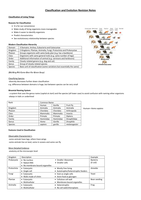
Classification and Evolution Revision Notes
Classification of Living Things
Reasons for Classification
It is for our convenience
Make study of living organisms more manageable
Make it easier to identify organisms
Predict characteristics
See evolutionary relationship between species
Modern Classification Hierarchy
Domain 3 Domains: Archea, Eubacteria and Eukaryotae
Kingdom 5 Kingdoms: Plantae, Animalia, Fungi, Protoctista and Prokaryotae
Phylum Groups organisms with same body plan (e.g. has a backbone)
Class Organisms with same general traits (e.g. same number of legs)
Order Additional information of animal (e.g. carnivore and herbivore)
Family Closely related genera (e.g. dog and cat)
Genus Group of closely related species
Species Basic unit of classification (some variations but essentially the same)
(Did King Phil Come Over For Green Soup)
Classifying Species
-diversity decreases further down classification
e.g. difference between domains is huge, but between species can be very small
Binomial Naming System
- a system that uses the genus name (capital at start) and the species (all lower case) to avoid confusion with naming other organisms
-always in italic or underlined
Rank Common Name
Human Gorilla Fruit Fly
Kingdom Animalia Animalia Animalia Human= Homo sapiens
Phylum Chordata Chordata Arthropoda
Class Mammalia Mammalia Insecta
Order Primate Primate Diptera
Family Hominidae Hominidae Drosphilidae
Genus Homo Gorilla Drosphila
Species sapiens gorilla melanogaster
Features Used in Classification
Observable Characteristic’s
-some animals have legs, others have wings
-some animals live on land, some in oceans and some can fly
More Detailed Evidence
-anatomy at the microscopic level
Kingdom Description Example
Prokaryote No nucleus • Smaller ribosomes Bacteria
Naked DNA Smaller cells (E-coli)
No membrane bound organelles
Protoctista Eukaryotic Mostly free living Amoeba
Single cell Autotrophic/heterotrophic feeders
Fungi Eukaryotic Exist as single cells Yeast
Walls made of chitin Store food as glycogen
Plantae Eukaryotic Cellulose cell wall Bean seeding
Multicellular Membrane bound organelles
Animalia Eukaryotic Heterotrophic Frog
Multicellular No cell wall/chloroplasts
Classification of Living Things
Reasons for Classification
It is for our convenience
Make study of living organisms more manageable
Make it easier to identify organisms
Predict characteristics
See evolutionary relationship between species
Modern Classification Hierarchy
Domain 3 Domains: Archea, Eubacteria and Eukaryotae
Kingdom 5 Kingdoms: Plantae, Animalia, Fungi, Protoctista and Prokaryotae
Phylum Groups organisms with same body plan (e.g. has a backbone)
Class Organisms with same general traits (e.g. same number of legs)
Order Additional information of animal (e.g. carnivore and herbivore)
Family Closely related genera (e.g. dog and cat)
Genus Group of closely related species
Species Basic unit of classification (some variations but essentially the same)
(Did King Phil Come Over For Green Soup)
Classifying Species
-diversity decreases further down classification
e.g. difference between domains is huge, but between species can be very small
Binomial Naming System
- a system that uses the genus name (capital at start) and the species (all lower case) to avoid confusion with naming other organisms
-always in italic or underlined
Rank Common Name
Human Gorilla Fruit Fly
Kingdom Animalia Animalia Animalia Human= Homo sapiens
Phylum Chordata Chordata Arthropoda
Class Mammalia Mammalia Insecta
Order Primate Primate Diptera
Family Hominidae Hominidae Drosphilidae
Genus Homo Gorilla Drosphila
Species sapiens gorilla melanogaster
Features Used in Classification
Observable Characteristic’s
-some animals have legs, others have wings
-some animals live on land, some in oceans and some can fly
More Detailed Evidence
-anatomy at the microscopic level
Kingdom Description Example
Prokaryote No nucleus • Smaller ribosomes Bacteria
Naked DNA Smaller cells (E-coli)
No membrane bound organelles
Protoctista Eukaryotic Mostly free living Amoeba
Single cell Autotrophic/heterotrophic feeders
Fungi Eukaryotic Exist as single cells Yeast
Walls made of chitin Store food as glycogen
Plantae Eukaryotic Cellulose cell wall Bean seeding
Multicellular Membrane bound organelles
Animalia Eukaryotic Heterotrophic Frog
Multicellular No cell wall/chloroplasts