Biological Membranes Revision Notes
Fluid Mosaic Model
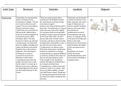
Component of Membrane Structure Function
Phospholipids 2 phospholipids forms phospholipid bilayer Acts as a barrier to most water-soluble substances
Hydrophilic phosphate head points outwards More unsaturated the tail, the more fluid the
Hydrophobic fatty acid tail points inwards membrane
Glycoproteins Carbohydrate chains attached to intrinsic proteins Act as recognition sites for hormones and
neurotransmitters
Helps cells to attach to one another to form tissues
Glycolipids Carbohydrate chain attached to a phospholipid Helps cells attach to one another to form tissues
Helps stabilise membrane
Cholesterol Composed of 4 carbon-based rings Maintains membrane fluidity
Found throughout the membrane (very hydrophilic) Important in stopping water and dissolved ions from
leaking from the cell
Extrinsic Proteins On surface or partially embedded in bilayer Gives mechanical support
Works with glycolipids act as cell receptors
Intrinsic Proteins Span through phospholipid bilayer Some act as carriers
Channel Proteins – transport large hydrophilic
molecules (glucose)
Carrier Proteins – carries a specific molecule/ion
by active transport (Na+ ion channels)
Others are enzymes
Factors Affecting Membrane Permeability
Decreasing Temperature –
-Compresses the fatty acids – kinks in tail push each other away maintain fluidity
-Cholesterol prevent phospholipid molecules getting too close together
Increases Temperature
-Increases fluidity and permeability increase
-Changes may cause proteins acting as enzyme to become denatured
Substances
-Non-polar molecule go through easier than polar molecules
-Small molecules pass easier than large ones
Solvents
-Water is involved in regulating structure
Hydrophilic phosphate heads are attracted to the water
Hydrophobic fatty acid tails are orientated away from the water
-Organic solvents (ethanol) will damage cell membrane as they dissolve lipids
Different Membrane Compositions
Nuerones
-Protein channels and carriers in membrane of axon allows entry and exit of ions to cause electrical impulse
-Membrane around myelin sheath = 20% protein and 75% lipid
Root Hair Cells
-Lots of carrier proteins to transport nitrate ions from the soil into the cells
Mitochondria
-Inner membrane 76% protein and 34% lipid – need carrier proteins for hydrogen ion channels for ATP production
Fluid Mosaic Model
Component of Membrane Structure Function
Phospholipids 2 phospholipids forms phospholipid bilayer Acts as a barrier to most water-soluble substances
Hydrophilic phosphate head points outwards More unsaturated the tail, the more fluid the
Hydrophobic fatty acid tail points inwards membrane
Glycoproteins Carbohydrate chains attached to intrinsic proteins Act as recognition sites for hormones and
neurotransmitters
Helps cells to attach to one another to form tissues
Glycolipids Carbohydrate chain attached to a phospholipid Helps cells attach to one another to form tissues
Helps stabilise membrane
Cholesterol Composed of 4 carbon-based rings Maintains membrane fluidity
Found throughout the membrane (very hydrophilic) Important in stopping water and dissolved ions from
leaking from the cell
Extrinsic Proteins On surface or partially embedded in bilayer Gives mechanical support
Works with glycolipids act as cell receptors
Intrinsic Proteins Span through phospholipid bilayer Some act as carriers
Channel Proteins – transport large hydrophilic
molecules (glucose)
Carrier Proteins – carries a specific molecule/ion
by active transport (Na+ ion channels)
Others are enzymes
Factors Affecting Membrane Permeability
Decreasing Temperature –
-Compresses the fatty acids – kinks in tail push each other away maintain fluidity
-Cholesterol prevent phospholipid molecules getting too close together
Increases Temperature
-Increases fluidity and permeability increase
-Changes may cause proteins acting as enzyme to become denatured
Substances
-Non-polar molecule go through easier than polar molecules
-Small molecules pass easier than large ones
Solvents
-Water is involved in regulating structure
Hydrophilic phosphate heads are attracted to the water
Hydrophobic fatty acid tails are orientated away from the water
-Organic solvents (ethanol) will damage cell membrane as they dissolve lipids
Different Membrane Compositions
Nuerones
-Protein channels and carriers in membrane of axon allows entry and exit of ions to cause electrical impulse
-Membrane around myelin sheath = 20% protein and 75% lipid
Root Hair Cells
-Lots of carrier proteins to transport nitrate ions from the soil into the cells
Mitochondria
-Inner membrane 76% protein and 34% lipid – need carrier proteins for hydrogen ion channels for ATP production