

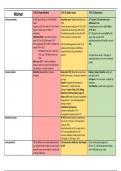
1918-23 (hyperinflation) 1924-28 (golden years) 1929-32 (depression)
Weimar
Economic problems By 1918 gov debt was at 144,000 million Not golden years? Inflation fell below zero 24th October 1929 wall street crash =
marks. 1926. deflationary crisis
Output was 30% less than 1914, lost all their German economy only grew 4% 1913-1929 Unemployment rose from 6.3% 1928 to
colonies + had to pay 6.6 billion in compared to US economy growth of 70% 29.9% 1932
reparations. Unemployment peaked at more than 20% By 1932 people only receiving 86% of the
HYPERINFLATION – went from 2,000 mil 1926, was still at 2 mil in feb 1929 wages they received 1928.
marks 1913 to 45,000 mil marks 1919. Industrial production fell rapidly to around
Prices quadrupled 1919-1920 + monthly rate 20% of land belonged to less than 1% of 50%
passed 50% in 1922. people and right wingers in Reichstag
- A newspaper that cost 1 mark may stopped this from being redistributed
1922, cost 1700 billion marks nov properly. Gov failed to act quickly + changing of
1923. chancellors blames, led to rise in extremist
Ruhr crises 1923 – French and Belgium parties.
troops. Essential to German economy due to
coal industries. = passive resistance
Economic policies Chancellor Cuno policy of passive Dawes plan 1924 Germany receive loan Bruning = hunger chancellor, wage cuts,
resistance of 800 million marks + France not allowed to raise taxes, tariffs.
go rouge. Von Papen = tax concessions + subsides for
Schacht introduced the rentenmark. 1 businesses.
Rentenmark = 1 million old marks Von Schleicher = public works programmes
Signing of Locarno Treaty 1925, Kellogg-
Briand Pact 1928 and joining League of
Nations 1926 make Germany an acceptable
foreign power = more trade agreements +
lending of money
Cartelisation of businesses
Economic enabling law 1924 +
unemployment insurance law 1927
Economic successes By 1925 chemical industry was producing
more than 1/3rd than in 1913 and almost
2/3rds by 1930.
Industrial exports met its pre-war levels in
1927 and exceeded them by 1928.
Currency stabilised. German exports were
34% higher in 1929 than in 1913
Living standards 90% of children 2-6yrs were undernourished. 1924 income of a middle class had dropped 8 hour working day disappeared
e.g., Lignans family lost land, servants had to by 60% Berlin 1925, 130,500 people were lodgers
close the house, move to Berlin, and take job and 44,600 paid for just a bed.
in offices of factories.
Weimar
Economic problems By 1918 gov debt was at 144,000 million Not golden years? Inflation fell below zero 24th October 1929 wall street crash =
marks. 1926. deflationary crisis
Output was 30% less than 1914, lost all their German economy only grew 4% 1913-1929 Unemployment rose from 6.3% 1928 to
colonies + had to pay 6.6 billion in compared to US economy growth of 70% 29.9% 1932
reparations. Unemployment peaked at more than 20% By 1932 people only receiving 86% of the
HYPERINFLATION – went from 2,000 mil 1926, was still at 2 mil in feb 1929 wages they received 1928.
marks 1913 to 45,000 mil marks 1919. Industrial production fell rapidly to around
Prices quadrupled 1919-1920 + monthly rate 20% of land belonged to less than 1% of 50%
passed 50% in 1922. people and right wingers in Reichstag
- A newspaper that cost 1 mark may stopped this from being redistributed
1922, cost 1700 billion marks nov properly. Gov failed to act quickly + changing of
1923. chancellors blames, led to rise in extremist
Ruhr crises 1923 – French and Belgium parties.
troops. Essential to German economy due to
coal industries. = passive resistance
Economic policies Chancellor Cuno policy of passive Dawes plan 1924 Germany receive loan Bruning = hunger chancellor, wage cuts,
resistance of 800 million marks + France not allowed to raise taxes, tariffs.
go rouge. Von Papen = tax concessions + subsides for
Schacht introduced the rentenmark. 1 businesses.
Rentenmark = 1 million old marks Von Schleicher = public works programmes
Signing of Locarno Treaty 1925, Kellogg-
Briand Pact 1928 and joining League of
Nations 1926 make Germany an acceptable
foreign power = more trade agreements +
lending of money
Cartelisation of businesses
Economic enabling law 1924 +
unemployment insurance law 1927
Economic successes By 1925 chemical industry was producing
more than 1/3rd than in 1913 and almost
2/3rds by 1930.
Industrial exports met its pre-war levels in
1927 and exceeded them by 1928.
Currency stabilised. German exports were
34% higher in 1929 than in 1913
Living standards 90% of children 2-6yrs were undernourished. 1924 income of a middle class had dropped 8 hour working day disappeared
e.g., Lignans family lost land, servants had to by 60% Berlin 1925, 130,500 people were lodgers
close the house, move to Berlin, and take job and 44,600 paid for just a bed.
in offices of factories.

