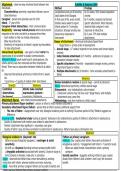
Attachment – close two-way emotional bond between two Schaffer & Emerson 1964
individuals. Method Findings
- Characteristics; proximity, separation distress, secure- Longitudinal study on 60 working By 32 weeks, 50% showed separation
base behaviour. class babies from Glasgow. anxiety
Caregiver – person who provides care for child In first year of life, every month, By 7 months, majority had formed
Infant – 1st year of life mothers were asked to report specific attachment. Most intensely
Caregiver-infant interactions – their communication. infants protest in 7 everyday attached had caregiver’s most
Reciprocity – two-way mutual process where each person situations. Stranger anxiety was reponsive & interactive.
responds to the other and elicits a response from them. measure by response to By 1 year, 75% had multiple
- both mother & child can initiate interactions. intervewier attachments.
- Baby has active role. Stages of attachment – (Antisocial Individuals Speak More)
- Sensitivity of reciprocity to infants’ signals lays foundation - Stage theory = a fixed order of development.
for later attachment. 1. Asocial stage – (1st weeks) responds to non-human and human objects
Interactional Synchrony – care giver & infant mirror the similarly
expressions of one another to sustain communication. 2. Indiscriminate attachment (2-7 months) – preference to people, no
(Meltzoff & Moore) adult made facial & hand gestures, the separation/ stranger anxiety
infants dummy was then removed and their expressions 3. Specific attachment (7months) – separation/ stranger anxiety, primary
filmed. There was an association between infants bh & adults attachment figure to mother.
bh. 4. Multiple attachments (by 18 months) – form secondary attachments to
- observed interactional synchrony in infants from 2 weeks father.
old. Weakness
- ↑synchrony = ↑quality of mother-infant attachment. Babies immobile & random at asocial stage – cannot be observed
Strength Weakness Moore interactional synchrony conflicts asocial stage
Controlled Infants make constant Ethnocentric – only individualistic culture tested.
observations. expressions/ gestures – - Collectivist cultures may not have such ‘Stage theory’ and multiple
No demand uncertainty if deliberate attachments may come first.
Attachment figures – who infants become attached to Methodology - bias from mothers in child’s report
Primary attachment figure (mother) – person an infant is most intensely attached to
Secondary attachment figure (father) – person that an infant receives additional support from
- The role of father – disagreement over role; biological evidence points to nothing? Grossman points to Play? Modern suggests no
difference.
Grossman 2002 - longitudinal study looking at parents’ behaviour & its relationship to quality of children’s attachment in adolescence.
- Quality of attachment with mothers was related to attachment in adolescence.
- Fathers’ attachment less significant = secondary care giver.
- Quality of father’s play did have correlation to attachment in adolescence. Fathers have play & stimulation role.
Strength Weakness
Biological evidence to ‘playmate’ role Fathers as primary caregivers
- fathers not psychologically equipped, ↓ oestrogen & social Feldman - Gay couples show fathers have same activation of
sensitivity. amygdala & oxytocin, ↑engagement with infant = ↑oxytocin levels.
- No birth so ↓Oxytocin (bonding hormone produced after birth) - Males can adopt female characteristics when a primary
- ↓Amygdala activation (associated with anxiety). Oxytocin surge at caregiver.
birth activates in females, male only ¼ activation. Socially sensitive - Suggests working mothers & gay couples
Gieger – observed that fathers had a more stimulating & exciting disadv their children & that a father’s role is only for economic
interaction with infants, whereas mothers are more nurturing. benefit.
Hardy – found that primary caregiver fathers are less able to detect and
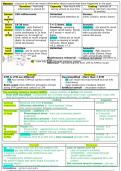
, Animal Studies: Lorenz Explanations of attachment
Method 1.Learning theory – importance of caregiver as provider of food
1. Randomly divided goose eggs Classical Operant conditioning
2. ½ hatched with mother goose conditioning
3. ½ hatched in incubator; seeing Lorenz as their first moving Acquires attachment Maintains attachment through mutual
object through association reinforcement (rf)
4. Lorenz mixed the groups and observed which figure they Food (UCS) = Feeling discomfort produces drive to
followed. pleasure (UCR) ↓discomfort
5. Lorenz varied time between birth & seeing a moving object to Mother (NS) + Food - Need = Drive = Drive reducing
measure the critical period (UCS) = pleasure behaviour
6. Lorenz imprinted Peacocks of giant tortoises to see if they (UCR) Primary rf = direct supply of comfort (food)
displayed courtship Mother = pleasure Secondary rf = source of comfort (mother)
Imprinting – animals form specific attachment to 1st moving object (CR) - Crying = receives food (+ve rf)
they see. - Provides food = stops crying (-ve rf)
- Imprinting is innately programmed & occurs within the first few
days. Strength Weakness
- Imprinting cannot be reversed. CC is valid Harlow’s monkeys spent more time with ‘coth
- Critical period – time in which imprinting must take place explanation to child mother’ so preferred contact comfort.
(dependant on species). If imprinting does not occur = no development Schaffer & Emmerson – babies attached to
attachment made. (behaviourist mothers despite being fed by carer
Sexual imprinting – birds imprinted on humans later displayed approach). Creditable Oversimplistic & reductionist – uses basic
courtship towards humans. that association can animals for evidence which do not have
Strength Weakness affect attachment. emotional complexity
Bowlby – also Guiton - Chickens imprinted & originally 2.Bowlby monotropic theory – rejected the learning theory & explains
suggested attachment tried to mate with yellow washing gloves WHY.
is innate but later learnt to mate with chickens - Attachment has evolved through natural selection to ↑survival.
Harlow - We are born with an innate tendency to form an attachment
Method Findings - Infants are born with social releasers (large eyes, small nose, crying,
1. Lab study - Reared 16 monkeys with Monkeys cuddled soft smiling) their purpose is to activate the innate adult attachment
2 wire surrogates object regardless of system making an adult feel love towards their baby.
2. wire monkey dispensed food which dispensed milk - a reciprocal process – baby & mother have an innate
3. Cloth covered dispensed no food Contact comfort predisposition to become attached to one another.
4. Recorded time spent with each - Greater importance - Critical Period – 2.5 years where infant is sensitive to attachment.
mother than food in Monotropy – the idea we form a more important monotropic bond to our
5. Frightened the monkeys to see which attachment primary attachment ‘mother’ figure
mother they went to - The law of continuity – the more constant & predictable the child’s
Maternal deprivation consequences – monkeys with wire mothers care the better quality their attachment & development
were most dysfunctional. ↑aggressive, ↓social, ↓breeding being - The law of accumulate separation – the effects of every
unskilled at mating. As mothers some neglected/ attacked children. separation are accumulative, so the safest separation is zero.
- Critical period – mother figure to be introduced to infant within - Forms the internal working model – which acts as a blueprint for all
90 days. future relationships
- After critical period damage is irreversible. Strength Weakness
Strength Weakness Schaffer & Emerson – specific attachment by 7mo, Ethically
Real-life application - Social workers Ethical issues – but multiple attachment by 18mo sensitive -
understand risk of child neglect & abuse. Zoos monkeys’ similarity Brazelton 1975 Support social releasers Mothers Burden mothers
ignored infant’s social releasers = babies gave with responsibility
individuals. Method Findings
- Characteristics; proximity, separation distress, secure- Longitudinal study on 60 working By 32 weeks, 50% showed separation
base behaviour. class babies from Glasgow. anxiety
Caregiver – person who provides care for child In first year of life, every month, By 7 months, majority had formed
Infant – 1st year of life mothers were asked to report specific attachment. Most intensely
Caregiver-infant interactions – their communication. infants protest in 7 everyday attached had caregiver’s most
Reciprocity – two-way mutual process where each person situations. Stranger anxiety was reponsive & interactive.
responds to the other and elicits a response from them. measure by response to By 1 year, 75% had multiple
- both mother & child can initiate interactions. intervewier attachments.
- Baby has active role. Stages of attachment – (Antisocial Individuals Speak More)
- Sensitivity of reciprocity to infants’ signals lays foundation - Stage theory = a fixed order of development.
for later attachment. 1. Asocial stage – (1st weeks) responds to non-human and human objects
Interactional Synchrony – care giver & infant mirror the similarly
expressions of one another to sustain communication. 2. Indiscriminate attachment (2-7 months) – preference to people, no
(Meltzoff & Moore) adult made facial & hand gestures, the separation/ stranger anxiety
infants dummy was then removed and their expressions 3. Specific attachment (7months) – separation/ stranger anxiety, primary
filmed. There was an association between infants bh & adults attachment figure to mother.
bh. 4. Multiple attachments (by 18 months) – form secondary attachments to
- observed interactional synchrony in infants from 2 weeks father.
old. Weakness
- ↑synchrony = ↑quality of mother-infant attachment. Babies immobile & random at asocial stage – cannot be observed
Strength Weakness Moore interactional synchrony conflicts asocial stage
Controlled Infants make constant Ethnocentric – only individualistic culture tested.
observations. expressions/ gestures – - Collectivist cultures may not have such ‘Stage theory’ and multiple
No demand uncertainty if deliberate attachments may come first.
Attachment figures – who infants become attached to Methodology - bias from mothers in child’s report
Primary attachment figure (mother) – person an infant is most intensely attached to
Secondary attachment figure (father) – person that an infant receives additional support from
- The role of father – disagreement over role; biological evidence points to nothing? Grossman points to Play? Modern suggests no
difference.
Grossman 2002 - longitudinal study looking at parents’ behaviour & its relationship to quality of children’s attachment in adolescence.
- Quality of attachment with mothers was related to attachment in adolescence.
- Fathers’ attachment less significant = secondary care giver.
- Quality of father’s play did have correlation to attachment in adolescence. Fathers have play & stimulation role.
Strength Weakness
Biological evidence to ‘playmate’ role Fathers as primary caregivers
- fathers not psychologically equipped, ↓ oestrogen & social Feldman - Gay couples show fathers have same activation of
sensitivity. amygdala & oxytocin, ↑engagement with infant = ↑oxytocin levels.
- No birth so ↓Oxytocin (bonding hormone produced after birth) - Males can adopt female characteristics when a primary
- ↓Amygdala activation (associated with anxiety). Oxytocin surge at caregiver.
birth activates in females, male only ¼ activation. Socially sensitive - Suggests working mothers & gay couples
Gieger – observed that fathers had a more stimulating & exciting disadv their children & that a father’s role is only for economic
interaction with infants, whereas mothers are more nurturing. benefit.
Hardy – found that primary caregiver fathers are less able to detect and
, Animal Studies: Lorenz Explanations of attachment
Method 1.Learning theory – importance of caregiver as provider of food
1. Randomly divided goose eggs Classical Operant conditioning
2. ½ hatched with mother goose conditioning
3. ½ hatched in incubator; seeing Lorenz as their first moving Acquires attachment Maintains attachment through mutual
object through association reinforcement (rf)
4. Lorenz mixed the groups and observed which figure they Food (UCS) = Feeling discomfort produces drive to
followed. pleasure (UCR) ↓discomfort
5. Lorenz varied time between birth & seeing a moving object to Mother (NS) + Food - Need = Drive = Drive reducing
measure the critical period (UCS) = pleasure behaviour
6. Lorenz imprinted Peacocks of giant tortoises to see if they (UCR) Primary rf = direct supply of comfort (food)
displayed courtship Mother = pleasure Secondary rf = source of comfort (mother)
Imprinting – animals form specific attachment to 1st moving object (CR) - Crying = receives food (+ve rf)
they see. - Provides food = stops crying (-ve rf)
- Imprinting is innately programmed & occurs within the first few
days. Strength Weakness
- Imprinting cannot be reversed. CC is valid Harlow’s monkeys spent more time with ‘coth
- Critical period – time in which imprinting must take place explanation to child mother’ so preferred contact comfort.
(dependant on species). If imprinting does not occur = no development Schaffer & Emmerson – babies attached to
attachment made. (behaviourist mothers despite being fed by carer
Sexual imprinting – birds imprinted on humans later displayed approach). Creditable Oversimplistic & reductionist – uses basic
courtship towards humans. that association can animals for evidence which do not have
Strength Weakness affect attachment. emotional complexity
Bowlby – also Guiton - Chickens imprinted & originally 2.Bowlby monotropic theory – rejected the learning theory & explains
suggested attachment tried to mate with yellow washing gloves WHY.
is innate but later learnt to mate with chickens - Attachment has evolved through natural selection to ↑survival.
Harlow - We are born with an innate tendency to form an attachment
Method Findings - Infants are born with social releasers (large eyes, small nose, crying,
1. Lab study - Reared 16 monkeys with Monkeys cuddled soft smiling) their purpose is to activate the innate adult attachment
2 wire surrogates object regardless of system making an adult feel love towards their baby.
2. wire monkey dispensed food which dispensed milk - a reciprocal process – baby & mother have an innate
3. Cloth covered dispensed no food Contact comfort predisposition to become attached to one another.
4. Recorded time spent with each - Greater importance - Critical Period – 2.5 years where infant is sensitive to attachment.
mother than food in Monotropy – the idea we form a more important monotropic bond to our
5. Frightened the monkeys to see which attachment primary attachment ‘mother’ figure
mother they went to - The law of continuity – the more constant & predictable the child’s
Maternal deprivation consequences – monkeys with wire mothers care the better quality their attachment & development
were most dysfunctional. ↑aggressive, ↓social, ↓breeding being - The law of accumulate separation – the effects of every
unskilled at mating. As mothers some neglected/ attacked children. separation are accumulative, so the safest separation is zero.
- Critical period – mother figure to be introduced to infant within - Forms the internal working model – which acts as a blueprint for all
90 days. future relationships
- After critical period damage is irreversible. Strength Weakness
Strength Weakness Schaffer & Emerson – specific attachment by 7mo, Ethically
Real-life application - Social workers Ethical issues – but multiple attachment by 18mo sensitive -
understand risk of child neglect & abuse. Zoos monkeys’ similarity Brazelton 1975 Support social releasers Mothers Burden mothers
ignored infant’s social releasers = babies gave with responsibility