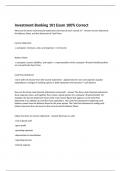
Investment Banking 101 Exam 100% Correct
What are the three main financial statements and what do each consist of? - Answer Income Statement, the Balance Sheet, and the Statement of Cash Flows Income Statement -a company's revenues, costs, and expenses = net income Balance Sheet -a company's assets, liabilities, and equity = a representation of the company's financial health/position on one particular day in time Cash Flow Statement -starts with net income from the income statements - adjustments for non-cash expenses (capital expenditures, changes in working capital, or debt repayment and issuance) = cash balance How are the three main financial statements connected? - Answer The three main financial statements show separate views, and together they create a whole picture of a company's financial health. For example, the Income Statement closes with a net income figure that appears on the Cash Flow Statement as an addition to cash flow from operations. The Cash Flow Statement's beginning cash balance comes from the Balance Sheet for the prior period. The Cash Flow Statement's ending cash balance becomes the cash asset on the current period's Balance Sheet. Major line items on income statement: - Answer Revenues or sales -cost of goods sold =gross profit -operating expenses -depreciation & amortization =operating income -interest expense -other expenses (or incomes) =pre-tax income -tax payments =net income When should an expense appear on the income statement? - Answer -Expenses that end up on the income statement are things like marketing expenses, employee salaries, etc. -In order to be on the income statement, the expense must be tax-deductible and must have been incurred during the period of the income statement. Line items on the balance sheet: (Assets) - Answer Assets: Cash: Self-explanatory, just like cash you have sitting in the bank. Short-Term Investments: Almost as liquid as cash, but not exactly. This includes things like money market accounts, CDs, etc. Inventory: Items that have already been produced, but haven't yet been sold. Clothing that is on the shelves, video games that are on the racks. Accounts Receivable: The company has sold items but hasn't yet been paid for them. It's been recorded on the income statement but is like an IOU from the customer. Prepaid Expense: The company has paid for expenses in cash, but hasn't yet recognized them as cash on the Income Statement. Property, Plant, and Equipment (PP&E): Any factories, warehouses, offices, land that has long-term (greater than one year) value and contributes to the Company's core business. Intangible Assets: This includes things like trademarks, patents, and other intellectual property. This is similar to goodwill and normally is the result of M&A activity. Certain intangible assets are amortizable. Goodwill: When a company acquires another company and pays a premium over the book value of the shareholders' equity, goodwill is created. Goodwill is no longer amortizable under U.S. GAAP. Instead, Goodwill is tested annually for impairment. Long-Term Investments: These are investments that are longer term and less liquid than short term investments but aren't PP&E. Line items on the balance sheet: (Liabilities) - Answer Liabilities: Revolver: This is a line of credit, which is not fixed in size, but rather has a maximum. A company can borrow and then pay off the debt at any time. Think of it as a credit card for companies. A Revolver is typically secured by a company's working capital assets, such as Accounts Receivable, Inventory, and Prepaid Assets. Accounts Payable: This is almost the opposite of Accounts Receivable. The company has received items, but hasn't yet paid for them. It's an IOU to their supplier. Deferred Revenue: The company has collected cash from customers for services that will be delivered over time (think a subscription you pay up front for an entire year). Accrued Expenses: These expenses are recorded on the income statement but haven't yet paid them in cash. These are typically recurring expenses like rent, salaries, etc. Deferred Tax Liability: The company has paid less cash taxes than it actually owes and will have to make it up by paying additional taxes to the government in the future. Long-Term Debt: Just like a car loan or a mortgage on your house, this is an amount of debt that matures in more than a year. Line items on the balance sheet: (Equity) - Answer Equity: Common Stock and Additional Paid-in Capital: This is the market value of the shares of stock when they were issued by the company, not the market value at the current time. Treasury Stock: This is the total value of shares that the company has repurchased from investors, at the value for which they were repurchased, not their current value. Retained Earnings: This is the company's cumulative net income minus any dividends that have been paid to equity investors. What are the three components of the statement of cash flows? - Answer Comprises three main components- showing all the company's sources and uses of cash CASH FROM OPERATIONS: Cash generated or lost through normal operations, sales, and changes in working capital. CASH FROM INVESTING: Cash generated or spent on investing activities; may include, for example, capital expenditures (use of cash) or asset sales (source of cash). This section will also show any investments in the financial markets and operating subsidiaries. NOTE: This section can explain a large negative cash flow during the reporting period, which isn't necessarily a bad thing if it is due to large capital expenditure in preparation for future growth. CASH FROM FINANCING: Cash generated or spent on financing the business; may include proceeds from debt or equity issuance (source of cash) or cost of debt or equity repurchase (use of cash).
Escuela, estudio y materia
- Institución
- Investment Banking 101
- Grado
- Investment Banking 101
Información del documento
- Subido en
- 2 de septiembre de 2023
- Número de páginas
- 10
- Escrito en
- 2023/2024
- Tipo
- Examen
- Contiene
- Preguntas y respuestas
Temas
- investment banking 101
-
investment banking 101 exam 100 correct
-
what are the three main financial statements and w
-
how are the three main financial statements connec

Documento también disponible en un lote