Concept 01: Development Giddens: Concepts for Nursing Practice, 3rdEdition
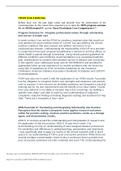
MULTIPLE CHOICE 1.The nurse manager of a pediatric clinic could confirm that the new nurse recog- nized the purpose of the HEADSS Ado- lescent Risk Profile when the new nurse responds that it is used to assess for needs related to a. anticipatory guidance. b. low-risk adolescents. c. physical development. d. sexual development. 2. The nurse preparing a teaching plan for a preschooler knows that, according to Piaget, the expected stage of develop- ment for a preschooler is a. concrete operational. b. formal operational. c. preoperational. d. sensorimotor. 3. The school nurse talking with a high school class about the difference be- tween growth and development would best describe growth as a. processes by which early cells special- ize. b. psychosocial and cognitive changes. c. qualitative changes associated with aging. d. quantitative changes in size or weight. ANS: A The HEADSS Adolescent Risk Profile is a psychosocial assessment screening tool which assesses home, education, activities, drugs, sex, and suicide for the purpose of identifying high-risk adoles- cents and the need for anticipatory guid- ance. It is used to identify high-risk, not low-risk, adolescents. Physical develop- ment is assessed with anthropometric data. Sexual development is assessed using physical examination ANS: C The expected stage of development for a preschooler (3-4 years old) is pre-oper- ational. Concrete operational describes the thinking of a school-age child (7-11 years old). Formal operational describes the thinking of an individual after about 11 years of age. Sensorimotor describes the earliest pattern of thinking from birth to 2 years old. ANS D: Growth is a quantitative change in which an increase in cell number and size re- sults in an increase in overall size or weight of the body or any of its parts. The processes by which early cells spe- cialize are referred to as differentiation. Psychosocial and cognitive changes are referred to as development. Qualitative changes associated with aging are re- ferred to as maturation. ANS: C The Denver II is the most common- ly used measure of developmental sta- tus used by healthcare professionals; Concept 01: Development Giddens: Concepts for Nursing Practice, 3rdEdition 2 / 3 4. The most appropriate response of the nurse when a mother asks what the Den- ver II does is that it a. can diagnose developmental disabili- ties. b. identifies a need for physical therapy. c. is a developmental screening tool. d. provides a framework for health teach- ing. 5. To plan early intervention anNd care for an infant with Down syndrome, the nurse considers knowledge of other physical development exemplars such asa. cerebral palsy. b. autism. c. attention-deficit/hyperactivity disorder (ADHD). d. failure to thrive. 6. To plan early intervention and care for a child with a developmental delay, the nurse would consider knowledge of the concepts most significantly impacted by development, including a. culture. b. environment. c. functional status. d. nutrition. it is a screening tool. Screening tools do not provide a diagnosis. Diagnosis requires a thorough neurodevelopment history and physical examination. Devel- opmental delay, which is suggested by screening, is a symptom, not a diagnosis. The need for any therapy would be iden- tified with a comprehensive evaluation, not a screening tool. Some providers use the Denver II as a framework for teaching about expected development, but this is not the primary purpose of the tool
Escuela, estudio y materia
- Institución
- Nursing Practice
- Grado
- Nursing Practice
Información del documento
- Subido en
- 1 de septiembre de 2023
- Número de páginas
- 3
- Escrito en
- 2023/2024
- Tipo
- Examen
- Contiene
- Preguntas y respuestas
Temas
- development giddens
- concept 1
- giddens
- nursing practice
-
development giddens concepts for nursing practi
-
giddens concepts for nursing
-
giddens concepts for nursing practice
-
concepts for nursing practice