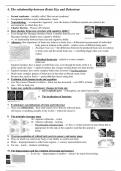
4. The relationship between Brain Size and Behaviour
o Savant syndrome – initially called ‘Idiot savant syndrome’
o Exceptional abilities in arts, mathematics, music
1. Neuroethology – a comparative approach – how the brains of different animals are suited to the
environments in which they live
o Charles Darwin – Theory of Evolution
2. Does absolute brain size correlate with cognitive ability?
o Even though the Macaque (monkey) brain is smaller than the cow one –
Macaque monkeys display more cognitive abilities
no relationship between brain size and cognitive ability
3. Allometry (the importance of brain size relative to body size) = differential measurement of individual
body parts in relation to the whole – relative sizes of different body parts
o Residual brain size = the difference between the predicted brain size (in relation
to body size) and the actual brain size -> something bigger than you would
expect
4.Residual brain size - related to a more complex
behaviour
Squirrel monkeys have a larger overall brain size, even though the body of the 2 is
pretty much the same -> squirrel monkey has a larger residual brain size than howler
o Squirrel monkeys have more complex behaviours in terms of feeding patterns
o Much more complex pattern of behaviour in bats that eat bloody meat, fruits
because they need to find it -> grater rbs than insect eating bats
4. Evolution of the human brain and cognition
o over the course of human evolution – brain size has increased – over 200% in brain
size – 50% in body size
5. Genes may underlie evolutionary changes in brain size
o microcephalin gene – if disrupted, can make brain smaller
6. The localization of functions
7. Evolutionary specializations of brain and behaviour
o They use echolocation – they send sound waves that are reflected back
off insects or anything actually in the world -> where the insect is
8. The principle of proper mass
SC: superior colliculus – vision
IC: inferior colliculus – hearing
o The principle of proper mass – we have a certain amount of mass brain that is
appropriate for the task or the cognitive task that the animal is
doing
9. Overrepresentation of critical body parts in sensory and motor maps
o Ways in which we control our body or our ability to control our body
o Brain – disproportionate to other brain regions -> sensory representation area
o For rats – touch – whiskers (whisking)
10. The hippocampus and the evolution of learning and memory
o Scrub Jay – hippocampus is smaller -> doesn’t do much food storing
o Savant syndrome – initially called ‘Idiot savant syndrome’
o Exceptional abilities in arts, mathematics, music
1. Neuroethology – a comparative approach – how the brains of different animals are suited to the
environments in which they live
o Charles Darwin – Theory of Evolution
2. Does absolute brain size correlate with cognitive ability?
o Even though the Macaque (monkey) brain is smaller than the cow one –
Macaque monkeys display more cognitive abilities
no relationship between brain size and cognitive ability
3. Allometry (the importance of brain size relative to body size) = differential measurement of individual
body parts in relation to the whole – relative sizes of different body parts
o Residual brain size = the difference between the predicted brain size (in relation
to body size) and the actual brain size -> something bigger than you would
expect
4.Residual brain size - related to a more complex
behaviour
Squirrel monkeys have a larger overall brain size, even though the body of the 2 is
pretty much the same -> squirrel monkey has a larger residual brain size than howler
o Squirrel monkeys have more complex behaviours in terms of feeding patterns
o Much more complex pattern of behaviour in bats that eat bloody meat, fruits
because they need to find it -> grater rbs than insect eating bats
4. Evolution of the human brain and cognition
o over the course of human evolution – brain size has increased – over 200% in brain
size – 50% in body size
5. Genes may underlie evolutionary changes in brain size
o microcephalin gene – if disrupted, can make brain smaller
6. The localization of functions
7. Evolutionary specializations of brain and behaviour
o They use echolocation – they send sound waves that are reflected back
off insects or anything actually in the world -> where the insect is
8. The principle of proper mass
SC: superior colliculus – vision
IC: inferior colliculus – hearing
o The principle of proper mass – we have a certain amount of mass brain that is
appropriate for the task or the cognitive task that the animal is
doing
9. Overrepresentation of critical body parts in sensory and motor maps
o Ways in which we control our body or our ability to control our body
o Brain – disproportionate to other brain regions -> sensory representation area
o For rats – touch – whiskers (whisking)
10. The hippocampus and the evolution of learning and memory
o Scrub Jay – hippocampus is smaller -> doesn’t do much food storing