T cell cellular immunity
❖ T cell cellular immunity:
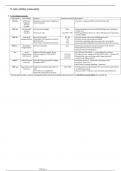
T cell subsets Overall Role Function Cytokines involved Mechanism
CD4 TH Activates & Stimulates components of adaptive & • Has TCR - recognises MHC II on B cells, body cells
regulates innate immunity
immune
response
CD4 TH1 Cell mediated Activates macrophages IFN-γ • Increases phagocytosis, microbicidal killing, prod of cytokines
immune (TNFα, IL1)
response Activates Tc cells IL2, IFN-γ, TNF • Prolif and diff into effector TC cells to kill target cells expressing
specific antigen
CD4 TH2 Parasite & Mast cell activation IL3, IL9 • Granule release and recruits inflammatory cells
allergen defence Eosinophils recruitment & activation IL5 • Granule release, causes parasite killing
IgE production IL4 • B cell class switching - IgE arms mast cells & eosinophils
Tissue repair and mucosal immunity IL13 • Promotes goblet/epithelial cell proliferation & mucus secretion
CD4 TH17 Bacterial & Activate neutrophils IL17 • Activates myeloid and stromal to produce G-CSF and IL8
fungal defence • Neutrophil recruitment and activation
• Granule release to kill bacteria
TFH B cell Helps B cells make specific Ab via • B7-CD28 & CD40-CD40L → creates larger Ab response
differentiation linked recognition of TCR & MHC IL4, IL21 • Cytokine release - signal prolif and diff of B cells → plasma cells
and Ab prod epitope IL4, IL21 • Essential for class switching, somatic hypermutation*,
IL6, IL21 memory cell differentiation
CD8 TC Killing infected Kills cells expressing specific antigen • Granzyme/perforin - perforation, granzymes enter
host cells Recognises MHC I • FasL/Fas - (FasL on TC)
• Both leads to caspase signalling → apoptosis
CD4 Treg Suppression and Suppresses activation and prolif of T IL10, TGFβ • CTLA4 protein receptor, binds to B7 co-stim mol on APC, blocks
Tolerance cells B7-CD28 interactions
Use of CTLA-4 to modify APC • Deprives other T cells of IL2 for activation and proliferation
Binds and consumes IL2 via CD25
*Somatic hypermutation - process undergoing random mutations resulting in the production of an Ab with increased affinity for a specific Ag
I^MD Page 1
❖ T cell cellular immunity:
T cell subsets Overall Role Function Cytokines involved Mechanism
CD4 TH Activates & Stimulates components of adaptive & • Has TCR - recognises MHC II on B cells, body cells
regulates innate immunity
immune
response
CD4 TH1 Cell mediated Activates macrophages IFN-γ • Increases phagocytosis, microbicidal killing, prod of cytokines
immune (TNFα, IL1)
response Activates Tc cells IL2, IFN-γ, TNF • Prolif and diff into effector TC cells to kill target cells expressing
specific antigen
CD4 TH2 Parasite & Mast cell activation IL3, IL9 • Granule release and recruits inflammatory cells
allergen defence Eosinophils recruitment & activation IL5 • Granule release, causes parasite killing
IgE production IL4 • B cell class switching - IgE arms mast cells & eosinophils
Tissue repair and mucosal immunity IL13 • Promotes goblet/epithelial cell proliferation & mucus secretion
CD4 TH17 Bacterial & Activate neutrophils IL17 • Activates myeloid and stromal to produce G-CSF and IL8
fungal defence • Neutrophil recruitment and activation
• Granule release to kill bacteria
TFH B cell Helps B cells make specific Ab via • B7-CD28 & CD40-CD40L → creates larger Ab response
differentiation linked recognition of TCR & MHC IL4, IL21 • Cytokine release - signal prolif and diff of B cells → plasma cells
and Ab prod epitope IL4, IL21 • Essential for class switching, somatic hypermutation*,
IL6, IL21 memory cell differentiation
CD8 TC Killing infected Kills cells expressing specific antigen • Granzyme/perforin - perforation, granzymes enter
host cells Recognises MHC I • FasL/Fas - (FasL on TC)
• Both leads to caspase signalling → apoptosis
CD4 Treg Suppression and Suppresses activation and prolif of T IL10, TGFβ • CTLA4 protein receptor, binds to B7 co-stim mol on APC, blocks
Tolerance cells B7-CD28 interactions
Use of CTLA-4 to modify APC • Deprives other T cells of IL2 for activation and proliferation
Binds and consumes IL2 via CD25
*Somatic hypermutation - process undergoing random mutations resulting in the production of an Ab with increased affinity for a specific Ag
I^MD Page 1