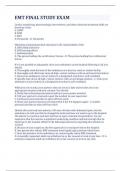
Emt Final Study Exam Verified A+
EMT FINAL STUDY EXAM Cardiac monitoring, pharmacologic interventions, and other advanced treatment skills are functions of the: A. AEMT B. EMR C. EMT D. Paramedic - D. Paramedic Obtaining continuing medical education is the responsibility of the: A. EMS medical director B. EMS training officer C. Individual state D. The person holding the certification/ license - D. The person holding the certification/ license If it is not possible to adequately clean your ambulance at the hospital following a call, you should: A. Thoroughly wash the back of the ambulance at a local car wash or similar facility B. thoroughly and effectively clean all high- contact surfaces with an anti-bacterial solution C. Clean your ambulance at your station in a designated area that is well ventilated D. Quickly wipe down all high- contact surfaces with an anti fungal solution - C. Clean your ambulance at your station in a designated area that is well ventilated While you are on duty, your partner asks you out on a date and touches you in an appropriate location with your consent, You should: A. Notify law enforcement personnel and have your partner arrested B. Tell your partner to stop and report the incident to your supervisor C. Confine personal activities to when off from work. D. Warn your partner that you will report him it her if it happens again - C. Confine personal activities to when off from work Shortly after you load your patient, a 50-year-old man with abdominal pain, into the ambulance, he tells you that he changed his mind and does not want to go to the hospital. The patient is conscious and alert and has no signs of mental incapacitation. You are suspicious that the man has a significant underlying condition and feel strongly that he should go to the hospital. Which of the following statements regarding this situation is correct? A. Because of your suspicion, the best approach is to transport him to the hospital B. Any patient who refuses EMS treatment must legally sign a patient refusal form C. Once the patient is in the ambulance, he cannot legally refuse EMS treatment D. A mentally competent adult can withdraw his or her consent to treat at any time - D. A mentally competent adult can withdraw his or her consent to treat at any time Which of the following patients has decision - making capacity and can legally refuse emergency medical treatment: A. A man who is staggering and states that he has had 3 beers B. Diabetic woman who is conscious and alert with severe abdominal pain C. A confused young male who says he is president D. A diabetic woman who has slurred speech and is not aware of the date - B. Diabetic woman who is conscious and alert with severe abdominal pain At the scene of a motor vehicle crash, you determine that there are two critically injured patients and that another ambulance is needed. You attempt to contact the dispatcher with your portable radio but are unsuccessful. You should: A. Use the mobile radio in the ambulance to contact dispatch B. Make another attempt to contact dispatch from an area of higher terrain C. Place both patients in the ambulance and transport them at once D. Ask a police officer to call dispatch with his portable radio - A. Use the mobile radio in the ambulance to contact dispatch Information included in a radio report to the receiving hospital should include all of the following, EXCEPT: A. Avoiding a preliminary diagnosis of the patients problems B. A long drawn out history of the patients current problem C. A brief summary of the care you provided D. Your perception of the severity of the problem - B. A long drawn out history of the patients current problem In relation to the wrist, the elbow is: A. Distal B. Lateral C. Medial D. Proximal - D. Proximal Your patient has been involved in an MVA. The term MVA stands for: A. Motor vehicle accident B. Mitral valve accumulation C. Multiple vascular accidents D. Motor vehicle crash - A Motor vehicle accident Key hormones of the sympathetic nervous system include: A. Norepinephrine and Acetylcholine B. Epinephrine and Norepinephrine C. Epinephrine and Noradrenaline D. Acetylcholine and Insulin - B. Epinephrine and Norepinephrine Stimulation of the parasympathetic nervous system would result in: A. Vasoconstriction B. Tachycardia C. A strong pulse D. A slower heart rate - D. A slower heart rate At what age does separation anxiety typically peak in infants and small children? A. 10 to 18 months B. 18 to 24 months C. 24 to 36 months D. 6 to 8 months - A. 10 to 18 months The posterior fontanelle fuses together between the ages of: A. 18 months B. 3 months C. 8 months D. 14 months - B. 3 months Situations in which you should use the rapid extrication technique include all of the following, EXCEPT: A. A patient who blocks access to another seriously injured patient B. A patient who needs immediate care that requires a supine position C. A patient whose condition requires immediate transport to the hospital D. A patient who can properly access while still in the vehicle - D. A patient who can properly access while still in the vehicle When carrying a patient up or down stairs, you should avoid: A. Flexing the body at the knee B. The use of a long backboard or stretcher C. Using a wheeled stretcher whenever possible D. The use of more than two EMTs - A. Flexing the body at the knee Normal respiratory rates should not exceed ___ breathes per minute for toddlers and ___ breathes per minute in infants A. 20, 30 B. 30, 40 C. 40, 60 D. 18, 28 - B. 30, 40 The pressure exerted against the walls of the artery when the left ventricle contracts is called the: A. Venous blood pressure B. Pulse pressure C. Diastolic pressure D. Systolic pressure - D. Systolic pressure Proper technique for suctioning the oropharynx of an adult patient includes: A. Suctioning for up to 1 minute if the patient is well oxygenated B. Suctioning while withdrawing the catheter from the oropharynx C. Continuously suctioning patients with copious oral secretions D. Removing large, solid objects with a tonsil tip suction catheter - B. Suctioning while withdrawing the catheter from the oropharynx Which of the following statements regarding the one - person bag - valve mask technique is correct? A. The bag - valve mask delivers more tidal volume and a higher oxygen concentration than the mouth - to - mask technique B. Bag - valve mask ventilations should be delivered every 2 seconds when the device is being operated by one person C. Adequate tidal volume is often difficult to achieve when one EMT is operating the bag - valve mask D. The C - clamp method of holding the mask to the face is not effective when ventilating a patient with a bag - valve mask - D. The C - clamp method of holding the mask to the face is not effective when ventilating a patient with a bag - valve mask A mucosal atomizer device (MAD) is used to deliver certain medications via the: A. Sublingual route B. Intranasal route C. Inhalation route D. Transdermal route - B. Intranasal route What medication form does oral glucose come in? A. Suspension B. Fine powder C. Gel D. Liquid - C. Gel Clinical signs of compensated shock include all the following, EXCEPT: A. Rapid, shallow breathing B. Weak peripheral pulses C. Cool and dry skin D. Restlessness or anxiety - C. Cool and dry skin Neurogenic shock occurs when: A. A spinal cord is severed and causes massive hemorrhaging B. Massive vasoconstriction occurs distal to spinal cord injury C. Failure of the nervous system causes widespread vasodilation D. There is too much blood to fill a smaller vascular container - C. Failure of the nervous system causes widespread vasodilation If gastric distention begins to make positive-pressure ventilation difficult, you should: A. Reposition the patients airway B. Increase the rate of ventilation C. Suction the patients oropharynx D. Insert an oropharyngeal airway - A. Reposition the patients airway
Información del documento
- Subido en
- 23 de agosto de 2023
- Número de páginas
- 16
- Escrito en
- 2023/2024
- Tipo
- Examen
- Contiene
- Preguntas y respuestas