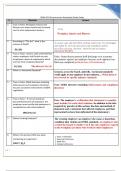
OSHA 510 (Construction Standards) Study Guide graded A+
OSHA 510 (Construction Standards) Study Guide # Question Answer 1 True or False: Workplace injuries and illnesses can lower morale and increased cost to train replacement workers. True Workplace injuries and Illnesses 2 According to “The Act”, what is the mission of OSHA? PG 581 To assure safe and healthful working conditions for working men and women by setting and enforcing standards and by providing training, outreach, education and assistance. American Workers 3 True or False - Section 11(c) of the OSH Act states: employers shall furnish to each employees a place of employment which are free from recognized hazards? PG 581 The above is 5(a) (1) False - States that no person shall discharge or in a manner discriminate against any employee because such employee has filed any complaint (without fear of Punishment) 4 What is a Horizontal Standard? General, across the board, umbrella - horizontal standards could apply to any employer in any industry. When items is not covered by specific industry standards 5 True or False: OSHA directives including Enforcement and compliance directives ensures consistent enforcement of OSHA regulations. True: OSHA directives including Enforcement and compliance directives 6 True or False – If not corrected yet documented at time of inspection, the employers must certify that abatement is completed for each cited violation? 1903.19(c)(3) True: The employer's certification that abatement is complete must include, for each cited violation. In addition to the info required by para(h) of this section, the date and method of abatement and a statement that affected employees and their representatives have been informed of the abatement ) 7 Define Creating Employer? The creating employer: an employer who causes a hazardous condition that violates an OSHA standard. An employer who created the hazard is citable even if the only employees exposed in the workplace are those who work for other employers 8 What is the process CSHO use when conducting an inspection? 1903.7, Pg 2 1. Show Credentials 2. Opening Conferance 3. Walk-thru 4. Closing Conference 9 True or False: Days the employee was only able to work a partial work shift is classified as restricted work activity. 1904.7 (b)(4)(v) PG 13 True restricted work occurs when you keep the employee from performing one or more routine functions of the job or from workingthe full work day 10 When calculating incident rate, what does the 200,000 figure in the formula represent? PG 597 The 200,000 in the formula represents the equivalent of 100 employees working 40 hours per week, 50 weeks per year, and provides the standard base for the incidence rates. 11 True or False: Leading by example is a way to demonstrate management leadership and commitment to Safety and health? S&H MGMT Guideline (b)(1) True: by knowing and following the rules. the employees are expected to follow 12 In accordance with (IAW) 1926.20(B) having a safety & health program and jobsite inspections by a competent person are two main components of an employer's responsibilities. 1926.20 (b) PG 177 Accident Prevention: It shall be the responsibility of the employer to initiate and maintain such programs as may be necessary to comply with this part. Such programs shall provide for frequent and regular inspections of the job sites, materials, and equipment to be made by competent persons designated by the employers. 13 How far can a Class 2A Fire Extinguishers be away from the employees? 1926.150(c)(1)(ii) Pg 271 A fire extinguisher, rated not less than 2A, shall be provided for each 3,000 square feet of the protected building area, or major fraction thereof. Travel distance from any point of the protected area to the nearest fire extinguisher shall not exceed 100 feet. 14 True or False: Accident prevention signs such as danger, caution and exits signs shall be visible while working. 1926.200(a) Pg 285 Subpart G True: Signs and symbols required by this subpart shall be visible at all times when work is being performed, and shall be removed or covered promptly when the hazards no longer exist 15 What is the maximum deceleration distance a personal fall arrest system shall bring employees to a stop? 1926.502 (d)(16)(iv) Pg 341 Subpart M bring an employee to a complete stop and limit maximum deceleration distance an employee travels to 3.5 feet (1.07 m); and, have sufficient strength to withstand twice the potential impact energy of an employee free falling a distance of 6 feet (1.8 m), or the free fall distance permitted by the system, whichever is less. 16 True or False: Only hand and power tools purchased by the employer must be maintained in a safe condition. 1926.300(a) PG 291, Subpart I False - Condition of tools. All hand and power tools and similar equipment, whether furnished by the employer or the employee, shall be maintained in a safe condition. 17 IAW Subpart C what is the definition qualified person. 1926.32(m) PG 178 One who, by possession of a recognized degree, certificate or professional standing, or who by extensive knowledge, training, and experiance, has successfully demonstrated his ability to solve or resolve problems relating to the subject matter, the work or project 18 How do you protect employee and other employees vision in the vicinity during Arc Welding operations? 1926.351 (e) PG 300 1926.353(d)(1)(iii) shall be shielded by noncombustible or flameproof screens which will protect employees and other persons working in the vicinity from the direct rays of the ARC. 19 True or False: Failure to inspect oil or grease on regulator fitting, valves or cap threads on a oxygen cylinder can result in fire or explosion. 1926.350(i) PG 300 Subpart J True: Oil and grease hazards. Oxygen cylinders and fittings shall be kept away from oil or grease. Cylinders, cylinder caps and valves, couplings, regulators, hose, and apparatus shall be kept free from oil or greasy substances and shall not be handled with oily hands or gloves. Oxygen shall not be directed at oily surfaces, greasy clothes, or within a fuel oil or other storage tank or vessel. 20 How should PFAS be rigged? 1926.104{(d) Pg 269 1926.502(d)(16)(iii) Personal fall arrest systems shall be rigged such that an employee can neither free fall more than 6 feet (1.8 m) nor contact any lower level. 21 When using mechanical equipment perpendicular from the roof edge, how far away from the roof edge must warning line be? 1926.502(f)(1)(ii) PG 341 Subpart M When mechanical equipment is being used, the warning line shall be erected not less than 6 feet (1.8 m) from the roof edge which is parallel to the direction of mechanical equipment operation, and not less than 10 feet (3.1 m) from the roof edge which is perpendicular to the direction of mechanical equipment operation. 22 Who initiates and maintains accident prevention programs. 1926.20(b)(1) PG 177 Subpaart C The Employer: It shall be the responsibility of the employer to initiate and maintain such programs as may be necessary to comply with this part. 23 Define Assured Equipment Grounding Conductor program. 1926.404(b)(1)(iii) PG 305 Subpart K The assured equipment grounding conductor program covers all cord sets, receptacles which are not a part of the permanent wiring of the building or structure, and equipment connected by cord and plug which are available for use or used by employees. Not a part of the Building or Structure 24 True of False: When guarding live parts, areas with 45 volts or greater, requires that only a qualified person (electrician) have access to protected areas. 1926.403(I)(2)(i) PG 304 Subpart K False - Except as required or permitted elsewhere in this subpart, live parts of electric equipment operating at 50 volts or more shall be guarded against accidental contact by cabinets or other forms of enclosures, or by any of the following means: By location in a room, vault, or similar enclosure that is accessible only to qualified persons. 25 Define bonding. 1926.449 1926.152 The practice of connecting two metallic objects to prevent static sparks is called The permanent joining of metallic parts to form an electrically conductive path which will assure electrical continuity and the capacity to conduct safely any current likely to be imposed. 26 True or False: When working around Power Transmission & Distribution lines you only have to give an initial Job briefing at the beginning of the project if the work being performed is repetitive and similar to other task? 1926.952(c)(1) PG 424 False - At least one before each day or shift. If the work or operations to be performed during the work day or shift are repetitive and similar, at least one job briefing shall be conducted before the start of the first job of each day or shift. **Additional job briefings shall be held if significant changes, which might affect the safety of the employees, occur during the course of the work 27 True or False: A competent person can supervise the dismantling of scaffolding? Subpart L 1926.451(f)(7) True - Scaffolds shall be erected, moved, dismantled, or altered only under the supervision and direction of a competent person qualified in scaffold erection, moving, dismantling or alteration. Such activities shall be performed only by experienced and trained employees selected for such work by the competent person. 28 IAW Subpart M, what is the height of a the top rail of a guardrail system. 1926.502(b)(1) PG 339 Subpart M Top edge height of top rails, or equivalent guardrail system members, shall be 42 inches (1.1 m) plus or minus 3 inches (8 cm) above the walking/working level. When conditions warrant, the height of the top edge may exceed the 45-inch height, provided the guardrail system meets all other criteria of this paragraph. 29 When must a material chute be enclosed during demolition operations. 1926.852(b) PG 415 Subpart T All materials chutes, or sections thereof, at an angle of more than 45 deg. from the horizontal, shall be entirely enclosed, except for openings equipped with closures at or about floor level for the insertion of materials. The openings shall not exceed 48 inches in height measured along the wall of the chute. At all stories below the top floor, such openings shall be kept closed when not in use. 30 Define "Type B" Soil. 1926 Subpart P Appendix A pg 369 Cohesive soil with an unconfined compressive strength greater than 0.5 tsf (48 kPa) but less than 1.5 tsf (144 kPa), Granular cohesionless soils including: angular gravel (similar to crushed rock), silt, silt loam, sandy loam and, in some cases, silty clay loam and sandy clay loam. 31 True or False? A masonry wall must be braced when it reaches 6 feet in height? 1926.706(b) PG 384 Subpart Q False -All masonry walls over eight feet in height shall be adequately braced to prevent overturning and to prevent collapse unless the wall is adequately supported so that it will not overturn or collapse. The bracing shall remain in place until permanent supporting elements of the structure are in place. 32 True or False: On temporary stairs, handrails must have a minimum clearance of 4 inches? 1926.1052(c)(11) PG 468 Subpart X False - Handrails that will not be a permanent part of the structure being built shall have a minimum clearance of 3 inches (8 cm] between the handrail and walls, stairrail systems, and other objects. 33 What are the requirements for a "limited access zone" for masonry construction. 1926.706 (a) (2&3) Pg 383 Subpart Q The limited access zone shall be equal to the height of the wall to reconstructed plus four feet, and shall run the entire length of the wall.The limited access zone shall be established on the side of the wall which will be unscaffolded. 34 What is the intended load of the max intended load for self-supporting portable ladders? (Robert Kuri) 1926.1053 (a)(1)(i) PG 468 Subpart X Each portable ladder that is not self-supporting: At least four times the maximum intended load, except that each extra-heavy-duty type 1A metal or plastic ladders shall sustain at least 3.3 times the maximum intended load. The ability of a ladder to sustain the loads indicated in this paragraph shall be determined by applying or transmitting the requisite load to the ladder in a downward vertical direction when the ladder is placed at an angle of 75 1/2 degrees from the horizontal. 35 True or False: During Steel Erection, controlled decking zone can used as fall protection up to a maximum height of 50 feet? 1926.760 (c) PG 391 Subpart R False: A controlled decking zone may be established in that area of the structure over 15 and up to 30 feet above a lower level where metal decking is initially being installed and forms the leading edge of a work area. In each CDZ, the following shall apply:Each employee working at the leading edge in a CDZ shall be protected from fall hazards of more than two stories or 30 feet (9.1 m), whichever is less. 36 In Accordance With (IAW) Subpart P, Appendix B, Figure B-1, when performing short-term excavations, what is the sloped ratio, duration limit, and depth limit when excavating Type A soil? Subpart P Appendix B PG 370 Exception: Simple slope excavations which are open 24 hours or less (short term) and which are 12 feet or less in depth shall have a maximum allowable slope of ½:1. Duration: 24 hrs or Less Slope Ratio: 1/2:1 Depth limit: 12' or Less 37 When must portable ladders be removed from service? 1926.1053(b)(16) PG 470 Subpart X Portable ladders with structural defects, such as, but not limited to, broken or missing rungs, cleats, or steps, broken or split rails, corroded components, or other faulty or defective components, shall either be immediately marked in a manner that readily identifies them as defective, or be tagged with "Do Not Use" or similar language, and shall be withdrawn from service until repaired. 38 When is cross bracing on a scaffold acceptable as a midrail? 1926.451(g)(4)(xv) PG 325 Subpart L When the crossing point of two braces is between 20" and 30" above the work platform or as a toprail when the crossing point of two braces is between 38" and 48" above the work platform. 39 True or False? Material handling rigging equipment only needs to be inspected once daily? 1926.251 (a)(1) PG 287 Subpart H False - Rigging equipment for material handling shall be inspected prior to use on each shift and as necessary during its use to ensure that it is safe. Defective rigging equipment shall be removed from service. 40 Who has the authority to stop crane operations? 1926.1418 PG 554 Subpart CC The operator must have the authority to stop and refuse to handle loads until a qualified person has determined that safety 41 IAW 1926.1419, during operations when is the operator required to safely stop operations… 1926.1419 (F ) PG 555 Subpart CC During operations requiring signals, the ability to transmit signals between the operator and signal person must be maintained. If that ability is interrupted at any time, the operator must safely stop operations requiring signals until it is reestablished and a proper signal is given and understood. 42 Who is responsible for training crane signal personnel. 1926.1430 (b) PG 560 IAW 1926.1428 (c)(1-5) PG 559 The Employer 43 True or False: Rollover Protection materials must perform at 10 degrees Fahrenheit? 1926.1001(f)(2)(iv) PG 459 Subpart W False - Material used in the ROPS must have the capability of performing at zero degrees Fahrenheit, or exhibit Charpy V notch impact strength of 8 foot-pounds at minus 20 deg. Fahrenheit. 44 What regulation covers training for powered industrial trucks? 1910.178 PG 42 45 IAW Subpart A, which organization and regulation (incorporated by reference) covers eye and face protection. 1926.6 (h)(31) PG 167 Subpart A ANSI / Z87.1 - 1968 46 What is the hierarchical control method employers use to protect employees. Precautions necessary to prevent over exposure including: engineering controls, administrative controls and PPE 47 Respirators are covered by what regulation? 1910.134 PG 24 / 48 IAW Subpart D, when is personnel certified first-aid training required? 1926.50(c) PG 181 In the absence of an Infirmany, clinic, hospital or physician a person who has a valid certificate in first aid 49 How should drinking water be dispensed from portable containers? 1926.51(a)(2) PG 181 Tightly closed, With a TAP 50 True or Flase: IAW Subpart D paragraph L, excessive exposure to lead only has adverse effects on the male reproductive system. 1926.62(II)(B)(2) PG 216 FALSE - effects both males and female and hazardous to the fetus
Información del documento
- Subido en
- 23 de agosto de 2023
- Número de páginas
- 7
- Escrito en
- 2023/2024
- Tipo
- Examen
- Contiene
- Preguntas y respuestas