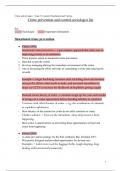
Crime and deviance - Topic 2:Interactionism and labelling theory
The social construction of crime-sociologist list
Key:
Heheh-Sociologist Heheh-Important information
Key information:
- Labelling theorists want to discover why certain acts are defined as
deviant/criminal in the first place
- Argue that no act is inherently deviant itself, but only when others define it as
such
● Becker (1963)
- Deviance is in the eye of the beholder
- Deviant is a label which has been applied
- Deviant behaviour is the acts that ‘deviants’ commit
- Moral entrepreneurs → people who lead a moral ‘crusade’ to change the law
- New laws invariably create two effects:
1. Creation of a new group of ‘outcasts/outsiders’ → deviants who break rules
2. Creation/expansion of social control agencies to enforce rules and label
offenders
- Social control agencies may try and change the law to give themselves
more power(e.g. US Marijuana Act of 1937 banned the use of the drug →
not to prevent the dangerous effects of the drug, but to increase the US
Federal Bureau of Narcotics power and influence)
- New laws are created by powerful individuals that deem what is, and what isn’t
unacceptable
● Platt (1969)
- ‘Juvenile delinquency’ → created by upper-class Victorian moral
entrepreneurs who wanted to protect the youth at risk
- ‘Juveniles’ → new separate category of the offender with their own courts
→ state has control over the young due to their ‘status offences’(behaviour is
an offence due to their age)
1
, Who gets labelled?
Factors of whether a person is charged, arrested or convicted:
1. Interactions with social control agencies
2. Appearance, background and personal biography
3. situation/circumstances of the offence
- Studies show that ASC(Agencies of Social Control) are more likely to label
certain groups of people as deviant
● Piliavin and Briar (1964)
- Police that were arresting youth were mainly based on physical
cues(manner and dress) → made judgements about the youth’s character
- Other aspects included were the suspects’ gender, class and ethnicity, as
well as time and place(e.g. Stopped and searched late at night → more likely
to be arrested)
- Ethnicity also placed a factor as anti-social behaviour orders were used against
ethnic minorities
● Cicourel: the negotiation of justice
- The officer's decision to arrest is made on stereotypical assumptions
- Officers had ‘typifications’ → common sense theories/stereotypes of what an
ordinary delinquent is, and makes them focused on that particular image
→ Example: class bias- bias against w/class people and areas meant more
police enforcement in these areas, more arrests being made and confirming
the stereotypes
- Other ASC reinforced the bias → probation officers assumed that juvenile
delinquency was due to a broken home, poverty and lax parenting
→ assumed that they would commit crimes in the future and less likely to
support non-custodial sentences
- Justice is negotiable, not fixed → e.g. a middle-class youth may commit a
crime, however, they do not fit the police’s assumptions and therefore will
be less likely to be prosecuted(other factors include their parents to
negotiate with ASCs)
2
The social construction of crime-sociologist list
Key:
Heheh-Sociologist Heheh-Important information
Key information:
- Labelling theorists want to discover why certain acts are defined as
deviant/criminal in the first place
- Argue that no act is inherently deviant itself, but only when others define it as
such
● Becker (1963)
- Deviance is in the eye of the beholder
- Deviant is a label which has been applied
- Deviant behaviour is the acts that ‘deviants’ commit
- Moral entrepreneurs → people who lead a moral ‘crusade’ to change the law
- New laws invariably create two effects:
1. Creation of a new group of ‘outcasts/outsiders’ → deviants who break rules
2. Creation/expansion of social control agencies to enforce rules and label
offenders
- Social control agencies may try and change the law to give themselves
more power(e.g. US Marijuana Act of 1937 banned the use of the drug →
not to prevent the dangerous effects of the drug, but to increase the US
Federal Bureau of Narcotics power and influence)
- New laws are created by powerful individuals that deem what is, and what isn’t
unacceptable
● Platt (1969)
- ‘Juvenile delinquency’ → created by upper-class Victorian moral
entrepreneurs who wanted to protect the youth at risk
- ‘Juveniles’ → new separate category of the offender with their own courts
→ state has control over the young due to their ‘status offences’(behaviour is
an offence due to their age)
1
, Who gets labelled?
Factors of whether a person is charged, arrested or convicted:
1. Interactions with social control agencies
2. Appearance, background and personal biography
3. situation/circumstances of the offence
- Studies show that ASC(Agencies of Social Control) are more likely to label
certain groups of people as deviant
● Piliavin and Briar (1964)
- Police that were arresting youth were mainly based on physical
cues(manner and dress) → made judgements about the youth’s character
- Other aspects included were the suspects’ gender, class and ethnicity, as
well as time and place(e.g. Stopped and searched late at night → more likely
to be arrested)
- Ethnicity also placed a factor as anti-social behaviour orders were used against
ethnic minorities
● Cicourel: the negotiation of justice
- The officer's decision to arrest is made on stereotypical assumptions
- Officers had ‘typifications’ → common sense theories/stereotypes of what an
ordinary delinquent is, and makes them focused on that particular image
→ Example: class bias- bias against w/class people and areas meant more
police enforcement in these areas, more arrests being made and confirming
the stereotypes
- Other ASC reinforced the bias → probation officers assumed that juvenile
delinquency was due to a broken home, poverty and lax parenting
→ assumed that they would commit crimes in the future and less likely to
support non-custodial sentences
- Justice is negotiable, not fixed → e.g. a middle-class youth may commit a
crime, however, they do not fit the police’s assumptions and therefore will
be less likely to be prosecuted(other factors include their parents to
negotiate with ASCs)
2