
Photosynthesis
This process transfers light energy into chemical potential energy which can be released for work in
respiration.
The light dependent reaction only takes place in
the presence of suitable pigments that absorb a
certain wavelength of light.
Primary pigments and accessory pigments are
arranged into light-harvesting clusters caked
photosystems. The accessory pigments
surround the primary pigment and the energy
of the light absorbed is passed to them. These
primary pigments are said to be reaction
centres.
Light energy is also needed to provide chemical
energy in the form of ATP for the reduction of
carbon dioxide to carbohydrate in the light
independent reaction (Calvin cycle).
Light dependent reaction
Light energy is needed for the splitting of water into hydrogen and oxygen, called photolysis (oxygen
is a waste product).
ATP is synthesised in photophosphorylation. The hydrogen ions combine with the carrier molecule
NADP to make reduced NADP. Reduced NADP and ATP are passed from the light dependent
reaction to the light independent reaction (Calvin cycle).
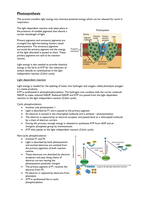
Cyclic phosphorylation:
Involves only photosystem 1
Light is absorbed by P1 and is passed to the primary pigment
An electron is excited in the chlorophyll molecule and is emitted – photoactivation
The electron is captured by an electron acceptor and passed back to a chlorophyll molecule
by a chain of electron carriers
During this process, enough energy is released to synthesise ATP from ADP and an
inorganic phosphate group by chemiosmosis
ATP then passes to the light independent reaction (Calvin cycle)
Non-cyclic phosphorylation:
Involves P1 and P2
Light is absorbed by both photosystems
and excited electrons are emitted from
the primary pigments of both reaction
centres
These electrons are absorbed by electron
acceptors and pass along chains of
electron carriers leaving the
photosystems positively charged
The primary pigment of P1 receives the
electron from P2
P2 electron is replaced by electrons from
photolysis
ATP is synthesised like in cyclic
phosphorylation
This process transfers light energy into chemical potential energy which can be released for work in
respiration.
The light dependent reaction only takes place in
the presence of suitable pigments that absorb a
certain wavelength of light.
Primary pigments and accessory pigments are
arranged into light-harvesting clusters caked
photosystems. The accessory pigments
surround the primary pigment and the energy
of the light absorbed is passed to them. These
primary pigments are said to be reaction
centres.
Light energy is also needed to provide chemical
energy in the form of ATP for the reduction of
carbon dioxide to carbohydrate in the light
independent reaction (Calvin cycle).
Light dependent reaction
Light energy is needed for the splitting of water into hydrogen and oxygen, called photolysis (oxygen
is a waste product).
ATP is synthesised in photophosphorylation. The hydrogen ions combine with the carrier molecule
NADP to make reduced NADP. Reduced NADP and ATP are passed from the light dependent
reaction to the light independent reaction (Calvin cycle).
Cyclic phosphorylation:
Involves only photosystem 1
Light is absorbed by P1 and is passed to the primary pigment
An electron is excited in the chlorophyll molecule and is emitted – photoactivation
The electron is captured by an electron acceptor and passed back to a chlorophyll molecule
by a chain of electron carriers
During this process, enough energy is released to synthesise ATP from ADP and an
inorganic phosphate group by chemiosmosis
ATP then passes to the light independent reaction (Calvin cycle)
Non-cyclic phosphorylation:
Involves P1 and P2
Light is absorbed by both photosystems
and excited electrons are emitted from
the primary pigments of both reaction
centres
These electrons are absorbed by electron
acceptors and pass along chains of
electron carriers leaving the
photosystems positively charged
The primary pigment of P1 receives the
electron from P2
P2 electron is replaced by electrons from
photolysis
ATP is synthesised like in cyclic
phosphorylation


