

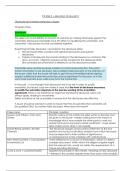
PA SGS 5 – allocation of risk part 2
Disclosure and vendor protection clauses
Chapter notes:
Disclosure:
How does the disclosure process work?
The seller can avoid liability for breach of warranty by making disclosures against the
warranties. Disclosures essentially have the effect of qualifying the warranties, and
warranties + disclosures must be considered together.
Everything formally disclosed = recorded in the disclosure letter.
• The disclosure letter contains both general disclosures and specific
disclosures.
• Copies of all relevant documents relating to the disclosures (i.e contracts, title
docs, accounts + litigation papers) will be annexed to the disclosure letter
(the annexed documentation is referred to as the disclosure bundle)
Warranties serve another purpose outside of contractual protection; they elicit
further information to be disclosed. New problems being bought to the attention of
the buyer. Likely that the buyer will seek to get the issue remedied before signing,
request additional indemnity protection and/or adjustment to the price, or in the
worst case scenario even walk away from the transaction.
In the past – it was thought that disclosure had to be fair in order to qualify
warranties. But recent case law makes it clear that the level of disclosure necessary
to qualify the warranties depends on the precise wording of the acquisition
agreement. There is not therefore an objective standard of disclosure which will
always apply, leading to uncertainty.
Sellers should be as fair as possible to ensure that the disclosures are effective.
A buyer should be advised to seek to ensure that the AA specifies that warranties will
be qualified ONLY by matters fairly disclosed. What does fair mean?
Case name Principle / position
Levison and Others v Farin and Specific notice of the matter the seller wants to disclose must
Others be given to the buyer: ‘merely making know the means of
knowledge which may enable the other party to work out
certain facts and conclusions will be insufficient’. (case where
dress maker was ill, drop in net asssets).
Daniel Reeds Limited v EM ESS ‘fair disclosure requires some positive statement of the true
Chemists position and not just a fortuitous omission from which the buyer
may be expected to infer matters of significance’.
i.e missing licence in the schedule with valid licences.
New Hearts Limited v Cosmopolitan ‘mere reference to a source of information, which is in itself a
Investments Ltd complex document, within which the diligent enquirer might
find the relevant info, would not satisfy the requirements of a
clause providing disclosure’.
Curtis & Anor v Lockheed Martin Applied the principle in New Hearts: meaning of fairly disclosed
= fairness in this context requires more than clues which enable
, a purchaser to start a paper chase for matters which should be
fairly disclosed.
What is the position if the acquisition agreement DOES NOT specify that disclosure
must be fair?
Infiniteland Limited v Artisan Contracting Limited + MAN Nutzfahrzeuge AG and
others v Freightliner:
• The q of whether or not disclosure effectively qualifies the warranties in any
acquisition agreement will depend on the level of disclosure that the buyer
has agreed to accept.
• Ex. The buyer may agree to accept that the warranties are qualified by ‘all
the matters contained in or referred to in the disclosure letter and its
accompanying documents’.
o Vague nature of this wording = buyer cannot later complain that an
issue had not been properly been disclosed because the
consequences of the matter were not fully explained in the disclosure
letter.
• In infiniteland; the buyer accepted the wording ‘save as set out in the
Disclosure Letter, the warranties in Sch 3 are true and accurate…’. This was
distinguished from New Hearts where warranties were given ‘subject to the
matters fairly disclosed (with sufficient details to identify the nature and scope
of the matter disclosed).
• If acting for the buyer, solicitors should ensure that the acquisition agreement
contains wording similar to New Hearts SO THAT ONLY FIR DISCLOSURE WILL
QUALIFY THE WARRANTIES.
What if the buyer knows before completion about facts that amount to a breach of
warranty?
• Whether a buyer can pursue a claim for breach of warranty where it knew
before completion that the warranty in question was untrue, even though the
info that has made it untrue had not been formally disclosed by the seller was
considered in Eurocopy plc v Teesdale and Others + later in Infiniteland
(obiter).
• Following Infiniteland, it appears that the position will depend on the wording
of the AA.
What if the seller does not wish to disclose something?
• A seller who fails to disclose a relevant matter in relation to the warranties
may have a claim made against it by the buyer for breach of warranty.
• A claim for misrepresentation is also a possibility.
• The seller may also, in this situation, have to consider the provisions of the
Fraud Act 2006:
o Relevant if a representation is made, or warranty given, that is false
(and in the case of a warranty, which is not disclosed against) and the
seller has made such representation or given such warranty
, dishonestly, intending to make a gain for itself and/or cause loss to the
buyer.
o The provision of the Fraud Act 2006 are applicable to both share and
business sales.
• The Fraud Act 2006 creates a general criminal offences of fraud that can be
committed by a person who, amongst other things:
o Dishonestly makes a false rep or
o Dishonestly fails to disclose info which he is under a legal duty to
disclose and
o Intends to make a ‘gain’ for himself or to cause or to expose another
to the risk of a ‘loss’.
• The max penalty for the offence = 10 years’ imprisonment and/or a fine.
• If a company commits the offence (because for example the seller is a
company) and it is found to have committed the offence with the consent
of, for ex, a director, then the director as well as the company will be
prosecuted.
In the case of split exchange + completion, there would usually be a contractual
duty on the seller to disclose breaches of warranty in the period between exchange
and completion.
• If so and if the seller fails to make relevant disclosures during this period, it
would not only have to consider the risk of a claim being made against it by
the buyer for breach of warranty, but also the offence of fraud if it
deliberately withholds a disclosure to avoid putting off the transaction.
• Failure to disclose in these circumstances may also mean that a false rep has
been made by the seller to the buyer.
Limitation: vendor protection provisions
• Under the normal limitation rules, the seller is exposed to being sued for any
size of claim without qualification or limitation (subject to normal contractual
rules on loss + damage) for up to 6 yrs (or 12 yrs if the AA is executed as a
deed).
• The seller’s solicitors will wish to limit their client’s exposure by including a set of
limitation clauses in the acquisition agreement. These are known as vendor
protection clauses.
o Most common = max cap on liability (de maximis clauses
o And/or a minim threshold on claims so that the seller will not be
troubled by every claim no matter how trivial (de minimis) and will
have to bring a claim within a reasonable time (time limits).
• If a buyer accepts a de maximis clause in the AA, then it should try to ensure
that this limitation does not apply to protect the seller in relation to any claims
which arise or which are delayed as a result of dishonesty, fraud, or wilful
concealment by the seller.
• Entire agreement clauses are also an example of it.
For tax limits = generally accepted practice for parties to agree a time limit between
1-2 yrs in respect of non tax warranties
Disclosure and vendor protection clauses
Chapter notes:
Disclosure:
How does the disclosure process work?
The seller can avoid liability for breach of warranty by making disclosures against the
warranties. Disclosures essentially have the effect of qualifying the warranties, and
warranties + disclosures must be considered together.
Everything formally disclosed = recorded in the disclosure letter.
• The disclosure letter contains both general disclosures and specific
disclosures.
• Copies of all relevant documents relating to the disclosures (i.e contracts, title
docs, accounts + litigation papers) will be annexed to the disclosure letter
(the annexed documentation is referred to as the disclosure bundle)
Warranties serve another purpose outside of contractual protection; they elicit
further information to be disclosed. New problems being bought to the attention of
the buyer. Likely that the buyer will seek to get the issue remedied before signing,
request additional indemnity protection and/or adjustment to the price, or in the
worst case scenario even walk away from the transaction.
In the past – it was thought that disclosure had to be fair in order to qualify
warranties. But recent case law makes it clear that the level of disclosure necessary
to qualify the warranties depends on the precise wording of the acquisition
agreement. There is not therefore an objective standard of disclosure which will
always apply, leading to uncertainty.
Sellers should be as fair as possible to ensure that the disclosures are effective.
A buyer should be advised to seek to ensure that the AA specifies that warranties will
be qualified ONLY by matters fairly disclosed. What does fair mean?
Case name Principle / position
Levison and Others v Farin and Specific notice of the matter the seller wants to disclose must
Others be given to the buyer: ‘merely making know the means of
knowledge which may enable the other party to work out
certain facts and conclusions will be insufficient’. (case where
dress maker was ill, drop in net asssets).
Daniel Reeds Limited v EM ESS ‘fair disclosure requires some positive statement of the true
Chemists position and not just a fortuitous omission from which the buyer
may be expected to infer matters of significance’.
i.e missing licence in the schedule with valid licences.
New Hearts Limited v Cosmopolitan ‘mere reference to a source of information, which is in itself a
Investments Ltd complex document, within which the diligent enquirer might
find the relevant info, would not satisfy the requirements of a
clause providing disclosure’.
Curtis & Anor v Lockheed Martin Applied the principle in New Hearts: meaning of fairly disclosed
= fairness in this context requires more than clues which enable
, a purchaser to start a paper chase for matters which should be
fairly disclosed.
What is the position if the acquisition agreement DOES NOT specify that disclosure
must be fair?
Infiniteland Limited v Artisan Contracting Limited + MAN Nutzfahrzeuge AG and
others v Freightliner:
• The q of whether or not disclosure effectively qualifies the warranties in any
acquisition agreement will depend on the level of disclosure that the buyer
has agreed to accept.
• Ex. The buyer may agree to accept that the warranties are qualified by ‘all
the matters contained in or referred to in the disclosure letter and its
accompanying documents’.
o Vague nature of this wording = buyer cannot later complain that an
issue had not been properly been disclosed because the
consequences of the matter were not fully explained in the disclosure
letter.
• In infiniteland; the buyer accepted the wording ‘save as set out in the
Disclosure Letter, the warranties in Sch 3 are true and accurate…’. This was
distinguished from New Hearts where warranties were given ‘subject to the
matters fairly disclosed (with sufficient details to identify the nature and scope
of the matter disclosed).
• If acting for the buyer, solicitors should ensure that the acquisition agreement
contains wording similar to New Hearts SO THAT ONLY FIR DISCLOSURE WILL
QUALIFY THE WARRANTIES.
What if the buyer knows before completion about facts that amount to a breach of
warranty?
• Whether a buyer can pursue a claim for breach of warranty where it knew
before completion that the warranty in question was untrue, even though the
info that has made it untrue had not been formally disclosed by the seller was
considered in Eurocopy plc v Teesdale and Others + later in Infiniteland
(obiter).
• Following Infiniteland, it appears that the position will depend on the wording
of the AA.
What if the seller does not wish to disclose something?
• A seller who fails to disclose a relevant matter in relation to the warranties
may have a claim made against it by the buyer for breach of warranty.
• A claim for misrepresentation is also a possibility.
• The seller may also, in this situation, have to consider the provisions of the
Fraud Act 2006:
o Relevant if a representation is made, or warranty given, that is false
(and in the case of a warranty, which is not disclosed against) and the
seller has made such representation or given such warranty
, dishonestly, intending to make a gain for itself and/or cause loss to the
buyer.
o The provision of the Fraud Act 2006 are applicable to both share and
business sales.
• The Fraud Act 2006 creates a general criminal offences of fraud that can be
committed by a person who, amongst other things:
o Dishonestly makes a false rep or
o Dishonestly fails to disclose info which he is under a legal duty to
disclose and
o Intends to make a ‘gain’ for himself or to cause or to expose another
to the risk of a ‘loss’.
• The max penalty for the offence = 10 years’ imprisonment and/or a fine.
• If a company commits the offence (because for example the seller is a
company) and it is found to have committed the offence with the consent
of, for ex, a director, then the director as well as the company will be
prosecuted.
In the case of split exchange + completion, there would usually be a contractual
duty on the seller to disclose breaches of warranty in the period between exchange
and completion.
• If so and if the seller fails to make relevant disclosures during this period, it
would not only have to consider the risk of a claim being made against it by
the buyer for breach of warranty, but also the offence of fraud if it
deliberately withholds a disclosure to avoid putting off the transaction.
• Failure to disclose in these circumstances may also mean that a false rep has
been made by the seller to the buyer.
Limitation: vendor protection provisions
• Under the normal limitation rules, the seller is exposed to being sued for any
size of claim without qualification or limitation (subject to normal contractual
rules on loss + damage) for up to 6 yrs (or 12 yrs if the AA is executed as a
deed).
• The seller’s solicitors will wish to limit their client’s exposure by including a set of
limitation clauses in the acquisition agreement. These are known as vendor
protection clauses.
o Most common = max cap on liability (de maximis clauses
o And/or a minim threshold on claims so that the seller will not be
troubled by every claim no matter how trivial (de minimis) and will
have to bring a claim within a reasonable time (time limits).
• If a buyer accepts a de maximis clause in the AA, then it should try to ensure
that this limitation does not apply to protect the seller in relation to any claims
which arise or which are delayed as a result of dishonesty, fraud, or wilful
concealment by the seller.
• Entire agreement clauses are also an example of it.
For tax limits = generally accepted practice for parties to agree a time limit between
1-2 yrs in respect of non tax warranties


