
PCT Exam Practice Questions Answered 100% correct
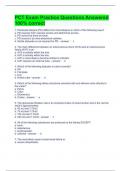
PCT Exam Practice Questions Answered 100% correct 1. Peritoneal dialysis (PD) differs from hemodialysis in which of the following ways? a. PD requires both vascular access and abdominal access. b. PD cannot be done at home. c. PD access is by intra-abdominal catheter. d. Sterile dialysate is not required for PD. c 2. The main difference between an arteriovenous shunt (AVS) and an arteriovenous fistula (AVF) is an: a. AVS is entirely within the arm. b. AVF is entirely within the arm. c. AVF is more likely to become clotted or infected. d. AVF requires an external tube. b 3. Which of the following dialyzers is used currently? a. Kiil b. Flat plate c. Coil d. Hollow tube d 4. Which of the following kidney structures connects with and delivers urine directly to the ureter? a. Pelvis b. Calyx c. Glomerulus d. Cortex a 5. The glomerular filtration rate is an important index of renal function and in the normal adult is approximately: a. 50 mL/min/1.73m2 b. 75 mL/min/1.73m2 c. 125 mL/min/1.73m2 d. 200 mL/min/1.73m2 c 6. All of the following substances are produced by the kidney EXCEPT: a. renin. b. aldosterone. c. erythropoeitin. d. calcitriol b 7. The most likely cause of post-renal failure is: a. severe dehydration. b. nephrotoxic drug. c. glomerulonephritis. d. benign prostatic hypertrophy. d 8. The most common cause of chronic kidney disease in the United States is: a. diabetes. b. hypertension. c. glomerulonephritis d. polycystic kidney disease. a 9. Uremia may cause which of the following conditions? a. Itching. b. Edema (swelling) of the extremities c. Anemia d. All of the above d 10. All of the following conditions are associated with chronic kidney failure EXCEPT: a. low hemoglobin. b. hypoparathyroidism. c. hyperkalemia. d. hyperphosphatemia. b 11. What percentage of transplanted kidneys is functional 1 year after transplantation? a. 90% b. 70% c. 50% d. 30% a 12. Which hemodialysis schedule is likely to be the most efficient? a. In-center hemodialysis, 3-4 hours a session, 3 days a week. b. Conventional home dialysis. c. Short daily home hemodialysis, 2-3 hours a session, 5-7 days a week. d. Nocturnal home hemodialysis, 8 hours during sleep, 3 days a week. c 13. The fluid restriction for most patients undergoing in-center hemodialysis is equal to urine volume/day plus: a. 0 L. b. 0.5 L c. 1.0 L d. 2.0 L c 14. Failure to excrete beta2-microglobulin in patients with kidney failure predisposes to: a. pericarditis. b. amyloidosis. c. neuropathy. d. seizures. b 15. Blood tests for ferritin are performed in hemodialysis patients: a. to check for iron stores. b. to check for magnesium levels. c. as an alternative to hemoglobin concentration. d. to maintain electrolyte balance. a 16. Which of the following phosphate binders would best control hyperphosphatemia with the fewest side effects in patients with end stage kidney disease? a. Aluminium hydroxide. b. Calcium carbonate. c. High dairy product diet. d. Lanthanum carbonate. d 17. Hemodialysis patients should be taught to: a. put in their own needles. b. weigh themselves and record it. c. check their dialyzer settings and dialysate. d. do all of the above. d 18. All of the following statements about vitamins in dialysis patients are true EXCEPT: a. dialysis does not remove water-soluble vitamins. b. supplemental B-complex vitamins should be given. c. vitamin D should be given to most dialysis patients. d. megadose fat -or water- soluble vitamins should not be given. a 19. Osmosis is best defined as: a. diffusion of solute through a semipermeable membrane from a high- to low - solute concentration. b. diffusion of solvent through a semipermeable membrane from low- to high-solute concentration. c. a version of hydraulic pressure used in dialysis. d. diffusion of solvent through a semipermable membrane from high- to low- solute concentration. b 20. In hemodialysis, blood and dialysate have which of the following properties? a. they flow in the same direction. b. they flow in opposite directions. c. they mix within the dialyzer. d. they do not require a semipermeable membrane. b 21. In the dialyzer, water may be removed from: a. the intracellular compartment. b. the intravascular compartment. c. the interstitial compartment. d. all of the above compartments. c 22. Which site in the hemodialysis pathway has the highest positive pressure? a. Arterial blood in the afferent tubing. b. Blood entering the dialyzer fibers. c. Blood leaving the dialyzer fibers. d. Blood in the venous return. b 23. The term "sieving coefficient of a membrane" refers to the: a. fraction of solute that passes through the membrane by convection. b. amount of water required for solute drag through the membrane. c. concentration of pores in the membrane. d. size of the pores in the membrane a
Información del documento
- Subido en
- 10 de agosto de 2023
- Número de páginas
- 23
- Escrito en
- 2023/2024
- Tipo
- Examen
- Contiene
- Preguntas y respuestas

