HAZMAT OPS Test Bank 1 (100% Correct) Questions and Answers
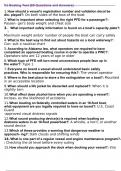
HAZMAT OPS Test Bank 1 (100% Correct) Questions and AnswersHAZMAT OPS Test Bank 1 (100% Correct) Questions and Answers Which of the following agencies regulates pipelines that carry hazardous materials across state borders, navigable waterways, and federal lands? a. EPA (Environmental Protection Association) b. CERCLA (Comprehensive Environmental Response Compensation & Liability Act) c. DOT (Department of Transportation) d. FEMA (Federal Emergency Management Association) - c. DOT (Department of Transportation) Of the following, which is the quickest available source of MSDS for first responders at a hazmat emergency? a. the supplier of the material b. the Local Emergency Planning Committee (LEPC) c. CHEMTRAC d. OSHA - c. CHEMTRAC Directions: Read the statements below and select your answer from alternatives A-D. Statement 1: If placards are clearly displayed on the transportation mode, shipping papers are not required. Statement 2: If a transportation mode is not carrying hazardous materials, there is no requirement for specific information to be provided on shipping papers. Statement 3: Shipping papers must contain the proper name of the chemical or its hazard class. a. all three statements are true b. statement 1 is true; statement 2 and 3 are false c. statements 1 and 3 are true; statement 2 is false d. statements 2 and 3 are true; and statement 1 is false - d. statements 2 and 3 are true; and statement 1 is false Directions: Read the statements below and select your answer from alternatives A-D. Statement 1: When carrying hazardous materials, transportation mode must carry shipping papers. Statement 2: Shipping papers may include a packing group number listed as I, II, or III. Statement: The higher the packing group number, the more dangerous the chemical is. a. statement 1 is true; statements 2 and 3 are false b. statements 1 and 2 are true; statement 3 is false c. statements 2 and 3 are true; statement 1 is false d. all three statements are true - b. statements 1 and 2 are true; statement 3 is false Who is responsible for care and control of a bill of lading? a. conductor/crew b. driver c. Captain or Master d. pilot - b. driver Who is responsible for care and control of dangerous cargo manifest? a. Captain or Master b. Conductor/crew c. pilot d. driver - a. Captain or Master Who is responsible for care and control of an air bill? a. Captain or Master b. Conductor/crew c. pilot d. driver - c. pilot Where would a first responder expect to find a dangerous cargo manifest? a. Bridge or pilot house b. engine or caboose c. cockpit cab of the vehicle - a. Bridge or pilot house Where would a first responder expect to find a waybill or consist? a. cab of truck b. cockpit c. bridge or pilot house d. engine or caboose - d. engine or caboose Where would a first responder expect to find an airbill? a. cab of the vehicle b. cockpit c. bridge or pilot house d. engine or caboose - b. cockpit Which of the following is not an indication of a physical action? a. activated pressure-relief devices b. pinging or popping of heat-exposed vessels c. wavy vapors over the surface of liquid puddle d. wavy vapors over water surfaces - d. wavy vapors over water surfaces Direction: Read the following statements regarding hazmat recognition and identification and select your answer from alternatives A-D. Statement 1: There are numerous informal ways to recognize the presence of hazardous materials. Statement 2: Using the senses of sight, sound and odor is one of the informal ways of recognizing the presence of hazardous. Statement 3: Using the human senses indiscriminately to detect the presence of hazmat, while fairly reliable, is unsafe. a. all three statements are true b. statement 1 is true; statements 2 and 3 are false c. statements 1 and 2 are true; statement 3 is false d. statements 2 and 3 are true; statement 1 is false - c. statements 1 and 2 are true; statement 3 is false The senses which are acceptable for use in hazmat detection are: a. touch, smell, and taste b. vision and smell c. vision and hearing d. smell and hearing - c. vision and hearing You have arrived on the scene of an incident involving an explosion. People in the immediate vicinity are all experiencing runny noses and difficulty breathing. Some are having convulsions. You suspect a terrorist incident involving a: a. biological agent b. blister agent c. nerve agent d. blood agent - c. nerve agent While extinguishing a small fire in an unoccupied house, you discover a lab setup and numerous types of raw materials. There is a particularly large amount of powders. What type of illegal activity might be occurring here? a. explosive manufacturing b. drug production c. biological weapons production d. chemical agent production - a. explosive manufacturing In the course of extinguishing a small fire in an unoccupied house you discover the presence of chemicals and lab equipment, an indicator of possible illegal activity. According to statistics, the most likely illegal activity occurring is: a. bomb making b. warfare agent research c. drug making d. terrorism agent production - c. drug making Using the nuclear, biological and chemical (NBC) classification, which of the following is not considered a biological warfare agent? a. Mycotoxins b. Tularemia c. Plague d. Soman - d. Soman Of the following biological or chemical agents, which is the easiest for a terrorist to make? a. Ricin b. Vessicants c. Nerve agents d. Blood agents - a. Ricin Directions: Read the statements below and select your answer from alternatives A-D. Statement 1: Nerve agents were designed for one purpose--to kill people. Statement 2: Blood and choking agents, while being terrorism agents, are also common industrial chemicals. Statement 3: Biological agents are the easiest of the categories of warfare agents to make. a. Statement 1 is true, statement 2 and 3 are false. b. Statements 1 and 2 are true; statement 3 is false. c. Statement 1 is false; statements 2 and 3 are true. d. All three statements are true - d. All three statements are true. The acronym SLUDGEM is used to describe the signs and symptoms of exposure to which of the categories of warfare agents? a. Nerve agents b. Vesicants c. Blood and choking agents d. Biological agents - a. Nerve agents Blister agents belong in which category of warfare agents under the CBRNE classification? a. Biological b. Incendiary c. Chemical d. Explosive - c. Chemical Directions: Read the statements below and select your answer from alternatives A-D. Statement 1: Federal public buildings are prime targets for terrorist attacks. Statement 2: Social security buildings would be an exception to statement 1, above. Statement 3: Virtually all terrorist attacks are directed toward public buildings. a. Statements 1 and 2 are true; statement 3 is false. b. Statements 1 and 3 are true, statement 2 is false. c. Statement 1 is true; statements 2 and 3 are false. d. All three statements are true. - c. Statement 1 is true; statements 2 and 3 are false. Which of the following are signs and symptoms of exposure to a nerve agent at a Haz Mat or suspected terrorism incident? a. Eye and respiratory irritation b. Dizziness and difficulty breathing c. Loss of bladder control and vomiting d. Fever and muscle tenderness - c. Loss of bladder control and vomiting Using the nuclear, biological and chemical (NBC) classification, which of the following is not considered a chemical warfare agent? a. Sarin b. Mustard c. Ricin
Escuela, estudio y materia
- Institución
- HAZMAT OPS
- Grado
- HAZMAT OPS
Información del documento
- Subido en
- 30 de julio de 2023
- Número de páginas
- 18
- Escrito en
- 2022/2023
- Tipo
- Examen
- Contiene
- Preguntas y respuestas
Temas
-
hazmat ops test bank 1 100 correct questions an