NUTRITION ATI PRACTICE A & B 2019|WITH 100% CORRECT ANSWERS|ALREADY GRADED A|DOWNLOAD TO PASS
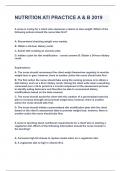
A nurse is caring for a client who expresses a desire to lose weight. Which of the following actions should the nurse take first? A. Recommend checking weight once weekly. B. Obtain a 24-hour dietary recall. C. Assist with creating an exercise plan. D. Initiate a plan for diet modification. B. Obtain a 24-hour dietary recall. Explanations: A. The nurse should recommend the client weigh themselves regularly to monitor weight loss or gain; however, there is another action the nurse should take first. B. The first action the nurse should take using the nursing process is to obtain a diet history, such as a 24-hr dietary recall. Having the client write down everything consumed over a 24-hr period is a crucial component of the assessment process to identify eating behaviors and therefore be able to recommend dietary modifications based on the data received. C. The nurse should assist the client with the creation of a personalized exercise plan to increase strength and promote weight loss; however, there is another action the nurse should take first. D. The nurse should initiate a personalized diet modification plan with the client based on the client's assessment data to promote weight loss; however, there is another action the nurse should take first. A nurse is teaching about nutritional requirements for a client who is starting a vegetarian diet. Which of the following information should the nurse include in the teaching? A. Consume high-fat cheese to replace meats when on a vegetarian diet. B. A vegetarian diet is high in vitamin B12. C. Fewer calories are required when on a vegetarian diet. D. Include two servings per day of nuts when on a vegetarian diet. D. Include two servings per day of nuts when on a vegetarian diet. Explanations: A. The nurse should instruct the client to consume low-fat cheese as a protein substitute. High-fat cheese has more saturated fat and calories than meat. B. Foods that contain vitamin B12 are animal-related. The best sources of dietary vitamin B12 are meats and other animal products. As vitamin B12 is generally not present in plant-based foods, the nurse should instruct the client to take vitamin B12 supplements or consume foods fortified with B12 to compensate for a potential deficiency. C. Clients who are consuming a vegetarian diet require a deceased intake of dietary fat rather than fewer calories. The nurse should instruct the client to increase intake of nutrient-dense foods to avoid the breakdown of the body's protein for energy requirements. D. The nurse should instruct the client to eat two servings of nuts or flaxseed per day to receive the daily requirement of omega-3 fatty acids. A nurse is caring for a client who has acute inflammatory bowel disease. Which of the following nutritional supplements should the nurse anticipate providing to this client? A. Hydrolyzed formula B. Polymeric formula C. Milk-based supplement formula D. Modular product supplement formula A. Hydrolyzed formula Explanations: A. Hydrolyzed or elemental formula provides protein and other nutrients in their simplest form, requiring little or no digestion and decreasing stimulation of the bowel. This type of formula is beneficial for clients who have impaired digestion due to conditions such as inflammatory bowel disease. B. Polymeric formula contains complex nutrient molecules and is not indicated for clients who have impaired digestion. C. Milk-based supplemental formulas contain lactose and are poorly tolerated by clients who have inflammatory bowel disease. D. Modular formulas are intended to increase the intake of a specific nutrient without increasing volume; they are not intended for clients who have impaired digestion. A nurse is teaching a client who is newly diagnosed with type 1 diabetes mellitus how to count carbohydrates. Which of the following statements made by the client indicates and understanding of the teaching? A. "I am including vegetables as starch items in my carbohydrate count." B. "I am limiting the number of carbohydrates to four carbohydrate choices or 60 grams per day." C. "I know the serving size can affect the number of carbohydrates I eat." D. "I know the carbohydrate count is dependent on the calories in the food item." C. "I know the serving size can affect the number of carbohydrates I eat." Explanation: A. The nurse should instruct the client about the difference between starchy and nonstarchy vegetables to accurately calculate the carbohydrate count. B. The nurse should instruct the client that generally three to five carbohydrate choices, or 45 g, are allowed per meal, plus one to two carbohydrate choices for each snack. C. The nurse should instruct the client that the portion size affects the number of carbohydrates. D. The nurse should instruct the client that the carbohydrate count is not dependent on the calorie count of a food item. Fats and proteins can provide calories as well. A nurse is providing dietary teaching for a client who has osteoporosis. The nurse should instruct the client that which of the following foods has the highest amount of calcium? A. 1 cup avocado B. 2 tablespoons peanut butter C. ½ cup roasted sunflower seeds D. ½ cup roasted almonds D. ½ cup roasted almonds Explanation: A. The nurse should recommend a different food because there is another choice that contains a higher amount of calcium. One cup of avocado contains 18 mg of calcium. B. The nurse should recommend a different food because there is another choice that contains a higher amount of calcium. Two tablespoons of peanut butter contain 17 mg of calcium. C. The nurse should recommend a different food because there is another choice that contains a higher amount of calcium. One half cup of roasted sunflower seeds contains 45 mg of calcium. D. The nurse should determine that ½ cup roasted almonds is the best food source to recommend because ½ cup of almonds contains 185 mg of calcium. Calcium helps to prevent bone loss in clients who have osteoporosis. A nurse is discussing dietary factors to assist in blood pressure management for a client who has hypertension. Which of the following client statements indicates an understanding of the teaching? A. "I can drink up to three glasses of wine each day." B. "I should choose whole grain pastas when selecting my foods." C. "I should decrease my consumption of foods high in potassium." D. "I can use low-sodium salt substitutes when I cook my food." B. "I should choose whole grain pastas when selecting my foods." Explanation: A. The client can consume alcohol in moderation, if at all. Moderate daily alcohol intake is one drink for women and two drinks for men. B. Whole grains are a healthy choice of carbohydrate because they contain ingredients that lower the risk of cardiovascular disease and improve blood pressure. C. Increased potassium levels decrease blood pressure levels. The client should increase their consumption of foods containing potassium. D. The nurse should instruct the client that low-sodium salt substitutes are not sodium-free and can contain nearly half as much sodium as table salt. A nurse is caring for a client who has a new prescription for parenteral nutrition (PN) containing a mixture of dextrose, amino acids, and lipids. Prior to administration of the PN, the nurse should report which of the following food allergies to the provider? A. Gelatin B. Peanuts C. Shellfish D. Eggs D. Eggs Explanations: A. There is no indication that a gelatin allergy has an effect on the administration of PN. Therefore, the nurse should report this allergy to the dietitian, rather than the provider. B. There is no indication that a peanut allergy has an effect on the administration of PN. Therefore, the nurse should report this allergy to the dietitian, rather than the provider. C. There is no indication that a shellfish allergy has an effect on the administration of PN. Therefore, the nurse should report this allergy to the dietitian, rather than the provider. D. Lipid emulsions are isotonic and are composed of soybean or safflower plus soybean oil, with egg phospholipid used as an emulsifier. Clients who are allergic to eggs can have a reaction to the emulsifier. Therefore, the nurse should report this finding to the provider. A nurse is teaching a client who has chronic kidney disease about limiting dietary calcium intake. Which of the following food choices should the nurse include in the teaching as having the highest amount of calcium? A. 1 cup low-fat yogurt B. 1 oz cheddar cheese C. 1 egg D. ½ cup spinach A. 1 cup low-fat yogurt Explanation: A. The nurse should determine that low-fat yogurt contains 314 mg of calcium per cup, which is the highest amount of calcium; therefore, the client should limit low-fat yogurt in the diet. B. The nurse should recommend a different food item to limit because there is another choice that contains more calcium. Cheddar cheese contains 214 mg of calcium per ounce. C. The nurse should recommend a different food item to limit because there is another choice that contains more calcium. One egg contains 25 mg of calcium. D. The nurse should recommend a different food item to limit because there is another choice that contains more calcium. Spinach contains 122 mg of calcium per half cup. A home health nurse is providing dietary teaching to a guardian of a 3-year-old child. Which of the following statements by the guardians should the nurse identify as understanding of the teaching? A. "I will offer my child a cup of peanut butter to dip her celery in." B. "I can leaver her grapes whole, so she can practice getting them with her fork." C. "I can giver her popcorn as a snack to provide a serving of whole grains." D. "I will put low-fat milk in her cup for her to drink." D. "I will put low-fat milk in her cup for her to drink." Explanation: A. The nurse should instruct the guardians to avoid giving the 3-year-old child celery or large amounts of peanut butter because both foods present a choking hazard. The guardians should spread peanut butter in a thin layer to decrease the risk of choking. B. The nurse should instruct the guardians to cut items into small pieces to reduce the risk of choking. C. The nurse should instruct the guardians to avoid foods that are easy to swallow whole, such as popcorn or hard pretzels, until the child is 4 years old, because they present a choking hazard. D. Whole milk provides necessary fat for neurological development for children up to 2 years of age, after which the child should consume low-fat or skim milk. Therefore, the nurse should identify this statement as indicating an understanding of the teaching. A nurse is caring for an adolescent who has type 1 diabetes mellitus. Which of the following actions should the nurse take to assess for Somogyi phenomenon? A. Monitor blood glucose levels during the night. B. Check for urinary ketones at the same time each day for 1 week. C. Perform an oral glucose tolerance test after administering a dose of insulin. D. Compare current glycosylated hemoglobin level with the level at time of diagnosis. A. Monitor blood glucose levels during the night. Explanation: A. Somogyi phenomenon is fasting hyperglycemia that occurs in the morning in response to hypoglycemia during the nighttime. The nurse should assess for this phenomenon by monitoring blood glucose levels during the night. B. The nurse's assessment of urinary ketones at the same time each day for 1 week is not an effective method of assessing for Somogyi phenomenon. Testing for urinary ketones occurs when a client is experiencing diabetic ketoacidosis. C. The nurse's administration of an oral glucose tolerance test after administering a dose of insulin is not an effective method of assessing for Somogyi phenomenon. D. The nurse's comparison of the current glycosylated hemoglobin level with the level at time of diagnosis is not an effective method of assessing for Somogyi phenomenon. Glycosylated hemoglobin levels are tested to diagnose diabetes and measure compliance and therapeutic effect of a client's diabetic regimen. A nurse is reviewing the introduction of solid foods with the guardian of a 4-month-old infant. Which of the following statements by the guardian indicates an understanding of the teaching? A. "My baby should consume 2 tablespoons of solid food at each feeding." B. "The majority of my baby's calories should come from solid food." C. "I will give my baby one bottle of fruit juice each day." D. "I will introduce a new solid food every 5 days." D. "I will introduce a new solid food every 5 days." Explanation: A. Infants should consume 1 to 2 teaspoons of solid food initially at each feeding. B. The infant should receive the majority of calories from infant formula or breast milk. C. Fruit juices should be introduced at 6 months of age, limited to 120 mL (4 oz), and offered in a cup. D. The client understands that new food items should be introduced every 4 to 7 days to monitor for indications of food allergies. A nurse in a long-term care facility is monitoring a client during mealtime who has Parkinson's disease. Which of the following findings should the nurse identify as the priority? A. The client eats all of their cake and a few bites of bread. B. The client drools while eating. C. The client's hand trembles when they hold their spoon. D. The client chooses to sit alone during the meal. B. The client drools while eating. Explanation: A. Eating small portions of non-nutritious foods instead of high-protein, high-calorie foods indicates that the client might be at risk for malnutrition; however, the nurse should identify another finding as the priority. B. Drooling while eating can indicate that this client is at greatest risk for aspiration of food from dysphagia, which can lead to pulmonary complications; therefore, the nurse should identify this as the priority finding. C. The nurse should offer the client assistance with feeding to promote adequate food and fluid intake; however, the nurse should identify another finding as the priority. D. The nurse should identify that the client is at risk for social isolation due to the disease process, which can lead to depression; however, the nurse should identify another finding as the priority. A home health nurse is reviewing the medical record of a client who had an open reduction internal fixation of the tibia. Which of the following findings should the nurse identify as a risk factor for impaired wound healing? A. The client's hemoglobin is 15 g/dL. B. The client's peripheral pulses are +3 distal to the affected extremity. C. The client consumes 1,000 kcal daily. D. The client takes zinc supplements. C. The client consumes 1,000 kcal daily. Explanation: A. A hemoglobin level of 15 g/dL is within the expected reference range of 14 to 18 g/dL in men and 12 to 16 g/dL in women. A hemoglobin level below the expected reference range is a risk factor for impaired wound healing. B. Pulses +3 strength are an expected finding. The nurse should identify decreased tissue perfusion as a risk factor for impaired wound healing. C. Adults who have had surgery require at least 1,500 kcal daily to meet energy needs and build protein for tissue healing. The nurse should recognize that a 1,000 kcal/day intake is below the client's needs. D. The body uses zinc to build proteins and aid the immune response. The nurse should identify this finding as a factor that will promote wound healing. A nurse is providing teaching to a client who has diabetes mellitus and an HbA1c of 8.7%. Which of the following statements by the client indicates an understanding of this laboratory value? A. "I should have gone to my exercise class yesterday." B. "This shows that my result is finally within a normal range." C. "This shows that I have not been following my diet." D. "I should have my blood work done first thing in the morning." C. "This shows that I have not been following my diet." Explanation: A. Short-term factors, such as exercise, do not affect the client's HbA1c level. B. The HbA1c goal level for a client who has diabetes is between 6.5% and 7%. An HbA1c level of 8.7% indicates less than optimal diabetic control. C. An HbA1c level of 8.7% is not within the expected reference range. The HbA1c goal level for a client who has diabetes is between 6.5% and 7%. D. The client can give a blood sample at any time of the day because the HbA1c level indicates the average blood glucose levels for the previous 100- to 120-day period. Fasting is not required.
Escuela, estudio y materia
- Institución
- NUTRITION ATI
- Grado
- NUTRITION ATI
Información del documento
- Subido en
- 29 de julio de 2023
- Número de páginas
- 78
- Escrito en
- 2022/2023
- Tipo
- Examen
- Contiene
- Preguntas y respuestas
Temas
-
nutrition ati practice a amp b 2019|with 100 correc

Documento también disponible en un lote