Social psychology
Date: 12/10/22
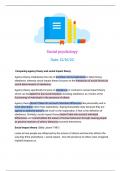
Comparing agency theory and social impact theory
Agency theory emphasizes the role of evolution and socialization on determining
obedience, whereas social impact theory focuses on the interaction of social forces as
social determinants of obedience.
Agency theory specifically focuses on obedience, in contrast to social impact theory
which can be applied to any social situation including obedience, as it looks at the
functioning of individuals in the presence of others.
Agency theory doesn’t take into account individual differences like personality and is
more descriptive rather than explanatory. Saying that people obey because they are
agents to authority doesn’t add much to the explanation, if that is the definition of
obedience. Similarly, social impact theory doesn’t take into account individual
differences and oversimplifies the nature of human behaviour through viewing people
as passive receivers of others’ behaviour towards themselves.
Social impact theory (Bibb Latane’ 1981)
Looks at how people are influenced by the actions of others and how this affects the
way they think and behave = social impact - how the presence of others (real, imagined,
implied) impacts us.
, 2
Target : the person being socially impacted
Source: the influencer
Multiplicative effect
Strength: determined by status, authority and age of source.
Immediacy: proximity/distance to source
Number: of targets and sources or presence of buffers that could act as barriers to
distance.
Divisional effect
Social pressure splits up among more targets. The number of targets to be influenced
affects the impact of the source.
Supporting evidence
Milgram’s variation #17 had 2 rebel peer confederates with teacher that refused to
continue.
Obedience dropped to 10%.
This shows that other individuals impact behavior as opposed to when alone-supporting
the divisional effect.
Conflicting evidence
Ignores individual differences: views people as passive receivers of others’ behavior.
Some are more resistant to social impact than others.
Oversimplifies the nature of human behavior/interaction.
Other explanations
In Milgram’s variation #10, obedience was lower in a run-down office block than at Yale
University.
Agency theory explains this through the prestige (legitimacy) of the setting adding to
status of authority, but social impact theory cannot.
, 3
Moral strain of participants in Milgram’s original experiment was explained in Agency
theory but not in social impact theory that considers only disobedience and obedience
but nothing in between.
Usefulness
Latane’ s mathematical formula allows us to predict whether laws will be followed from
knowing the number of people, the immediacy of order and strength of authority figure.
Testable
Limited to 1 type of social interaction : no prediction of what will happen if 2 equal
groups impact on one another.
Target and source interaction can’t be explained (not certain if principles of this theory
would apply in such cases).
Agency theory (Milgram 1963)
When people obey orders, they don’t feel responsible for their actions but act as agents
for authority figures, even if they act against their own moral values.
Moral strain: experiencing anxiety by doing something that goes against your moral
judgment since you feel powerless in disobeying.
Due to binding agents/factors that increase legitimacy of authority, we remain in an
agentic state to shift authority for consequences of our actions on the authority figure
and deny the severity of the resulting damage, reducing moral strain.
Agentic state: allowing others to direct our actions and passing off responsibility to
those giving orders. Acting as agents for authority figures.
- Person giving orders must be perceived as legitimate authority
- Person being ordered must believe that the authority will accept responsibility for
their actions.
Autonomous state: acting according to your own values, taking responsibility for the
results of your actions.
Supporting evidence
Milgram's original experiment supports agency theory as participants showed signs of
moral strain and during debrief, they stated that the experimenter would have taken
, 4
responsibility for their actions and that they didn’t want to administer potentially lethal
shocks.
This provides evidence for the concept of displacement of responsibility.
Conflicting evidence
No explanation of individual differences (why some obey but others don’t)
Research evidence suggests that dissent occurs due to gender differences, personality
type, situational factors.
Obedience is a more complex process than is being explained by agency theory.
Other explanations
No explanation of motivational issues behind obedience
French and Raven ( 1959) identified 5 bases of power held by individuals determining
obedience shown by group:
Legitimate, Reward. Referent, Expert, Coercive motivate and influence behavior
Better explanation for obedience and Milgram’s findings in his research
Usefulness
Used to explain real-life events involving obedience to authority
Ex. During Vietnam war, village My Lai massacred by American soldiers ordered by
Lieutenant Calley who stated in his court martial that he was just following orders=
Supporting agency theory involving a displacement of responsibility.
Testable
Concepts of autonomy and agency are difficult to define and measure.
Agency is a state of mind switched on when given an order by an authority figure
-this concept is an internal mental process that can’t be directly measured, only inferred
from the behavior of the agent.
Can’t objectively measure agency theory as an explanation for obedience.
Date: 12/10/22
Comparing agency theory and social impact theory
Agency theory emphasizes the role of evolution and socialization on determining
obedience, whereas social impact theory focuses on the interaction of social forces as
social determinants of obedience.
Agency theory specifically focuses on obedience, in contrast to social impact theory
which can be applied to any social situation including obedience, as it looks at the
functioning of individuals in the presence of others.
Agency theory doesn’t take into account individual differences like personality and is
more descriptive rather than explanatory. Saying that people obey because they are
agents to authority doesn’t add much to the explanation, if that is the definition of
obedience. Similarly, social impact theory doesn’t take into account individual
differences and oversimplifies the nature of human behaviour through viewing people
as passive receivers of others’ behaviour towards themselves.
Social impact theory (Bibb Latane’ 1981)
Looks at how people are influenced by the actions of others and how this affects the
way they think and behave = social impact - how the presence of others (real, imagined,
implied) impacts us.
, 2
Target : the person being socially impacted
Source: the influencer
Multiplicative effect
Strength: determined by status, authority and age of source.
Immediacy: proximity/distance to source
Number: of targets and sources or presence of buffers that could act as barriers to
distance.
Divisional effect
Social pressure splits up among more targets. The number of targets to be influenced
affects the impact of the source.
Supporting evidence
Milgram’s variation #17 had 2 rebel peer confederates with teacher that refused to
continue.
Obedience dropped to 10%.
This shows that other individuals impact behavior as opposed to when alone-supporting
the divisional effect.
Conflicting evidence
Ignores individual differences: views people as passive receivers of others’ behavior.
Some are more resistant to social impact than others.
Oversimplifies the nature of human behavior/interaction.
Other explanations
In Milgram’s variation #10, obedience was lower in a run-down office block than at Yale
University.
Agency theory explains this through the prestige (legitimacy) of the setting adding to
status of authority, but social impact theory cannot.
, 3
Moral strain of participants in Milgram’s original experiment was explained in Agency
theory but not in social impact theory that considers only disobedience and obedience
but nothing in between.
Usefulness
Latane’ s mathematical formula allows us to predict whether laws will be followed from
knowing the number of people, the immediacy of order and strength of authority figure.
Testable
Limited to 1 type of social interaction : no prediction of what will happen if 2 equal
groups impact on one another.
Target and source interaction can’t be explained (not certain if principles of this theory
would apply in such cases).
Agency theory (Milgram 1963)
When people obey orders, they don’t feel responsible for their actions but act as agents
for authority figures, even if they act against their own moral values.
Moral strain: experiencing anxiety by doing something that goes against your moral
judgment since you feel powerless in disobeying.
Due to binding agents/factors that increase legitimacy of authority, we remain in an
agentic state to shift authority for consequences of our actions on the authority figure
and deny the severity of the resulting damage, reducing moral strain.
Agentic state: allowing others to direct our actions and passing off responsibility to
those giving orders. Acting as agents for authority figures.
- Person giving orders must be perceived as legitimate authority
- Person being ordered must believe that the authority will accept responsibility for
their actions.
Autonomous state: acting according to your own values, taking responsibility for the
results of your actions.
Supporting evidence
Milgram's original experiment supports agency theory as participants showed signs of
moral strain and during debrief, they stated that the experimenter would have taken
, 4
responsibility for their actions and that they didn’t want to administer potentially lethal
shocks.
This provides evidence for the concept of displacement of responsibility.
Conflicting evidence
No explanation of individual differences (why some obey but others don’t)
Research evidence suggests that dissent occurs due to gender differences, personality
type, situational factors.
Obedience is a more complex process than is being explained by agency theory.
Other explanations
No explanation of motivational issues behind obedience
French and Raven ( 1959) identified 5 bases of power held by individuals determining
obedience shown by group:
Legitimate, Reward. Referent, Expert, Coercive motivate and influence behavior
Better explanation for obedience and Milgram’s findings in his research
Usefulness
Used to explain real-life events involving obedience to authority
Ex. During Vietnam war, village My Lai massacred by American soldiers ordered by
Lieutenant Calley who stated in his court martial that he was just following orders=
Supporting agency theory involving a displacement of responsibility.
Testable
Concepts of autonomy and agency are difficult to define and measure.
Agency is a state of mind switched on when given an order by an authority figure
-this concept is an internal mental process that can’t be directly measured, only inferred
from the behavior of the agent.
Can’t objectively measure agency theory as an explanation for obedience.