1. Leading questions
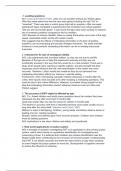
A01: Lotus and Palmer (1974), video of a car accident without any broken glass.
After they were asked how fast the cars were going including the verb "hit" or
"smashed". There was also a control group that had no question. After one week
participants (pps) completed a questionnaire that contained one critical question:
"Did you see any broken glass". It was found that pps were twice as likely to respond
yes in smashed condition compared to the hit condition.
A03: Because of schema, Bartlett. Glass is usually there when cars crush at the high
speed, associated certain words with certain results.
This suggests that the effects of misleading information in the form of leading
questions can be long lasing and actually changes memories. The study provides
evidence to how powerful misleading information can be in creating inaccurate
memories.
2. Criticised for its lack of ecological validity.
A03: Lab experiments lack mundane realism, so they are not true to real-life.
Because of that pps do not take the experiment seriously and they are not
emotionally aroused in the way that they would be in a real accident. There was a
study when people were watching a real-life robbery, and also thought that their
responses would influence the trial, their identification of the robber was more
accurate. Therefore, Loftus' results are invalid as they do not represent how
misleading information affects our memory in real-life setting.
Furthermore, when interviewing Canadian robbery witnesses 4 months after the
crime, their reports were accurate even after including 2 misleading questions. This
could be due to the culture difference. However, it provides strong support for the
idea that misleading information doesn't influence recall as much as Loftus and
Palmer suggest.
3. The accuracy of EWT might be affected by age.
A01: Flin: Asked children and adults same questions about the incident they have
witnessed one day after event and 5 months after
recall was similar after one day but worse for children 5 months later
The decline in accuracy with time is important because court cases usually occur a
long time after the crime itself. Valentine and Coxon (1997)
Method: a video of kidnapping. Children, young adults and elderly asked a series of
leading and non -leading questions
Results: elderly and children gave more incorrect answers. Children were mislead
more by leading questions
A03: implications in law when children and elderly and questioned.
4. Real world applications in justice system.
A03: A strength of research investigating EWT is its application to the criminal justice
system, which relies heavily on eyewitness identification for investigating and
prosecuting crimes. It is believed that mistaken eye witness identification was the
largest single factor contributing to the conviction of innocent people. Understanding
that EWT is not always accurate and there are many factors at play when recalling
an event helped the justice system be more fair. Development of cognitive interview
to reduce the influence of schemas.
A01: Lotus and Palmer (1974), video of a car accident without any broken glass.
After they were asked how fast the cars were going including the verb "hit" or
"smashed". There was also a control group that had no question. After one week
participants (pps) completed a questionnaire that contained one critical question:
"Did you see any broken glass". It was found that pps were twice as likely to respond
yes in smashed condition compared to the hit condition.
A03: Because of schema, Bartlett. Glass is usually there when cars crush at the high
speed, associated certain words with certain results.
This suggests that the effects of misleading information in the form of leading
questions can be long lasing and actually changes memories. The study provides
evidence to how powerful misleading information can be in creating inaccurate
memories.
2. Criticised for its lack of ecological validity.
A03: Lab experiments lack mundane realism, so they are not true to real-life.
Because of that pps do not take the experiment seriously and they are not
emotionally aroused in the way that they would be in a real accident. There was a
study when people were watching a real-life robbery, and also thought that their
responses would influence the trial, their identification of the robber was more
accurate. Therefore, Loftus' results are invalid as they do not represent how
misleading information affects our memory in real-life setting.
Furthermore, when interviewing Canadian robbery witnesses 4 months after the
crime, their reports were accurate even after including 2 misleading questions. This
could be due to the culture difference. However, it provides strong support for the
idea that misleading information doesn't influence recall as much as Loftus and
Palmer suggest.
3. The accuracy of EWT might be affected by age.
A01: Flin: Asked children and adults same questions about the incident they have
witnessed one day after event and 5 months after
recall was similar after one day but worse for children 5 months later
The decline in accuracy with time is important because court cases usually occur a
long time after the crime itself. Valentine and Coxon (1997)
Method: a video of kidnapping. Children, young adults and elderly asked a series of
leading and non -leading questions
Results: elderly and children gave more incorrect answers. Children were mislead
more by leading questions
A03: implications in law when children and elderly and questioned.
4. Real world applications in justice system.
A03: A strength of research investigating EWT is its application to the criminal justice
system, which relies heavily on eyewitness identification for investigating and
prosecuting crimes. It is believed that mistaken eye witness identification was the
largest single factor contributing to the conviction of innocent people. Understanding
that EWT is not always accurate and there are many factors at play when recalling
an event helped the justice system be more fair. Development of cognitive interview
to reduce the influence of schemas.