

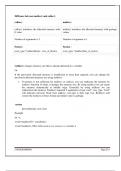
Diffrence between malloc() and calloc()
calloc() malloc()
calloc() initializes the allocated memory with malloc() initializes the allocated memory with garbage
0 value. values.
Number of arguments is 2 Number of argument is 1
Syntax : Syntax :
(cast_type *)calloc(blocks , size_of_block); (cast_type *)malloc(Size_in_bytes);
realloc(): changes memory size that is already allocated to a variable.
Or
If the previously allocated memory is insufficient or more than required, you can change the
previously allocated memory size using realloc().
If memory is not sufficient for malloc() or calloc(), you can reallocate the memory by
realloc() function. In short, it changes the memory size. By using realloc() we can create
the memory dynamically at middle stage. Generally by using realloc() we can
reallocation the memory. Realloc() required 2 arguments of type void*, size_type. Void*
will indicates previous block base address, size-type is data type size. Realloc() will
creates the memory in bytes format and initial value is garbage.
syntax
ptr=realloc(ptr, new-size)
Example
int *x;
x=(int*)malloc(50 * sizeof(int));
x=(int*)realloc(x,100); //allocated a new memory to variable x
C PROGRAMMING Page 231
,Example
void*realloc(void*, size-type);
int *arr;
arr=(int*)calloc(5, sizeof(int));
.....
........
....
arr=(int*)realloc(arr,sizeof(int)*10);
Example:
#include <stdio.h>
#include <stdlib.h>
int main()
{
int *ptr, i , n1, n2;
printf("Enter size of array: ");
scanf("%d", &n1);
ptr = (int*) malloc(n1 * sizeof(int));
printf("Address of previously allocated memory: ");
for(i = 0; i < n1; ++i)
printf("%u\t",ptr + i);
printf("\nEnter new size of array: ");
scanf("%d", &n2);
ptr = realloc(ptr, n2);
for(i = 0; i < n2; ++i)
printf("%u\t", ptr + i);
return 0;
}
C PROGRAMMING Page 232
, free()
When your program comes out, operating system automatically release all the memory allocated
by your program but as a good practice when you are not in need of memory anymore then you
should release that memory by calling the function free().
The memory occupied by malloc() or calloc() functions must be released by calling free()
function. Otherwise, it will consume memory until program exit.
Or
Dynamically allocated memory created with either calloc() or malloc() doesn't get freed on its
own. You must explicitly use free() to release the space.
Syntax:
free(ptr);
Example
#include <stdio.h>
#include <stdlib.h>
int main()
{
int num, i, *ptr, sum = 0;
printf("Enter number of elements: ");
scanf("%d", &num);
ptr = (int*) malloc(num * sizeof(int)); //memory allocated using malloc
if(ptr == NULL)
{
printf("Error! memory not allocated.");
exit(0);
}
printf("Enter elements of array: ");
for(i = 0; i < num; ++i)
{
scanf("%d", ptr + i);
C PROGRAMMING Page 233
calloc() malloc()
calloc() initializes the allocated memory with malloc() initializes the allocated memory with garbage
0 value. values.
Number of arguments is 2 Number of argument is 1
Syntax : Syntax :
(cast_type *)calloc(blocks , size_of_block); (cast_type *)malloc(Size_in_bytes);
realloc(): changes memory size that is already allocated to a variable.
Or
If the previously allocated memory is insufficient or more than required, you can change the
previously allocated memory size using realloc().
If memory is not sufficient for malloc() or calloc(), you can reallocate the memory by
realloc() function. In short, it changes the memory size. By using realloc() we can create
the memory dynamically at middle stage. Generally by using realloc() we can
reallocation the memory. Realloc() required 2 arguments of type void*, size_type. Void*
will indicates previous block base address, size-type is data type size. Realloc() will
creates the memory in bytes format and initial value is garbage.
syntax
ptr=realloc(ptr, new-size)
Example
int *x;
x=(int*)malloc(50 * sizeof(int));
x=(int*)realloc(x,100); //allocated a new memory to variable x
C PROGRAMMING Page 231
,Example
void*realloc(void*, size-type);
int *arr;
arr=(int*)calloc(5, sizeof(int));
.....
........
....
arr=(int*)realloc(arr,sizeof(int)*10);
Example:
#include <stdio.h>
#include <stdlib.h>
int main()
{
int *ptr, i , n1, n2;
printf("Enter size of array: ");
scanf("%d", &n1);
ptr = (int*) malloc(n1 * sizeof(int));
printf("Address of previously allocated memory: ");
for(i = 0; i < n1; ++i)
printf("%u\t",ptr + i);
printf("\nEnter new size of array: ");
scanf("%d", &n2);
ptr = realloc(ptr, n2);
for(i = 0; i < n2; ++i)
printf("%u\t", ptr + i);
return 0;
}
C PROGRAMMING Page 232
, free()
When your program comes out, operating system automatically release all the memory allocated
by your program but as a good practice when you are not in need of memory anymore then you
should release that memory by calling the function free().
The memory occupied by malloc() or calloc() functions must be released by calling free()
function. Otherwise, it will consume memory until program exit.
Or
Dynamically allocated memory created with either calloc() or malloc() doesn't get freed on its
own. You must explicitly use free() to release the space.
Syntax:
free(ptr);
Example
#include <stdio.h>
#include <stdlib.h>
int main()
{
int num, i, *ptr, sum = 0;
printf("Enter number of elements: ");
scanf("%d", &num);
ptr = (int*) malloc(num * sizeof(int)); //memory allocated using malloc
if(ptr == NULL)
{
printf("Error! memory not allocated.");
exit(0);
}
printf("Enter elements of array: ");
for(i = 0; i < num; ++i)
{
scanf("%d", ptr + i);
C PROGRAMMING Page 233

