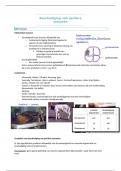
Chapter 5 5 carbon sugar – deoxyribose, only found in DNA
DNA Base – 4 types: adenine and guanine (purines) cytosine and
thymine (pyrimidine)
Nucleotide: 5 carbon sugar + base + phosphate
- Nucleotides form covalent bonds between the phosphate of one
nucleotide to the sugar of the next nucleotide to form chains
- The phosphate end of the chain is the 5P’
- The sugar end of the chain is 3OH’
- Nucleotide are added in the 3OH’ of the chain
The double helix structures
- 2 polynucleotide chains are connected by hydrogen bonds
between the bases
- The bases are inside of the DNA while the sugar phosphate
backbone is outside
- Base pairings are complementary; A-T and C-G
- When pairing, the bases are in a planar conformation i.e they
lie flat when binding to the complementary base on the other
strand
- The pairings give the most energetically favored arrangement
- Each base pair has a similar width which holds the backbones
apart at equal distance in a DNA molecule
- The 2 strands of a helix are antiparallel to each other
- The double helix twists every 10 base pairs and is called a
helical turn
- The twisting also contributes to the energetically favorable
structure
Hereditary mechanism
- Information is coded in a sequence using the nucleotides in each
DNA strand
- Organisms differ because they have DNA molecules with different
nucleotide sequences
, - A nucleotide sequence carries a “biological message” that helps - But only male have a nonhomologous chromosome
code for the linear sequence of an amino acid where a Y chromosome is inherited from the father and X
chromosome is inherited from the mother
Nucleotide Amino Amino The three- Function
sequence acid acid dimensional of a
Chromosomes contain long strings of genes
sequence structure of protein
- Important function of chromosome is to carry a gene
a protein
- A gene is defined as: the segment of DNA that contains the
- 4 nucleotides code for one amino acid; there are 20 different instructions for making a protein or RNA molecule
amino acid that code for proteins - Only mRNA code for proteins, about 2/3 of our genes code
- Amino acids are called the genetic code for proteins
- RNA molecules are encoded by the genes are mostly used
Structure of eukaryotic chromosome
as a template for producing a protein
- Average human cell contains 2 meters of DNA, and a nucleus is - But often, RNA is the final product, and they have their
only 5-8 micrometer in diameter own functions in the cell
- DNA is densely packaged into chromosomes to be able to fit in a - Total genetic information all together is called genome
nucleus - Mostly, the number of genes in an organism correlate to
- The complex task of coiling DNA is done by proteins that bind to the complexity of the organism
them and fold them into coils and loops that are high levels of - But it is not always true, because there are some plants
organization; they prevent the DNA from tangling and amoeba that have larger genomes than human
genomes (Humans have 20,000 genes)
Multiple chromosomes
- The number of chromosomes also differs from one specie
- DNA in nucleus is distributed in multiple chromosomes to another
- There are approximately 3.2*109 nucleotides in a nucleus
Specialized DNA sequences are required for DNA replication
- Each nucleus has 23 or 24 chromosomes
and chromosome segregation
- Each chromosome contains a single long chain of DNA
binded with proteins - Chromosomes must replicate and separate properly
- The compact structure of DNA and protein is called a - During interphase (the phase of the cycle when
chromatin chromosomes are duplicated) chromosomes are long, thin,
- Red blood cells lack DNA entirely and germ cells only have and tangled threads and cannot be viewed under the
single chromosomes microscope
- But all cells have homologous chromosomes, a maternal - To ensure replication occurs efficiently during interphase,
and paternal pair of chromosomes chromosomes have specialized sequences that make up
the replication origin of the chromosomes.
DNA Base – 4 types: adenine and guanine (purines) cytosine and
thymine (pyrimidine)
Nucleotide: 5 carbon sugar + base + phosphate
- Nucleotides form covalent bonds between the phosphate of one
nucleotide to the sugar of the next nucleotide to form chains
- The phosphate end of the chain is the 5P’
- The sugar end of the chain is 3OH’
- Nucleotide are added in the 3OH’ of the chain
The double helix structures
- 2 polynucleotide chains are connected by hydrogen bonds
between the bases
- The bases are inside of the DNA while the sugar phosphate
backbone is outside
- Base pairings are complementary; A-T and C-G
- When pairing, the bases are in a planar conformation i.e they
lie flat when binding to the complementary base on the other
strand
- The pairings give the most energetically favored arrangement
- Each base pair has a similar width which holds the backbones
apart at equal distance in a DNA molecule
- The 2 strands of a helix are antiparallel to each other
- The double helix twists every 10 base pairs and is called a
helical turn
- The twisting also contributes to the energetically favorable
structure
Hereditary mechanism
- Information is coded in a sequence using the nucleotides in each
DNA strand
- Organisms differ because they have DNA molecules with different
nucleotide sequences
, - A nucleotide sequence carries a “biological message” that helps - But only male have a nonhomologous chromosome
code for the linear sequence of an amino acid where a Y chromosome is inherited from the father and X
chromosome is inherited from the mother
Nucleotide Amino Amino The three- Function
sequence acid acid dimensional of a
Chromosomes contain long strings of genes
sequence structure of protein
- Important function of chromosome is to carry a gene
a protein
- A gene is defined as: the segment of DNA that contains the
- 4 nucleotides code for one amino acid; there are 20 different instructions for making a protein or RNA molecule
amino acid that code for proteins - Only mRNA code for proteins, about 2/3 of our genes code
- Amino acids are called the genetic code for proteins
- RNA molecules are encoded by the genes are mostly used
Structure of eukaryotic chromosome
as a template for producing a protein
- Average human cell contains 2 meters of DNA, and a nucleus is - But often, RNA is the final product, and they have their
only 5-8 micrometer in diameter own functions in the cell
- DNA is densely packaged into chromosomes to be able to fit in a - Total genetic information all together is called genome
nucleus - Mostly, the number of genes in an organism correlate to
- The complex task of coiling DNA is done by proteins that bind to the complexity of the organism
them and fold them into coils and loops that are high levels of - But it is not always true, because there are some plants
organization; they prevent the DNA from tangling and amoeba that have larger genomes than human
genomes (Humans have 20,000 genes)
Multiple chromosomes
- The number of chromosomes also differs from one specie
- DNA in nucleus is distributed in multiple chromosomes to another
- There are approximately 3.2*109 nucleotides in a nucleus
Specialized DNA sequences are required for DNA replication
- Each nucleus has 23 or 24 chromosomes
and chromosome segregation
- Each chromosome contains a single long chain of DNA
binded with proteins - Chromosomes must replicate and separate properly
- The compact structure of DNA and protein is called a - During interphase (the phase of the cycle when
chromatin chromosomes are duplicated) chromosomes are long, thin,
- Red blood cells lack DNA entirely and germ cells only have and tangled threads and cannot be viewed under the
single chromosomes microscope
- But all cells have homologous chromosomes, a maternal - To ensure replication occurs efficiently during interphase,
and paternal pair of chromosomes chromosomes have specialized sequences that make up
the replication origin of the chromosomes.