
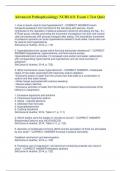
Advanced Pathophysiology NURS 611 Exam 1 Test Quiz
Advanced Pathophysiology NURS 611 Exam 1 Test Quiz 1. How is insulin used to treat hyperkalemia? - CORRECT ANSWER-Insulin transports potassium from the blood to the cell along with glucose. Insulin contributes to the regulation of plasma potassium levels by stimulating the Na+, K+- ATPase pump, thereby promoting the movement of potassium into liver and muscle cells simultaneously with glucose transport after eating. The intracellular movement of potassium prevents an acute hyperkalemia related to food intake. Insulin also can be used to treat hyperkalemia. (McCance & Huether, 2014, p. 119) 2. Hyperaldosteronism causes which fluid and electrolyte imbalances? - CORRECT ANSWER-Hypokalemia, hypernatremia, and fluid volume excess. Hyperaldosteronism promotes (1) increased renal sodium and water reabsorption with corresponding hypervolemia and hypertension and (2) renal excretion of potassium. (McCance & Huether, 2014, p. 755) 3. What mechanisms cause hypernatremia? - CORRECT ANSWER-• Inadequate intake of free water associated with total body sodium depletion. • Excessive losses of water from the urinary tract that leads to a combination of sodium and free water losses. • Water losses associated with extreme sweating. • Severe watery diarrhea • Excessive excretion of water from the kidneys or impaired responsiveness of the kidneys to vasopressin. 1. Excessive hypertonic salt solutions 2. Intravenous hypertonic sodium 3. Saline - induced abortions 4. Selected infant formulas 5. Hyperaldosteronism 6. Cushing Syndrome (McCance & Huether, 2014, Table 3-7, p. 111) 4. Which buffers work the fastest (in minutes to hours)? - CORRECT ANSWER-Bicarbonate/Carbonic acid (HCO3/H2CO3) (McCance & Huether, 2014, Table 3-11, p. 123) 5. Secretion of antidiuretic hormone (ADH) and the perception of thirst are stimulated by a(n) what? - CORRECT ANSWER-Increase in plasma osmolality. Feedback mechanism and baroreceptors (McCance & Huether, 2014, p. 109) 6. Excessive use of magnesium- and aluminum-containing antacids can result in what? - CORRECT ANSWER-Metabolic alkalosis
Información del documento
- Subido en
- 22 de julio de 2023
- Número de páginas
- 6
- Escrito en
- 2022/2023
- Tipo
- Examen
- Contiene
- Preguntas y respuestas

