
Roland UDVARLAKI
Unit 23 – Human Computer Interaction
P2 - explain the fundamental principles of HCI design
-Perception
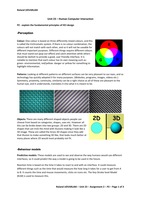
Colour: One colour is based on three differently mixed colours, and this
is called the trichromatic system. If there is no colour combination, the
colours will not match with each other, and so it will not be useable for
different important purposes. Different things require different colours
that must stand out (pop out effect) and catch attention while others
should be darkish to provide a good, user friendly interface. It is
notable to mention that each colour has its own meaning such as:
green- environmental, red/yellow- danger or yellow for something to
highlight information.
Patterns: Looking at different patterns on different surfaces can be very pleasant to our eyes, and so
technology has quickly adopted it for many purposes. (Websites, programs, images, videos etc.)
Symmetry, proximity, continuity, similarity can be a right choice as all of these are pleasant to the
human eye, and it understands, translates it into what it is meant to be.
Objects: There are many different shaped objects people can
choose from based on categories, shapes, uses etc. However all
this can be broke down into two groups: 2D and 3D. There are 2D
shapes that can trick the mind with illusions making it look like a
3D image. These are called the Gross 3D shapes since they add
that illusion to make something 3D like, that looks much better at
many places where 2D would most probably not fit.
-Behaviour models
Predictive models: These models are used to see and observe the way humans would use different
interfaces, so it could predict the way a model is going to be used in the future.
Reaction time is based on the time it takes to react to and with an interface. It could measure
different things such as the time that would measure the how long it takes for a user to get from A
to B. It counts the time and mouse movements, clicks on icons etc. The Key-Stroke level Model
(KLM) is used to measure this.
Roland UDVARLAKI – Unit 23 – Assignment 2 – P2 – Page 1 of 3

