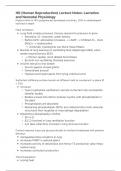
HR (Human Reproduction) Lecture Notes: Lactation
and Neonatal Physiology
Preterm birth is 10% pregnancies developed countries, 25% in undeveloped -
half end in death
Fetal ventilation
● Lung fluid creates pressure, tissues respond to pressure to grow
○ Secretion: Cl- channels, water follows
○ Before birth: adrenaline increases -> cAMP -> inhibited Cl-, more
ENaCs -> reabsorption
◆ Amiloride, triamterene can block these ENaCs
● Bounds of lung exercise of ventilating fluid (diaphragm EMG) when
awake (asynchronous EEG)
○ -> thinner septae, more dilated bronchioles
○ By birth not ventilating (finished exercise)
● At birth stimuli to first breath
○ Grunts against closed glottis
○ Generalised arousal
○ Hypoxia and hypercapnia from tying umbilical cord
Surfactant (differing surface tension at different radii to counteract La place (P
= 2T/r)
● Turnover
○ Type II (glandular epithelium) secrete surfactant into osmiophillic
lamellar bodies
○ Bodies unravel into lattice (tubular myelin) with phospholipids in
the gaps
○ Phospholipids are absorbed
○ Remaining phospholipids (90%) are collected into multi-vesicular
structures then reuptake or macrophage degradation
● Dipalmitoyl-phosphatidyl-choline
○ SP-A-D
○ B,C,D involved in lung ventilation function
○ A,D (aka collectins) involved in lung immune function
Cortisol matures lung (use glucocorticoids in mothers threatened with preterm
delivery)
● Upregulates beta receptors in lung
● Increases PNMT in adrenal gland
● Increases activity of deiodinase and hence T3 production (also helps
mature lung)
● Increases surfactant production
Thermoregulation
● Losing heat
and Neonatal Physiology
Preterm birth is 10% pregnancies developed countries, 25% in undeveloped -
half end in death
Fetal ventilation
● Lung fluid creates pressure, tissues respond to pressure to grow
○ Secretion: Cl- channels, water follows
○ Before birth: adrenaline increases -> cAMP -> inhibited Cl-, more
ENaCs -> reabsorption
◆ Amiloride, triamterene can block these ENaCs
● Bounds of lung exercise of ventilating fluid (diaphragm EMG) when
awake (asynchronous EEG)
○ -> thinner septae, more dilated bronchioles
○ By birth not ventilating (finished exercise)
● At birth stimuli to first breath
○ Grunts against closed glottis
○ Generalised arousal
○ Hypoxia and hypercapnia from tying umbilical cord
Surfactant (differing surface tension at different radii to counteract La place (P
= 2T/r)
● Turnover
○ Type II (glandular epithelium) secrete surfactant into osmiophillic
lamellar bodies
○ Bodies unravel into lattice (tubular myelin) with phospholipids in
the gaps
○ Phospholipids are absorbed
○ Remaining phospholipids (90%) are collected into multi-vesicular
structures then reuptake or macrophage degradation
● Dipalmitoyl-phosphatidyl-choline
○ SP-A-D
○ B,C,D involved in lung ventilation function
○ A,D (aka collectins) involved in lung immune function
Cortisol matures lung (use glucocorticoids in mothers threatened with preterm
delivery)
● Upregulates beta receptors in lung
● Increases PNMT in adrenal gland
● Increases activity of deiodinase and hence T3 production (also helps
mature lung)
● Increases surfactant production
Thermoregulation
● Losing heat